What Is the "What Grade Was I In" Calculator?
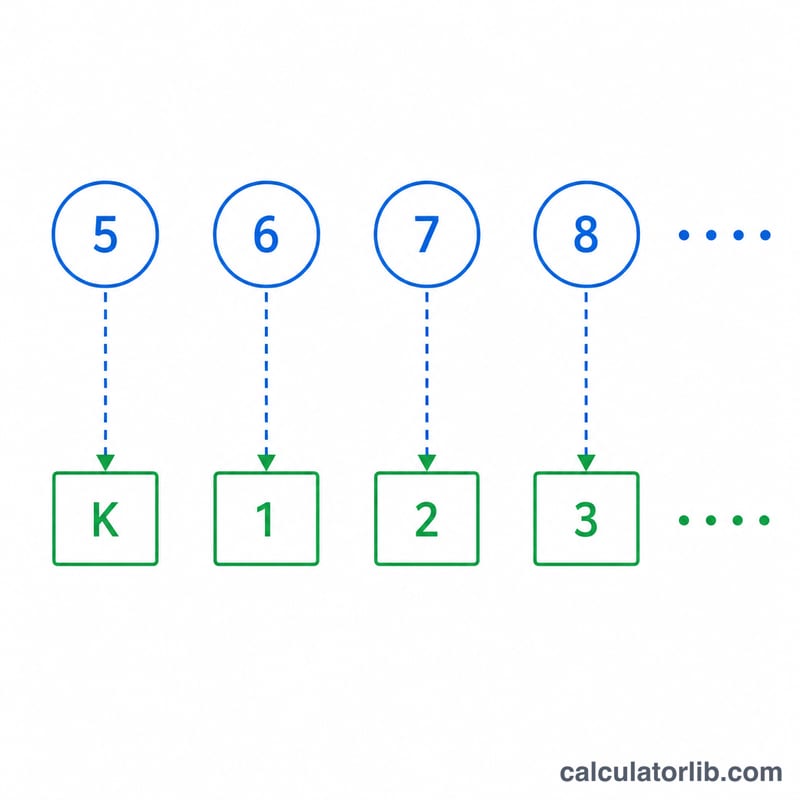
This tool applies to the United States K-12 school system. It estimates the grade level a person was in during a particular school year, based on their birth year. In the typical US pattern, children start kindergarten the fall they turn 5, first grade at age 6, and progress one grade per year through grade 12 (around age 18). Cutoff dates vary by state, so results are an approximation.
How to Use It
Enter your birth year and the school year you want to check (use the fall/start year, e.g. type 2024 for the 2024-2025 year). The calculator returns your grade level, the grade number, and your approximate age that year.
The Formula Explained
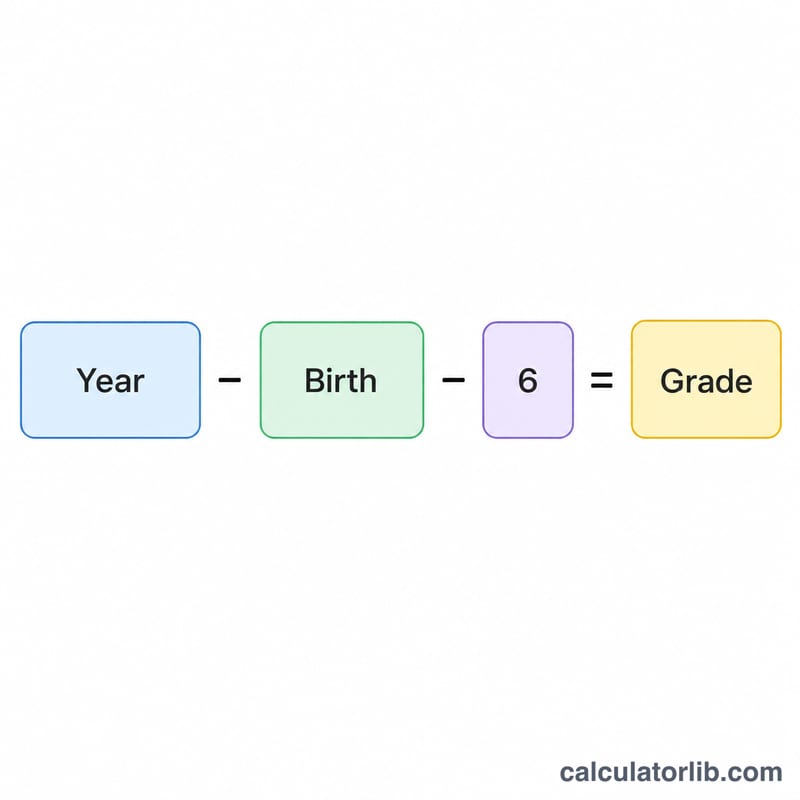
The core formula is $$\text{Grade} = \left(\text{TargetYear} - \text{BirthYear}\right) - 5$$ when your birthday is on or before the state's kindergarten cutoff (September 1 in most states), and \(\left(\text{TargetYear} - \text{BirthYear}\right) - 6\) when it falls after. TargetYear minus BirthYear is the age you reach in that calendar year; a child who is 5 by the cutoff starts kindergarten (grade 0) that fall, so subtracting 5 gives the grade, and a child born after the cutoff starts one year later. A result of 0 means kindergarten, negative means not yet in school (pre-K), and values above 12 mean you had already graduated.
Worked Example
Born in March 2010, checking the 2024 school year: $$2024 - 2010 = 14$$ (the age you reach in 2024, with a birthday before the September 1 cutoff), then $$14 - 5 = 9$$ So you were in Grade 9 during the 2024-2025 school year. Born in October 2010, after the cutoff, you started kindergarten a year later: \(14 - 6 = 8\), so Grade 8.
US Grade Levels by Age: Reference Table
This table maps each level of the United States K–12 system to the age a student typically is at the start of the school year (fall) and at the end of it (spring), together with the number this calculator returns. The calculator works from the age you turn during the school year you enter:
$$\text{Grade} = (\text{School Year} - \text{Birth Year}) - 5$$Because the subtraction uses whole years only, the ages below assume a birthday that falls before the state's kindergarten cutoff date — commonly September 1, but legally set anywhere from August 1 to December 31 depending on the US state. A child whose birthday falls after that cutoff normally starts a year later and sits one grade below the table.
| Level | Typical age at start (fall) | Typical age at end (spring) | Formula result | School band (US) |
|---|---|---|---|---|
| Pre-K (first year) | 3 | 4 | −2 | Preschool — not part of K–12 |
| Pre-K (second year) / Transitional Kindergarten | 4 | 5 | −1 | Preschool / TK (offered in some states, e.g. California) |
| Kindergarten | 5 | 6 | 0 | Elementary (K–5) |
| Grade 1 | 6 | 7 | 1 | Elementary |
| Grade 2 | 7 | 8 | 2 | Elementary |
| Grade 3 | 8 | 9 | 3 | Elementary |
| Grade 4 | 9 | 10 | 4 | Elementary |
| Grade 5 | 10 | 11 | 5 | Elementary |
| Grade 6 | 11 | 12 | 6 | Middle school (6–8) |
| Grade 7 | 12 | 13 | 7 | Middle school |
| Grade 8 | 13 | 14 | 8 | Middle school |
| Grade 9 (freshman) | 14 | 15 | 9 | High school (9–12) |
| Grade 10 (sophomore) | 15 | 16 | 10 | High school |
| Grade 11 (junior) | 16 | 17 | 11 | High school |
| Grade 12 (senior) | 17 | 18 | 12 | High school |
The K–5 / 6–8 / 9–12 split shown here is the most common US arrangement, but it is not universal: many districts use K–6 with a 7–9 junior high, and K–8 schools that feed straight into a four-year high school are still widespread. The grade numbers themselves are consistent nationwide; only the building names change. This table describes the US system specifically — other countries number their years differently and start compulsory schooling at different ages.
Interpreting Your Result
The calculator returns a single number. Read it against these ranges:
- Negative result — the person was not yet school-age in that year. A result of −1 corresponds to the year before kindergarten (pre-K or transitional kindergarten), −2 to the year before that, and anything lower to infancy or daycare age.
- 0 — kindergarten, the first year of the US K–12 sequence.
- 1 through 12 — that numbered grade. Use the reference table above for the matching school band: 1–5 elementary, 6–8 middle school, 9–12 high school (freshman, sophomore, junior, senior).
- Greater than 12 — the person had already finished grade 12 in that year. Subtract 12 to get how many years past high school it was: a result of 13 is the first year after graduation (typically the first year of college), 14 the second, and so on.
Treat the answer as accurate to within about one grade. The formula compares whole calendar years only, so it cannot see your birth month — and birth month is exactly what decides which school year a US child starts in. Each state sets its own kindergarten entry cutoff date; September 1 is the most common, but state cutoffs range from August 1 through December 31, and some states leave the date to individual districts.
A child born in the fall, close to or just after the cutoff, typically starts kindergarten a year later than a child born in the spring of the same calendar year, so the real grade for a fall-born student may be one grade lower than the number the calculator shows. Several other common situations shift the result by a year in either direction:
- Redshirting — delaying kindergarten entry by a year, which puts the student one grade below the formula.
- Grade skipping or early entry — one grade above the formula.
- Retention — repeating a grade puts the student one grade below the formula for every year repeated.
- Moving between states or countries — placement can change when cutoff dates or year structures differ.
The result is also anchored to a school year that spans two calendar years (for example, 2024–25). If your answer looks one grade off, check whether you entered the fall year or the spring year of the school year you had in mind, and re-run it with the other one. This calculator is a lookup for past years and general reference only; it reports what the arithmetic gives and is not a placement, enrollment or eligibility determination.
FAQ
Why subtract 5 (or 6)? School Year minus Birth Year is the age you reach in that calendar year. A child who is 5 by the kindergarten cutoff starts kindergarten (grade 0) that fall, so the grade is that age minus 5; with a birthday after the cutoff the child starts a year later, so the grade is that age minus 6.
What does grade 0 mean? Grade 0 represents kindergarten, which usually starts around age 5.
Is it always exact? No — birthday cutoffs (often Sept 1) and early/late enrollment, redshirting, or skipping grades can shift the result by one grade.
If I am a senior now, what year was I in 7th or 8th grade? A senior is in grade 12, so if your senior year starts in the fall of year Y, you were in grade g in the school year starting in Y − (12 − g): 8th grade in Y − 4 and 7th grade in Y − 5. For example, a senior in 2026-2027 was in 8th grade in 2022-2023 and in 7th grade in 2021-2022.