What Is the Screen Ratio Calculator?
This tool converts a screen's diagonal measurement and aspect ratio into its actual physical width and height. Manufacturers advertise displays by diagonal size (e.g. a "55-inch TV"), but to know whether a screen fits a space, a mount, or a media console, you need the real width and height. This calculator does that math instantly for any aspect ratio — 16:9 widescreen, 4:3 standard, 21:9 ultrawide, 16:10 monitors, and more.
How to Use It
Enter the diagonal size in inches, then enter the aspect ratio as two numbers (for a 16:9 TV, put 16 in the width box and 9 in the height box). Press calculate to get the exact width and height plus the screen's surface area.
The Formula Explained
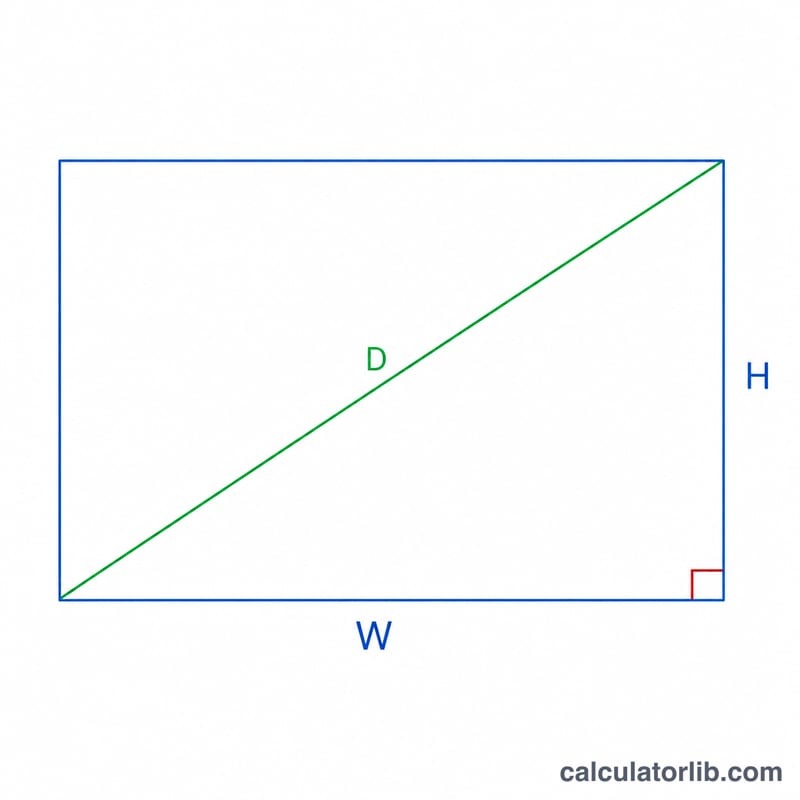
Let r be the aspect ratio (width ÷ height). A screen forms a right triangle where the diagonal is the hypotenuse. Since width = \(r \times \text{height}\), the Pythagorean theorem gives \(D^{2} = W^{2} + H^{2}\). Substituting yields:
$$W = \sqrt{\frac{D^{2} \cdot r^{2}}{1 + r^{2}}} \quad\text{and}\quad H = \frac{W}{r}.$$
Worked Example
For a 55-inch 16:9 TV: \(r = 16/9 \approx 1.7778\).
$$W = \sqrt{\frac{55^{2} \times 1.7778^{2}}{1 + 1.7778^{2}}} = \sqrt{\frac{3025 \times 3.1605}{4.1605}} \approx \sqrt{2297.5} \approx 47.94 \text{ in wide}.$$
$$H = \frac{47.94}{1.7778} \approx 26.96 \text{ in tall}.$$
Common Screen Sizes: Width and Height by Diagonal
Screen sizes are quoted as the diagonal, but the physical width and height depend on the aspect ratio. For a ratio \(r = \frac{w}{h}\) and diagonal \(D\), the calculator uses \(W = \sqrt{\frac{D^{2}\,r^{2}}{1 + r^{2}}}\) and \(H = \frac{W}{r}\). For 16:9 this simplifies to \(W = \frac{16D}{\sqrt{337}} \approx 0.8716\,D\) and \(H = \frac{9D}{\sqrt{337}} \approx 0.4903\,D\). Values below are for the visible image area only (not the bezel) and are rounded to 2 decimals.
| Diagonal (in) | Width (in), 16:9 | Height (in), 16:9 |
|---|---|---|
| 24 | 20.92 | 11.77 |
| 27 | 23.53 | 13.24 |
| 32 | 27.89 | 15.69 |
| 43 | 37.48 | 21.08 |
| 50 | 43.58 | 24.51 |
| 55 | 47.94 | 26.96 |
| 65 | 56.65 | 31.87 |
| 75 | 65.37 | 36.77 |
| 85 | 74.08 | 41.67 |
Multiply by 2.54 to convert inches to centimetres. Actual product dimensions are larger because of the bezel and stand.
Standard Aspect Ratios and Their Uses
The decimal ratio is width divided by height. A larger number means a wider, flatter screen.
| Aspect ratio | Decimal (W ÷ H) | Typical uses |
|---|---|---|
| 4:3 | 1.33 | Legacy standard-definition TV, older monitors, some tablets |
| 16:10 | 1.60 | Productivity monitors and laptops (a bit more vertical space) |
| 16:9 | 1.78 | HD and 4K TVs, most mainstream monitors, online video |
| 21:9 | about 2.33 (marketed); true 64:27 is 2.37 | Ultrawide monitors, cinematic content, multitasking |
| 32:9 | 3.56 | Super-ultrawide monitors, equal to two 16:9 screens side by side |
Note that "21:9" is a marketing label. Many panels are actually 64:27 (about 2.37:1) or similar, so enter the exact ratio your screen uses if you need precise dimensions.
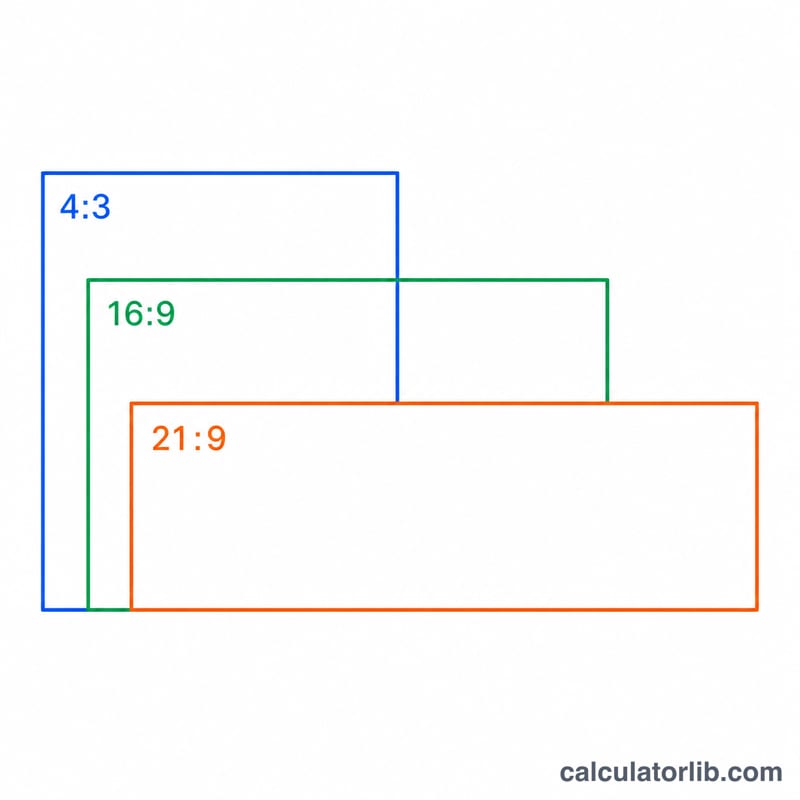
Same Diagonal, Different Aspect Ratios
Here is a fixed 34-inch diagonal at different aspect ratios. Area is \(A = W \times H\), which equals \(\frac{D^{2}\,r}{1 + r^{2}}\). For example, at 16:9: \(A = 1156 \times \frac{144}{337} \approx 493.96\) square inches.
| Aspect ratio | Width (in) | Height (in) | Area (sq in) |
|---|---|---|---|
| 4:3 | 27.20 | 20.40 | 554.88 |
| 16:10 | 28.83 | 18.02 | 519.55 |
| 16:9 | 29.63 | 16.67 | 493.96 |
| 21:9 | 31.25 | 13.39 | 418.55 |
| 32:9 | 32.73 | 9.21 | 301.29 |
With the diagonal held constant, a wider ratio gives more width but less height and a smaller total area. A 34-inch 4:3 screen has about 84% more area than a 34-inch 32:9 screen, so diagonal alone is a poor way to compare screens with different shapes.
FAQ
Does this work for any aspect ratio? Yes — enter any width:height pair, such as 21:9, 4:3, or 16:10.
Are the results in inches? They use the same unit as the diagonal you enter. Enter the diagonal in inches and you get inches; enter centimeters and you get centimeters.
Why is a 55-inch TV not 55 inches wide? The 55 inches refers to the diagonal corner-to-corner; the width is always smaller than the diagonal.