What is the Screen Size from Diagonal Calculator?
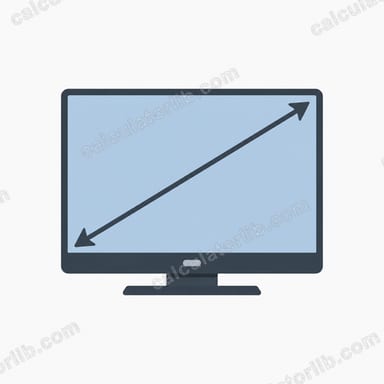
TVs, monitors, laptops and phones are almost always advertised by their diagonal measurement — a "55-inch TV" tells you the corner-to-corner distance, not how wide or tall the screen actually is. This calculator converts a diagonal size plus an aspect ratio into the real physical width and height of the display, and also reports the visible screen area.

How to use it
Enter the diagonal size in any unit (inches, centimetres — the output uses the same unit). Then enter the aspect ratio as two numbers, for example 16 and 9 for a standard widescreen TV, 21 and 9 for an ultrawide monitor, or 4 and 3 for an old display. Click calculate to see the width, height and area.
The formula explained
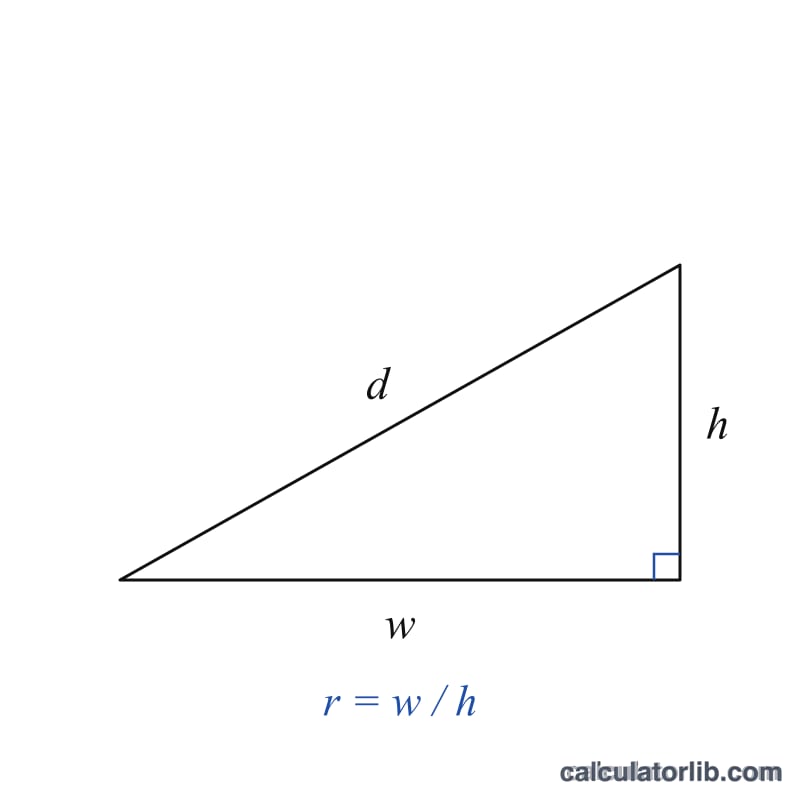
Let \(r = w/h\) be the aspect ratio. The diagonal forms the hypotenuse of a right triangle whose legs are the width and height. Since width = r × height, the Pythagorean theorem gives \(\text{diagonal}^2 = (r \cdot \text{height})^2 + \text{height}^2 = \text{height}^2 (r^2+1)\). Solving:
$$\text{height} = \frac{\text{diagonal}}{\sqrt{r^2+1}}$$ and $$\text{width} = \frac{\text{diagonal} \times r}{\sqrt{r^2+1}}$$. The area is simply \(\text{width} \times \text{height}\).
Worked example
For a 55-inch 16:9 TV, \(r = 16/9 \approx 1.7778\) and \(\sqrt{r^2+1} = \sqrt{3.1605+1} = \sqrt{4.1605} \approx 2.0397\). So $$\text{height} = \frac{55}{2.0397} \approx 26.96 \text{ in}$$ and $$\text{width} = \frac{55 \times 1.7778}{2.0397} \approx 47.94 \text{ in}.$$ Area = \(47.94 \times 26.96 \approx 1292.58\) square inches.
Standard Aspect Ratios Reference
The factor \(\sqrt{r^2+1}\) converts a diagonal to a height (\(H = D / \sqrt{r^2+1}\)). Width is then \(W = r \cdot H\), where \(r\) is width divided by height.
| Aspect ratio | r = W/H | \(\sqrt{r^2+1}\) | Typical devices / resolutions |
|---|---|---|---|
| 16:9 | 1.778 | 2.0397 | TVs, most monitors; 1920×1080, 3840×2160 |
| 16:10 | 1.6 | 1.8868 | Some laptops and monitors; 1920×1200, 2560×1600 |
| 21:9 (nominal) | 2.333 | 2.5386 | Marketing label for ultrawide monitors |
| 64:27 (true "21:9") | 2.370 | 2.5727 | 2560×1080 ultrawide (3440×1440 panels are about 2.39:1) |
| 32:9 | 3.556 | 3.6935 | Super-ultrawide monitors; 5120×1440 |
| 4:3 | 1.333 | 1.6667 | Older TVs and monitors; 1024×768, 1600×1200 |
| 3:2 | 1.5 | 1.8028 | Some laptops and tablets; 2256×1504 |
| 5:4 | 1.25 | 1.6008 | Older 17"/19" monitors; 1280×1024 |
Actual panels can differ slightly from the nominal ratio, so enter the true ratio (for example 3440 and 1440) if you want the most accurate size. The calculator accepts any custom Ratio W and Ratio H.
Inches to Centimetres Conversion
Conversion factors: 1 in = 2.54 cm exactly, so 1 sq in = 2.54² = 6.4516 sq cm. Multiply a length in inches by 2.54 and an area in square inches by 6.4516.
| Diagonal (in) | Diagonal (cm) |
|---|---|
| 24 | 60.96 |
| 27 | 68.58 |
| 32 | 81.28 |
| 43 | 109.22 |
| 50 | 127.00 |
| 55 | 139.70 |
| 65 | 165.10 |
| 75 | 190.50 |
| 85 | 215.90 |
Sample: 55-inch 16:9 screen
With \(\sqrt{r^2+1} = \sqrt{337}/9 \approx 2.0397\):
$$H = \frac{55}{2.0397} \approx 26.96\ \text{in} \approx 68.5\ \text{cm}$$
$$W = \frac{55 \cdot 16/9}{2.0397} \approx 47.94\ \text{in} \approx 121.8\ \text{cm}$$
So a 55" 16:9 screen is about 121.8 × 68.5 cm. Its area is about 1,292.6 sq in, or roughly 8,339 sq cm.
FAQ
Does the unit matter? No — output width, height and diagonal share the same unit; area is that unit squared.
Why is the width less than the diagonal? The diagonal is the longest line across the rectangle, so it always exceeds both the width and the height.
Can I use any aspect ratio? Yes. Try 16:10, 21:9, 32:9 or 3:2 — just enter the two numbers.