
What is the Rivet Size Calculator?
This tool estimates the right rivet diameter for a riveted joint using Unwin's empirical formula, and computes the grip length from the thicknesses of the sheets or plates being fastened. It is a universal engineering aid for designers, fabricators, and students working in metric units (millimetres).
How to use it
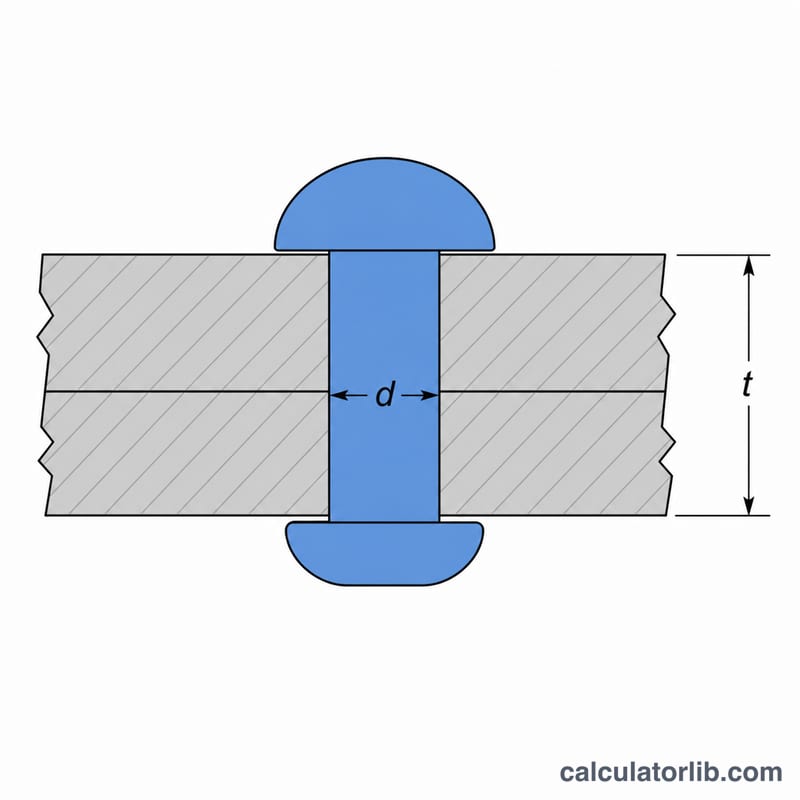
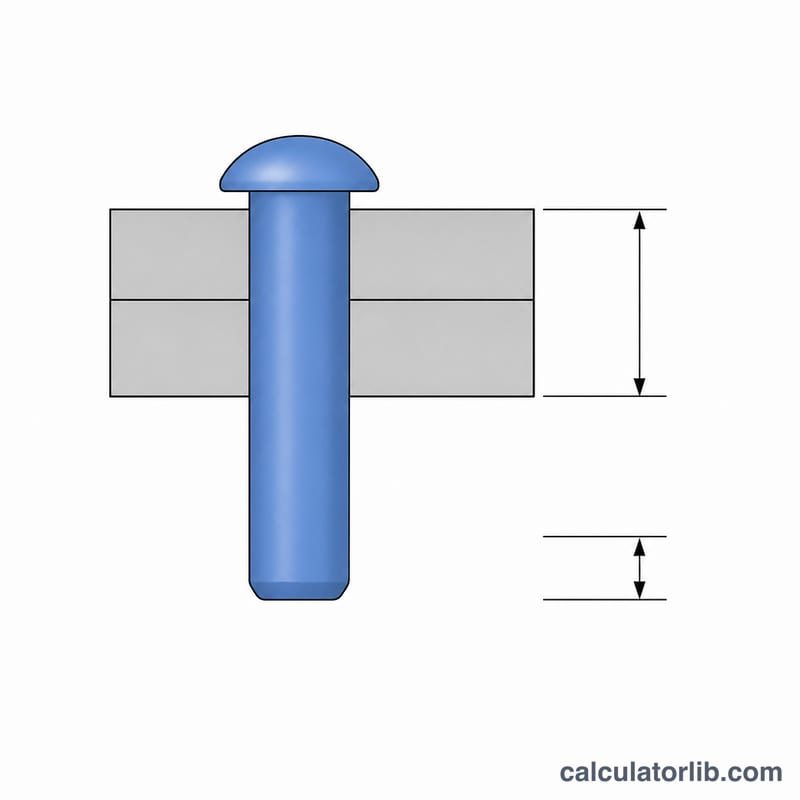
Enter the governing plate thickness t in millimetres. Then enter the individual sheet thicknesses (Sheet 1, Sheet 2, and an optional Sheet 3) that the rivet must clamp together. The calculator returns the recommended rivet shank diameter, the total grip length, and an estimated shank length that includes a head-formation allowance.
The formula explained
Unwin's formula gives the rivet diameter as \(d = 1.5 \times \sqrt{t}\), where t is the plate thickness in mm. It is an empirical relationship that scales rivet size with the square root of thickness so the joint balances shear and bearing strength. The grip length is simply the sum of all sheet thicknesses, \(L_g = t_1 + t_2 + t_3\). A practical shank length adds roughly 1.5d to the grip to allow material to form the closing head.
Worked example
For a plate thickness t = 16 mm joining two 8 mm sheets: $$d = 1.5 \times \sqrt{16} = 1.5 \times 4 = 6 \text{ mm}$$ Grip = 8 + 8 = 16 mm. Estimated shank = 16 + 1.5 \times 6 = 25 mm. You would round up to the next available standard rivet size.
FAQ
Is Unwin's formula exact? No — it is an empirical guide, most reliable for plate thicknesses above about 8 mm. Always round to a standard rivet diameter and verify by strength calculation.
What units does it use? Millimetres throughout. Convert imperial dimensions to mm before entering.
Why does shank length matter? The shank must be long enough to fill the hole plus form a sound closing head; too short gives a weak head, too long causes buckling.