
What This Calculator Does
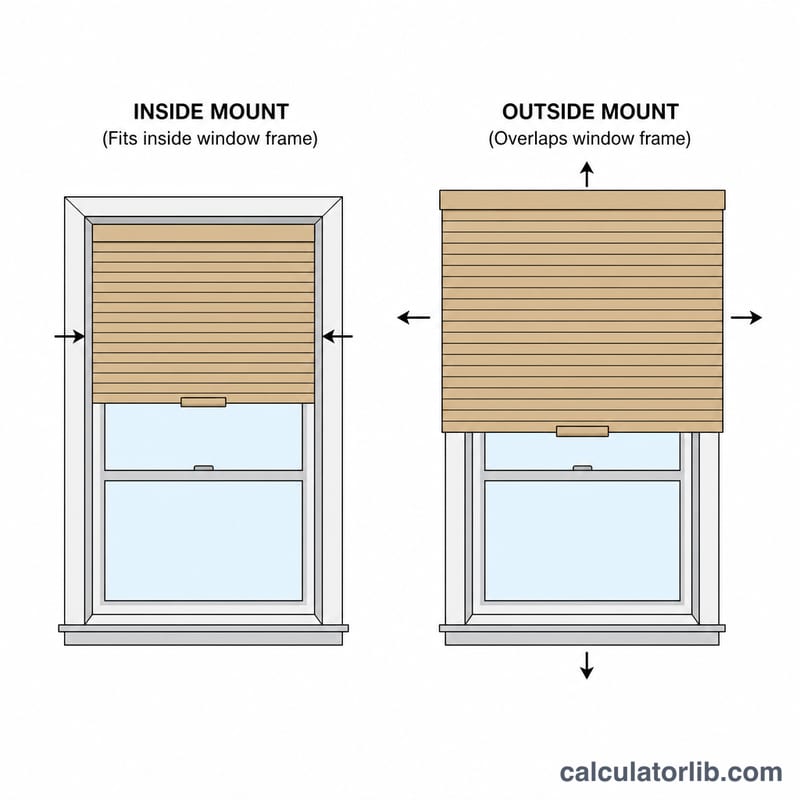
The Window Blind Size Calculator tells you the exact size to order or cut a window blind so it fits perfectly. It supports both inside mount blinds (mounted within the window frame) and outside mount blinds (mounted on the wall or trim above the window). Getting these measurements right avoids gaps, light leaks, and blinds that simply won't fit.
How to Use It
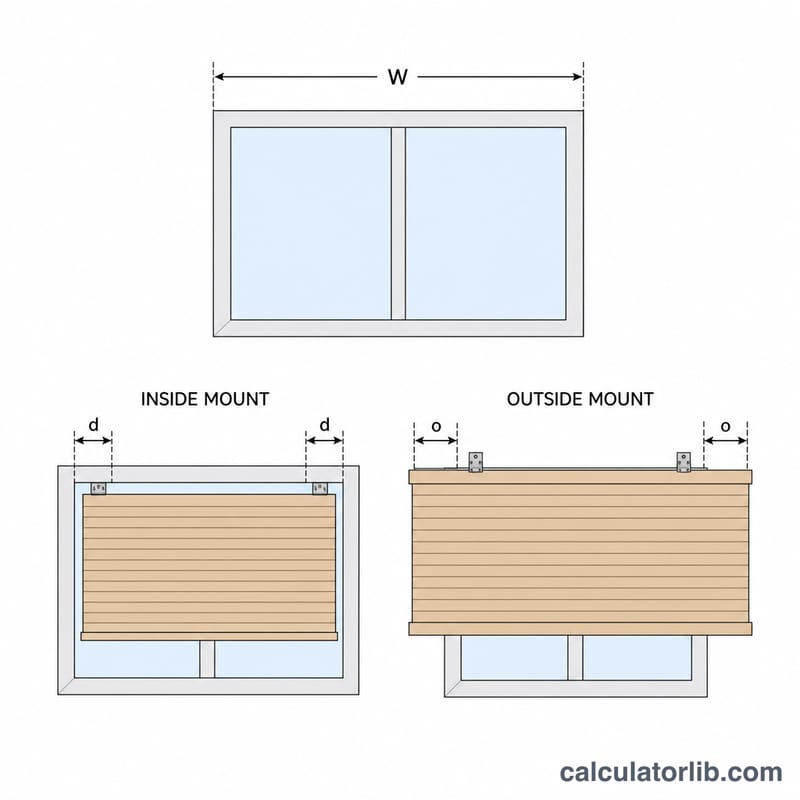
Measure your window opening in inches. Choose your mount type. For an inside mount, enter the deduction your manufacturer recommends (commonly 1/2 inch, sometimes 1/4 inch) — this small gap lets the blind raise and lower freely. For an outside mount, enter the overlap you want on each side (1.5 to 2 inches is typical) so the blind fully covers the opening for privacy and light blocking.
The Formula Explained
For an inside mount, the blind dimension equals the window dimension minus the deduction: \(\text{Blind} = \text{Window} - \text{deduction}\). The deduction is applied once to the total width and once to the height. For an outside mount, you add overlap on both sides: \(\text{Blind} = \text{Window} + 2 \times \text{overlap}\). The overlap is doubled because it applies to the left and right (or top and bottom) of the opening.
$$\begin{aligned} \text{Blind Width} &= \text{Window Width} - \text{Deduction} \\ \text{Blind Height} &= \text{Window Height} - \text{Deduction} \end{aligned}$$
$$\begin{aligned} \text{Blind Width} &= \text{Window Width} + 2 \times \text{Overlap} \\ \text{Blind Height} &= \text{Window Height} + 2 \times \text{Overlap} \end{aligned}$$
Worked Example
Suppose your window is 36 in wide and 48 in tall. With an inside mount and a 0.5 in deduction, the blind width is \(36 - 0.5 = 35.5\) in and the height is \(48 - 0.5 = 47.5\) in. With an outside mount and a 1.5 in overlap per side, the width is \(36 + (1.5 \times 2) = 39\) in and the height is \(48 + (1.5 \times 2) = 51\) in.
Typical Deduction & Overlap Ranges
Window blind sizing depends almost entirely on the mount type. The values below reflect common practice across most North American manufacturers, but you should always confirm the policy of the specific brand you are ordering from before submitting measurements.
| Mount type | Adjustment | Typical range | Applied to |
|---|---|---|---|
| Inside mount | Width deduction | 1/4 in to 1/2 in (0.25–0.5) | Subtracted from measured width so the blind clears the frame and operates freely |
| Inside mount | Height deduction | 0 to 1/4 in | Many makers cut height exactly or take a small deduction; some leave it to the factory |
| Outside mount | Width overlap | 1.5 in to 3 in per side | Added to each side of the window opening to block light gaps and add privacy |
| Outside mount | Headrail clearance | 2 in to 3 in above | Added above the opening so the headrail and mounting brackets have room |
Notes on common manufacturer practice
- Factory deduction vs. exact size. Most manufacturers ask for the exact opening size for inside mounts and apply the deduction themselves (commonly 1/4 in or 3/8 in total off the width). Ordering "exact" when the factory also deducts results in a blind that is too narrow — read the order form carefully.
- Per-side vs. total overlap. A 2 in overlap per side means roughly 4 in is added to the total ordered width. Confirm whether the form wants per-side or total figures.
- Light gaps. Even a perfectly sized inside-mount blind leaves small light gaps at the edges; choose an outside mount with generous overlap when room-darkening or privacy is the priority.
Ordering Tips
- Measure at three points. Measure the window width at the top, middle, and bottom, and the height at the left, center, and right. Frames are rarely perfectly square.
- Use the narrowest width for inside mount. Take the smallest of the three width measurements so the blind fits the tightest point of the opening. For height on an inside mount, use the longest measurement.
- Round to the nearest 1/8 in. Most blind factories cut to 1/8 in increments, so record measurements to that precision rather than estimating to the nearest inch.
- Confirm the manufacturer's deduction policy. Decide whether you are ordering the exact opening size (factory deducts) or the finished blind size (you deduct). Never deduct twice.
- Order outside mounts slightly larger. Add 1.5–3 in per side and 2–3 in above the opening so the blind overlaps the frame, hides light gaps, and gives better privacy.
- Note the deepest obstruction. For inside mounts, check the frame depth against the headrail's required mounting depth so the blind sits flush.
This is general guidance. When in doubt, follow the measuring instructions provided by your specific blind manufacturer, as their deduction and tolerance rules take precedence.
Mount & Size Scenarios Compared
The table compares finished blind dimensions for several common window sizes. Inside-mount figures use a 1/2 in (0.5) total width deduction with the height cut to the exact opening. Outside-mount figures add 2 in of overlap per side (4 in total width) and 2 in above for the headrail.
| Window (W × H, in) | Inside-mount blind (W × H) | Outside-mount blind (W × H) |
|---|---|---|
| 24 × 36 | 23.5 × 36 | 28 × 38 |
| 36 × 48 | 35.5 × 48 | 40 × 50 |
| 60 × 48 | 59.5 × 48 | 64 × 50 |
| 72 × 60 | 71.5 × 60 | 76 × 62 |
For example, a 24-inch-wide opening on an inside mount with a 1/2 in deduction yields a blind width of \(24 - 0.5 = 23.5\) in. The same 24-inch opening on an outside mount with 2 in of overlap per side gives \(24 + 2 + 2 = 28\) in of width and \(36 + 2 = 38\) in of height once headrail clearance is added.
FAQ
How much should I deduct for an inside mount? Most blind makers recommend 1/4 to 1/2 inch. Always check the manufacturer's guidance for the product you ordered.
Do I deduct from height for inside mounts? Many inside-mount blinds use the exact window height or a small deduction; this tool applies the same deduction to height. Adjust to your product's spec.
What overlap should I use outside mount? A common choice is 1.5–2 inches per side for good coverage and reduced light gaps.