
What this calculator does
This tool converts between the nominal (also called stated or surface) annual interest rate and the effective annual interest rate of a compound-interest account. Because interest is often compounded more than once a year, the rate a bank advertises (nominal) is not the same as the rate you actually earn or pay over a full year (effective). This is universal finance math and applies the same way everywhere.
How to use it
Enter the annual interest rate as a percent, choose whether that figure is the nominal or the effective rate, and pick how often interest compounds per year (annually, semi-annually, quarterly, monthly, or daily). The calculator outputs the matching converted rate: if you enter a nominal rate it returns the effective rate, and if you enter an effective rate it returns the nominal rate.
The formula explained
Let r be the nominal annual rate as a decimal, R the effective annual rate as a decimal, and k the number of compounding periods per year.
Nominal to effective: $$R = \left(1 + \frac{r}{k}\right)^{k} - 1$$ Effective to nominal: $$r = \left(\left(1 + R\right)^{1/k} - 1\right) \times k$$ Percent rates are divided by 100 before the math and multiplied by 100 afterward. When \(k = 1\), the nominal and effective rates are identical.
Worked example
A nominal rate of 6% compounded monthly (k = 12): $$R = \left(1 + \frac{0.06}{12}\right)^{12} - 1 = 1.005^{12} - 1 = 0.0616778$$ so the effective annual rate is about 6.16778%. Reversing it (enter 6.16778% as effective, k = 12) returns 6% nominal.
FAQ
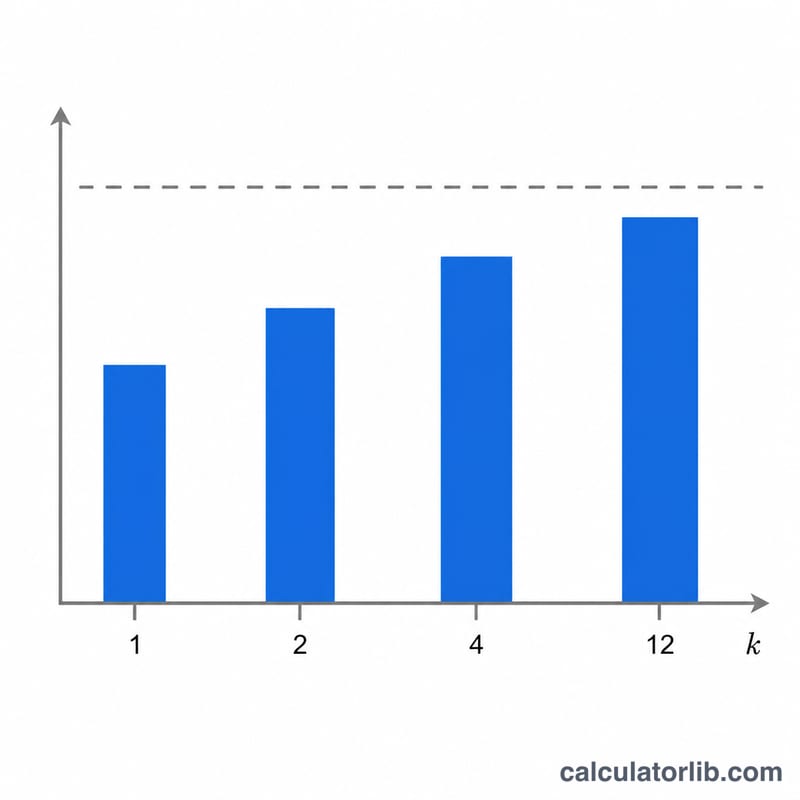
Why is the effective rate higher than the nominal rate? Compounding earns interest on previously credited interest, so more frequent compounding raises the effective rate above the stated nominal rate.
Which rate should I compare across products? Always compare effective annual rates, since they account for different compounding frequencies on a like-for-like basis.
Is this the exact figure my bank uses? This is the idealized mathematical conversion. Real institutions may apply their own rounding or day-count conventions, so small differences can occur.