
What Is the Nominal Interest Rate Calculator?
This calculator converts an effective annual interest rate into a nominal annual interest rate for a chosen compounding frequency. The effective rate reflects what you truly earn or pay over a year once compounding is included, while the nominal (or "stated") rate is the headline figure quoted before compounding. Because compounding lifts the actual return above the stated rate, converting back from effective to nominal requires the formula below.
How to Use It
Enter the effective annual rate as a percentage and the number of compounding periods per year (12 for monthly, 4 for quarterly, 365 for daily, 1 for annual). The calculator returns the nominal annual rate plus the rate applied in each individual compounding period.
The Formula Explained
The nominal rate is found with:
$$i = m \times \left( (1 + r)^{1/m} - 1 \right)$$
where r is the effective annual rate (as a decimal), m is the number of compounding periods per year, and i is the nominal annual rate. The term \((1 + r)^{1/m}\) finds the per-period growth factor; subtracting 1 gives the per-period rate, and multiplying by \(m\) annualizes it without compounding.
Worked Example
Suppose the effective annual rate is 5% and interest compounds monthly (\(m = 12\)). Then \(r = 0.05\) and:
$$i = 12 \times \left( (1.05)^{1/12} - 1 \right) = 12 \times (1.0040741 - 1) = 12 \times 0.0040741 \approx 0.048889$$ or about 4.8889%. So a 5% effective rate corresponds to roughly a 4.89% nominal rate compounded monthly.
FAQ
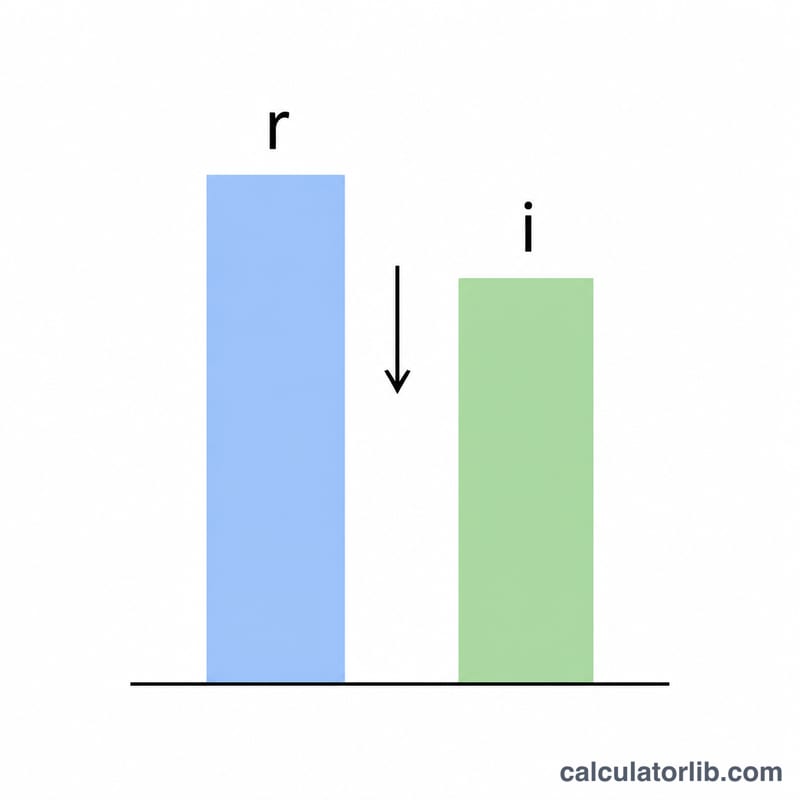
Is nominal always lower than effective? Yes, whenever there is more than one compounding period per year, because compounding adds extra growth on top of the nominal rate.
What if compounding is annual (\(m = 1\))? Then the nominal rate equals the effective rate exactly.
How is this different from APR/APY? APY is essentially the effective rate; the nominal rate here is comparable to APR before fees. This tool ignores fees and uses pure compounding math.