
What Is the Effective Annual Rate?
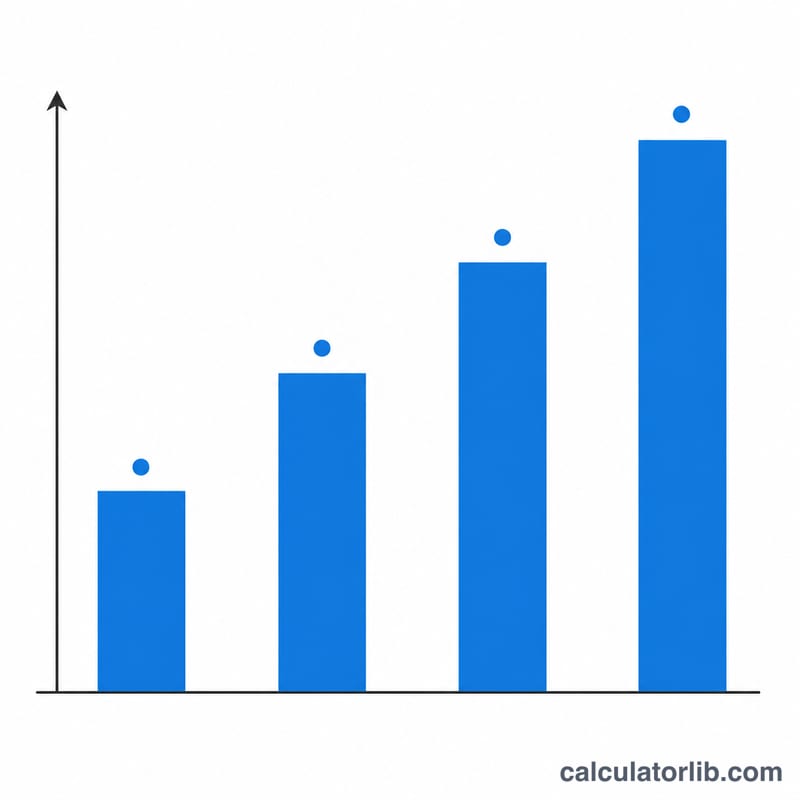
The effective annual rate (EAR), also called the annual equivalent rate or effective yield, is the real rate of interest you earn or pay once compounding is taken into account. A quoted "nominal" rate ignores how often interest is added; the EAR captures the extra growth that comes from interest earning interest within the year. The more frequently a rate compounds, the higher the EAR will be for the same nominal figure.
How to Use This Calculator
Enter the nominal annual rate as a percentage and the number of compounding periods per year. Common choices are 1 (annual), 2 (semi-annual), 4 (quarterly), 12 (monthly), 52 (weekly) and 365 (daily). The calculator returns the EAR as a percentage and shows how much higher it is than the nominal rate.
The Formula Explained
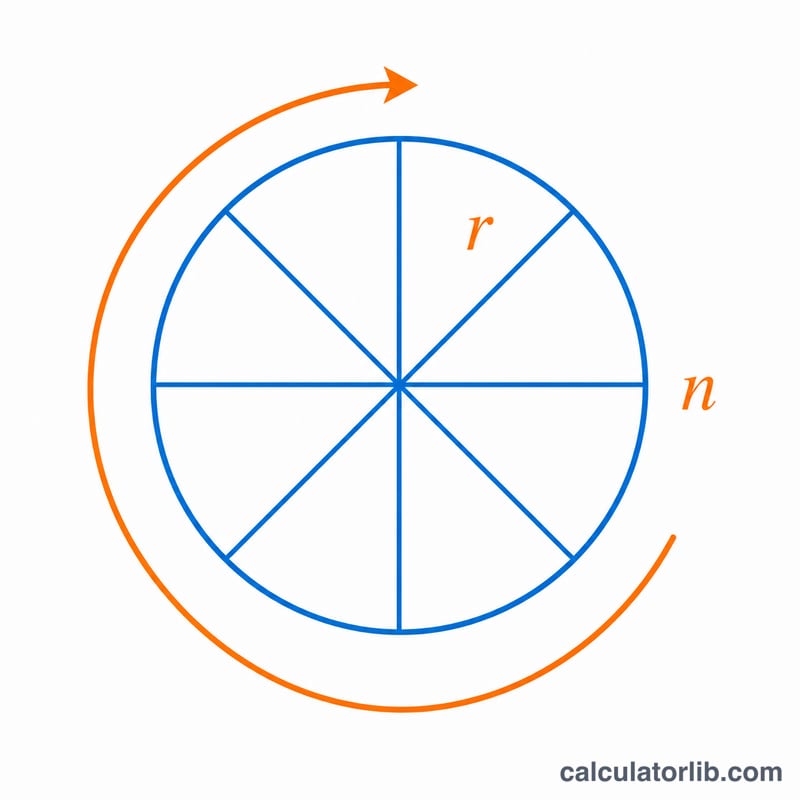
$$\text{EAR} = \left(1 + \frac{r}{n}\right)^{n} - 1$$ where \(r\) is the nominal rate written as a decimal (6% = 0.06) and \(n\) is the number of compounding periods per year. Dividing \(r\) by \(n\) gives the rate applied each period; raising the result to the power of \(n\) compounds it across the whole year; subtracting 1 converts the growth factor back into a rate.
Worked Example
Suppose a savings account quotes a 6% nominal rate compounded monthly (\(n = 12\)). Then $$\text{EAR} = \left(1 + \frac{0.06}{12}\right)^{12} - 1 = (1.005)^{12} - 1 \approx 0.061678,$$ or about 6.1678%. Although the nominal rate is 6%, the true annual return is roughly 6.17% — about 0.17 percentage points more thanks to monthly compounding.
FAQ
Why is the EAR higher than the nominal rate? Because interest earned partway through the year starts earning its own interest. With only annual compounding (\(n = 1\)), EAR equals the nominal rate.
Which rate should I compare across products? Always compare EARs. Two accounts with the same nominal rate but different compounding frequencies are not equivalent.
What about continuous compounding? As \(n\) grows very large, EAR approaches \(e^{r} - 1\). Daily compounding is already very close to that limit.