What is the Lighting kWh Usage Calculator?
This calculator estimates how much electrical energy your light bulbs consume over a chosen period, measured in kilowatt-hours (kWh) — the unit your utility uses for billing. By entering the number of bulbs, their wattage, daily usage hours and the number of days, you instantly see total consumption and an optional cost estimate. It works for any country since kWh is a universal unit; just enter your local electricity rate.
How to use it
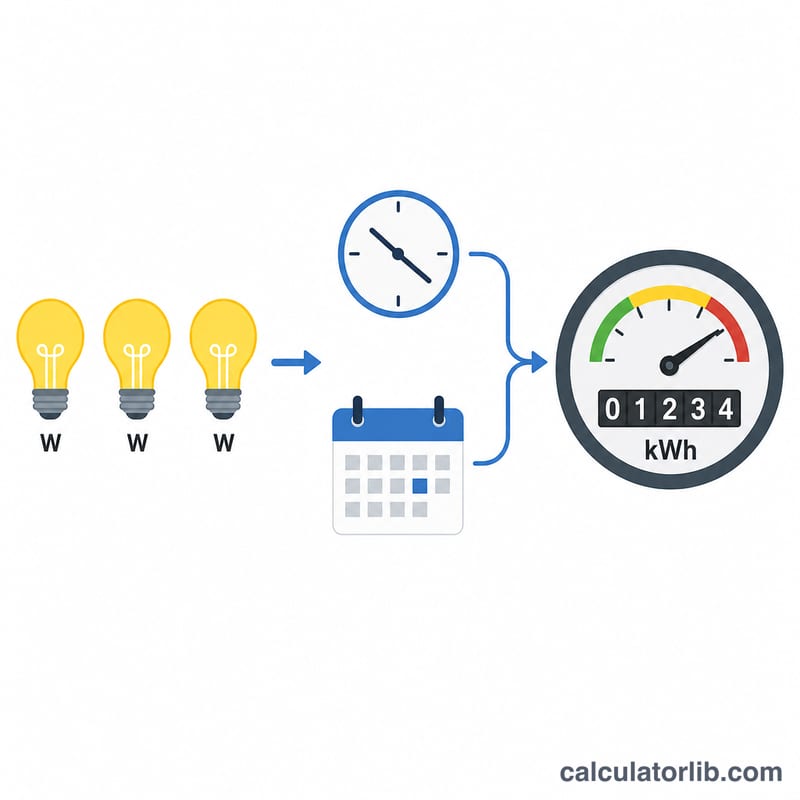
Enter the number of bulbs, the watts printed on each bulb, how many hours per day they are switched on, and the period in days. Optionally add your electricity rate (price per kWh) to estimate the bill. The result shows total kWh, total wattage, daily energy use, and projected cost.
The formula explained
First, total wattage = number of bulbs × watts per bulb. Energy in watt-hours is total wattage × hours per day × days. Dividing by 1000 converts watt-hours into kilowatt-hours: $$\text{kWh} = \frac{\text{totalWatts} \times \text{hoursPerDay} \times \text{days}}{1000}$$. Multiply the kWh by your rate to get cost.
Worked example
Suppose you have 10 bulbs of 60 W each, used 5 hours a day for 30 days. Total wattage = \(10 \times 60 = 600\) W. Energy = \(600 \times 5 \times 30 = 90{,}000\) Wh = 90 kWh. At a rate of 0.15 per kWh, the cost is \(90 \times 0.15 = 13.50\).
Typical Bulb Wattages by Type and Brightness
Brightness is measured in lumens (lm), and wattage is the power the bulb uses. To compare bulb types fairly, match them by lumens first, then look at the wattage. The table shows typical wattages for four common brightness levels. Use the wattage of the bulb you actually have in the Watts field of the calculator.
| Brightness (approx.) | Incandescent | Halogen | CFL | LED |
|---|---|---|---|---|
| About 450 lm | 40 W | about 29 W | about 9–11 W | about 5–6 W |
| About 800 lm | 60 W | about 43 W | about 13–15 W | about 8–10 W |
| About 1100 lm | 75 W | about 53 W | about 18–20 W | about 11–13 W |
| About 1600 lm | 100 W | about 72 W | about 23–26 W | about 15–17 W |
Note: These are typical figures only. Actual wattage varies by product, manufacturer and model, so check the wattage (and lumen rating) printed on the bulb or its packaging. Where you can buy incandescent, halogen and CFL bulbs also depends on the country, because many places have restricted or phased out less efficient lamps. The incandescent column is still the usual reference for describing brightness, as in "60 W equivalent".
Energy Use by Bulb Type: Same Usage Compared
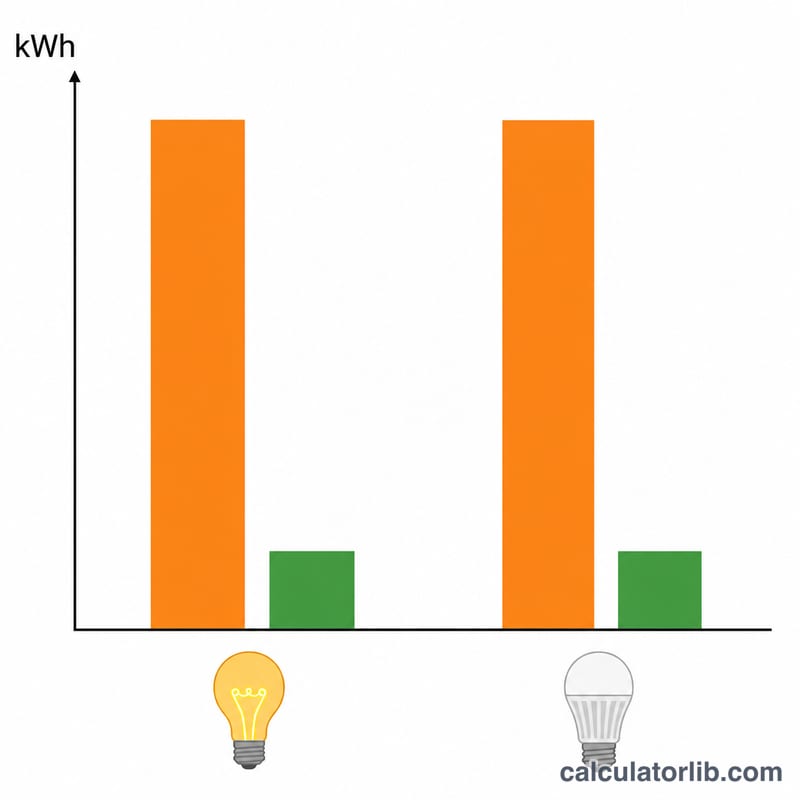
This comparison uses the same setup as the worked example: 10 bulbs, 5 hours a day and 30 days, with electricity at 0.15 per kWh. The rate is in whatever currency your utility bills in. Each bulb gives roughly the same brightness (about 800 lumens), and only the wattage changes. The yearly column uses 365 days in place of 30.
The general formulas are:
$$\text{kWh} = \frac{\text{Bulbs} \times \text{Watts} \times \text{Hours/Day} \times \text{Days}}{1000}$$$$\text{Cost} = \text{kWh} \times \text{Rate}$$| Bulb type | Formula (30 days) | Energy (30 days) | Cost (30 days) | Formula (365 days) | Energy (1 year) | Cost (1 year) |
|---|---|---|---|---|---|---|
| Incandescent, 60 W | \(\frac{10 \times 60 \times 5 \times 30}{1000}\) | 90 kWh | \(90 \times 0.15 = 13.50\) | \(\frac{10 \times 60 \times 5 \times 365}{1000}\) | 1,095 kWh | \(1095 \times 0.15 = 164.25\) |
| Halogen, 43 W | \(\frac{10 \times 43 \times 5 \times 30}{1000}\) | 64.5 kWh | \(64.5 \times 0.15 \approx 9.68\) | \(\frac{10 \times 43 \times 5 \times 365}{1000}\) | 784.75 kWh | \(784.75 \times 0.15 \approx 117.71\) |
| CFL, 14 W | \(\frac{10 \times 14 \times 5 \times 30}{1000}\) | 21 kWh | \(21 \times 0.15 = 3.15\) | \(\frac{10 \times 14 \times 5 \times 365}{1000}\) | 255.5 kWh | \(255.5 \times 0.15 \approx 38.33\) |
| LED, 9 W | \(\frac{10 \times 9 \times 5 \times 30}{1000}\) | 13.5 kWh | \(13.5 \times 0.15 \approx 2.03\) | \(\frac{10 \times 9 \times 5 \times 365}{1000}\) | 164.25 kWh | \(164.25 \times 0.15 \approx 24.64\) |
What the comparison shows: With identical usage, the 9 W LEDs use 85% less energy than the 60 W incandescents, because \(\frac{9}{60} = 0.15\). Over a year, the LEDs cut use from 1,095 kWh to 164.25 kWh. That saves 930.75 kWh, or about 139.61 at 0.15 per kWh. Costs are rounded to two decimals. Your real savings depend on your electricity rate, how long you leave the lights on, and the exact wattage of your bulbs.
Related tools
- Bulb energy cost: running cost of one bulb or a set of identical bulbs per day, month and year.
- LED savings and payback: how long an LED swap takes to pay for itself.
- Max lights per circuit: how many fixtures one breaker can carry at 80% continuous load.
FAQ
Why switch to LED bulbs? LEDs use far fewer watts for the same brightness — replacing a 60 W incandescent with a 9 W LED cuts that bulb's energy use by about 85%.
What rate should I enter? Use the price per kWh from your electricity bill, often labelled the unit rate or supply charge. On the U.S. page the field starts at the latest U.S. average residential price published by the EIA (about 18 cents per kWh in 2026); replace it with your own rate for an exact bill.
Does this include standby power? No. It only models the time bulbs are actively on; smart fixtures may draw a small standby load.