What Is a Cashback Calculator?
A cashback calculator tells you exactly how much money you earn back when you make a purchase with a rewards card or through a cashback program. Cashback is a rebate paid as a percentage of the amount you spend — for example, a 2% cashback card returns $2 for every $100 you spend. This tool also shows your effective net cost after the reward is applied, so you can compare offers at a glance.
How to Use It
Enter two values: the purchase amount (the total you are spending) and the cashback rate as a percentage. The calculator instantly returns the cashback earned and the net cost after that reward. Use it to evaluate a single purchase, compare two cards with different rates, or estimate annual rewards by entering your typical monthly or yearly spend.
The Formula Explained
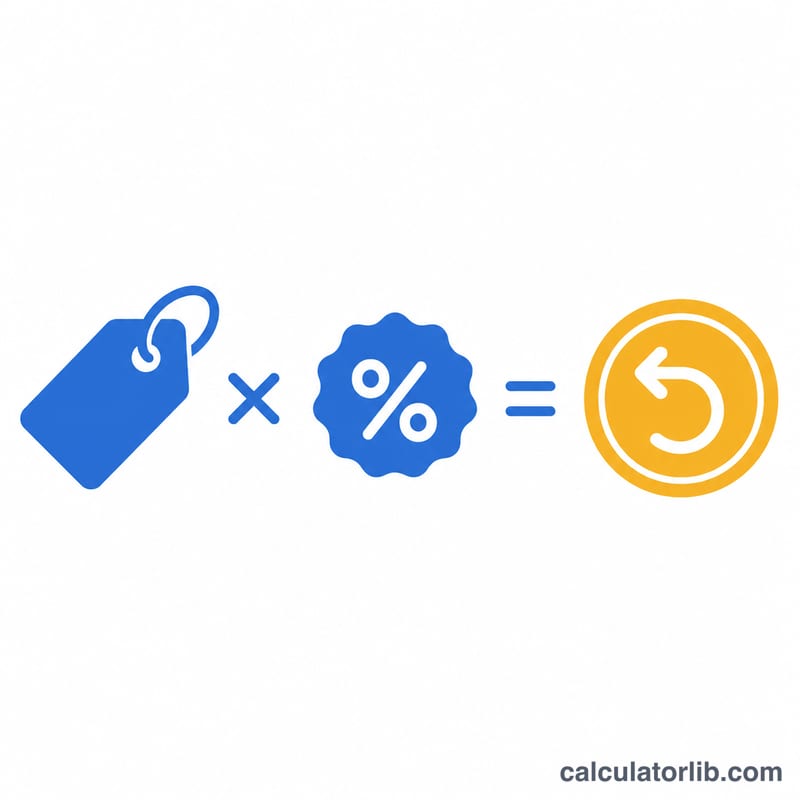
The math is simple: $$\text{cashback} = \text{purchaseAmount} \times \frac{\text{cashbackRate}}{100}$$ Dividing the rate by 100 converts a percentage into a decimal multiplier. The net cost is then the purchase amount minus the cashback. Because rewards scale linearly with spend, doubling your purchase doubles your cashback at the same rate.
Worked Example
Suppose you spend $250 using a card that offers 3% cashback. The cashback earned is $$250 \times (3 \div 100) = 250 \times 0.03 = 7.50$$ Your net cost drops to $$250 - 7.50 = 242.50$$ A higher 5% rate on the same purchase would return $12.50 instead.
Cashback Across Common Rates and Spend Levels
The table below applies the standard cashback formula to four realistic purchase or annual-spend figures at the five rates most commonly advertised on consumer rewards cards. Every cell is simply the amount multiplied by the rate:
$$\text{Cashback} = \text{Purchase Amount} \times \frac{\text{Rate}}{100}$$| Amount | 1% | 1.5% | 2% | 3% | 5% | Net cost at 2% |
|---|---|---|---|---|---|---|
| $50 | $0.50 | $0.75 | $1.00 | $1.50 | $2.50 | $49.00 |
| $250 | $2.50 | $3.75 | $5.00 | $7.50 | $12.50 | $245.00 |
| $1,000 | $10.00 | $15.00 | $20.00 | $30.00 | $50.00 | $980.00 |
| $5,000 | $50.00 | $75.00 | $100.00 | $150.00 | $250.00 | $4,900.00 |
Sample substitution for the $5,000 row at 1.5%:
$$5{,}000 \times \frac{1.5}{100} = 5{,}000 \times 0.015 = \$75.00$$All figures assume a flat, uncapped rate applied to the full amount, with no annual fee, no spending caps, no category restrictions, no minimum redemption and no exclusions. Real card programs frequently break at least one of those assumptions — see the notes below on effective rate. Currency symbols are shown as dollars for readability, but the arithmetic is identical in any currency.
Interpreting Your Cashback Result
Cashback earned is a rebate, not cash handed to you at checkout. When you pay $1,000 on a 2% card, you are still charged the full $1,000 by the merchant. The $20 arrives later — as a statement credit, a deposit, or points — after the transaction posts and often only once a billing cycle closes. Treat the result as money you will receive, not money you have.
Net cost is the effective price paid. The calculator's second output is:
$$\text{Net Cost} = \text{Purchase Amount} - \text{Cashback Earned}$$It is the useful number for comparing a purchase you would make anyway against the same item bought without rewards. It is not a discount you can offer a merchant, and it does not reduce sales tax, shipping or any amount financed if you carry a balance.
Comparing two cards means applying each rate to the same spend. Rates are only comparable on identical purchase amounts. On $2,400 of annual grocery spend, a 3% card returns $72.00 while a flat 1.5% card returns $36.00 — a $36 difference that only holds if all $2,400 actually qualifies for the 3% rate.
Why the advertised rate is rarely the rate you get. The headline percentage is a nominal rate. What matters is the effective rate across everything you spend:
$$\text{Effective Rate} = \frac{\text{Total Cashback} - \text{Annual Fee}}{\text{Total Spend}} \times 100$$- Annual fees subtract from rewards before any benefit exists. A 2% card with a $95 fee returns a net $105 on $10,000 of spend, an effective 1.05%.
- Category caps stop the bonus rate after a threshold. A 5% rate capped at $1,500 per quarter pays at most $75 per quarter; spend above the cap typically drops to a base rate such as 1%.
- Tiers pay different rates to different merchant categories, so a single blended figure — not the highest tier — describes your actual return.
- Minimum-redemption thresholds (for example, a $25 minimum) mean unredeemed balances are worth nothing until you reach them, and may expire.
- Foreign-transaction fees of roughly 1%–3% on many cards can exceed the cashback earned on purchases abroad, producing a negative effective return.
- Points programs require a conversion rate; if 1 point is worth $0.01 at cash redemption, a "3 points per dollar" rate is a 3% cashback rate only at that conversion.
To find the effective rate, run each spend segment through the calculator at its own rate, add the results, subtract any fee, and divide by total spend.
Tax treatment (United States). Under current IRS practice, credit card rewards earned as a percentage of purchases are generally treated as a purchase rebate — a reduction of the price paid — rather than taxable income, so they are usually not reported on a Form 1099. Bonuses received without a spending requirement, such as a payment for simply opening an account or a referral payout, may be treated differently and can be reported as income. Rebates on business purchases may also reduce the deductible cost of those purchases. This is a US-specific rule; other countries treat loyalty rewards under their own tax law, and the answer can differ.
This section is general information, not tax, financial or professional advice, and it makes no recommendation about which card or program to use. For your own situation, consult a qualified adviser and the issuer's terms.
Key Terms and Variables
| Term | Definition and effect on the calculation |
|---|---|
| Purchase amount | The transaction value the rate is applied to — the purchaseAmount input. Use the amount that actually qualifies for rewards; taxes, fees, shipping, cash advances and gift-card buys are included or excluded depending on program terms. |
| Cashback rate (nominal %) | The advertised percentage — the cashbackRate input. Enter it as a whole number of percent (enter 2 for 2%, not 0.02); the formula divides by 100 internally. |
| Cashback earned | The primary output: purchase amount × rate ÷ 100. The gross rebate before any fee, cap or redemption restriction is applied. |
| Net cost | The secondary output: purchase amount − cashback earned. The effective price of the purchase once the rebate is received. |
| Effective cashback rate | Total cashback actually received divided by total spend, ×100. Differs from the nominal rate whenever fees, caps, tiers or exclusions apply; it is the figure to use when comparing programs. |
| Statement credit | A redemption method that reduces your card balance by the cashback amount instead of paying cash. It does not change the calculator's output, only when and how you receive it. |
| Rotating / bonus category | A merchant category (groceries, fuel, dining) earning an elevated rate, sometimes changing each quarter and requiring activation. Model it by running that category's spend through the calculator at its own rate. |
| Cashback cap | A ceiling on spend or rewards at the bonus rate. Above the cap, enter the excess spend separately at the base rate — otherwise the calculator overstates earnings. |
| Tiered rate | A structure with several rates for different categories or spend bands. Each band is a separate calculation; summing the results gives total cashback. |
| Redemption threshold | A minimum balance (commonly $20–$25 on US cards) required before cashback can be redeemed. Earnings below it are accrued but not yet usable. |
| Points-to-cash conversion rate | The cash value of one point, e.g. $0.01. Multiply points per dollar by this value and by 100 to get the equivalent percentage to enter as the rate. |
| Annual fee | A fixed yearly charge. It is not part of this calculator's inputs — subtract it from total cashback afterwards to get the net benefit and the true effective rate. |
FAQ
Does cashback reduce the price I pay upfront? Usually no — most programs pay the rebate later as statement credit, points, or a deposit, so you still pay the full amount at checkout and receive the reward afterward.
Is cashback the same as a discount? Functionally similar, but a discount lowers the price immediately while cashback is paid back to you. The net cost ends up the same for an equal rate.
Are there caps or limits? Many cards limit cashback by category or annual total. This calculator assumes a flat, uncapped rate, so check your card's terms for tiered or capped rewards.