What Is the Savings Goal Timeline Calculator?
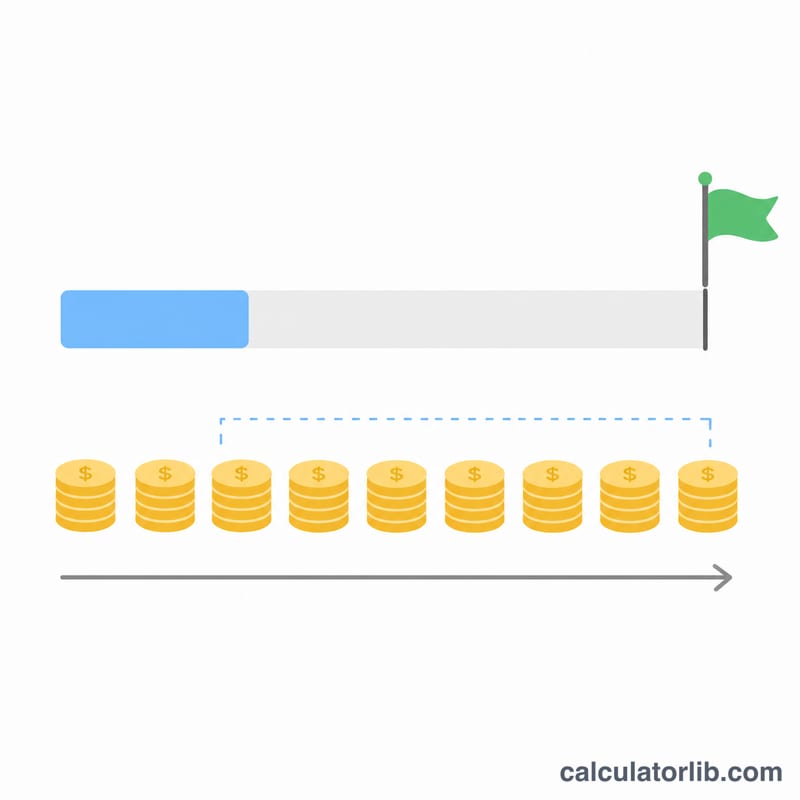
This calculator tells you how long it will take to reach a financial target — a vacation fund, an emergency fund, a house down payment, or any savings goal — based on what you have saved already and how much you set aside each month. It gives a simple, contribution-only estimate (no interest assumed), making it easy to plan and adjust.
How to Use It
Enter three values: your Savings Goal (the total you want to reach), your Current Savings (what you have right now), and your Monthly Contribution (how much you plan to save each month). The calculator returns the number of months and years needed to reach your goal, plus the amount still remaining.
The Formula Explained
The math is straightforward: subtract your current savings from your goal to find what is left, then divide by your monthly contribution.
$$\text{Months} = \frac{\text{Goal} - \text{Current Savings}}{\text{Monthly Contribution}}$$
To express the timeline in years, divide the months by 12. If you have already met or exceeded the goal, the result is zero months.
Worked Example
Suppose your goal is $10,000, you have already saved $2,000, and you contribute $500 per month. The remaining amount is $$\$10{,}000 - \$2{,}000 = \$8{,}000.$$ Dividing by $500 gives $$\frac{\$8{,}000}{\$500} = 16 \text{ months, or about } 1.33 \text{ years}.$$
How Monthly Contribution Changes Your Timeline
This table uses the article's example: a goal of $10,000 with $2,000 already saved, which leaves $8,000 to go. Each row divides that $8,000 by a different monthly contribution:
$$\text{Months} = \frac{\$10{,}000 - \$2{,}000}{\text{Monthly Contribution}} = \frac{\$8{,}000}{\text{Monthly Contribution}}$$| Monthly Contribution | Months (8,000 ÷ contribution) | Years (months ÷ 12) |
|---|---|---|
| $200 | 40 | 3.33 |
| $250 | 32 | 2.67 |
| $400 | 20 | 1.67 |
| $500 | 16 | 1.33 |
| $800 | 10 | 0.83 |
| $1,000 | 8 | 0.67 |
The formula is a plain division with no interest, so the timeline is inversely proportional to the contribution. If you double the contribution, the timeline is cut in half. For example, $200 a month takes 40 months and $400 a month takes 20. Likewise, $500 a month takes 16 months and $1,000 a month takes 8.
Interpreting Your Result
- Fractional months: A result like 16.4 months means 16 contributions aren't quite enough, and the goal is reached during the 17th one. Round up to the next whole month, \(\lceil 16.4 \rceil = 17\), to get the number of contributions you actually need.
- Decimal years: To turn decimal years into years and months, multiply the decimal part by 12. For example, 1.33 years becomes 1 year plus \(0.33 \times 12 \approx 4\) months, so about 1 year 4 months.
- Amount remaining: This is the goal minus your current savings, \(\text{Goal} - \text{Current Savings}\). It is the amount your monthly contributions have to cover.
- No interest included: The calculation leaves out interest and investment returns. If your contributions stay steady, the result is the longest it should take. Interest earned along the way would make the timeline shorter. Missed, late or smaller contributions would make it longer.
- A result of 0: Your current savings already equal or exceed the goal, so no more contributions are needed.
- A contribution of 0 or less: No timeline can be calculated. Dividing by zero is undefined, and a negative contribution means the balance is shrinking, so you never reach the goal.
This is general information about how to read the calculation, not financial advice.
More Worked Examples
Example 1: An emergency fund that doesn't divide evenly
Goal $6,000, current savings $750, monthly contribution $300.
- Subtract to find the amount remaining: $$\$6{,}000 - \$750 = \$5{,}250$$
- Divide by the monthly contribution: $$\frac{\$5{,}250}{\$300} = 17.5 \text{ months}$$
- Round up to whole months. Seventeen contributions add \(17 \times \$300 = \$5{,}100\), which is still $150 short. The 18th contribution closes the gap: $$\lceil 17.5 \rceil = 18 \text{ months}$$
- Convert to years: $$\frac{18}{12} = 1.5 \text{ years} = 1 \text{ year } 6 \text{ months}$$
Example 2: A goal that's already met
Goal $3,000, current savings $3,200, any positive monthly contribution.
- Subtract to find the amount remaining: $$\$3{,}000 - \$3{,}200 = -\$200$$
- Check the sign: The remaining amount is ≤ 0, so you have already reached the goal and have $200 more than you need. Nothing is left to divide.
- Round: There is no fraction to round. The result is 0 months.
- Convert to years: $$\frac{0}{12} = 0 \text{ years}$$
FAQ
Does this include interest? No. This is a simple contribution-only estimate. If your savings earn interest, you may reach the goal slightly sooner.
What if I already passed my goal? The result shows 0 months because no further saving is required.
Can I speed it up? Yes — increasing your monthly contribution lowers the number of months. Try different amounts to see the impact.