
What Is a Stacked Discount?
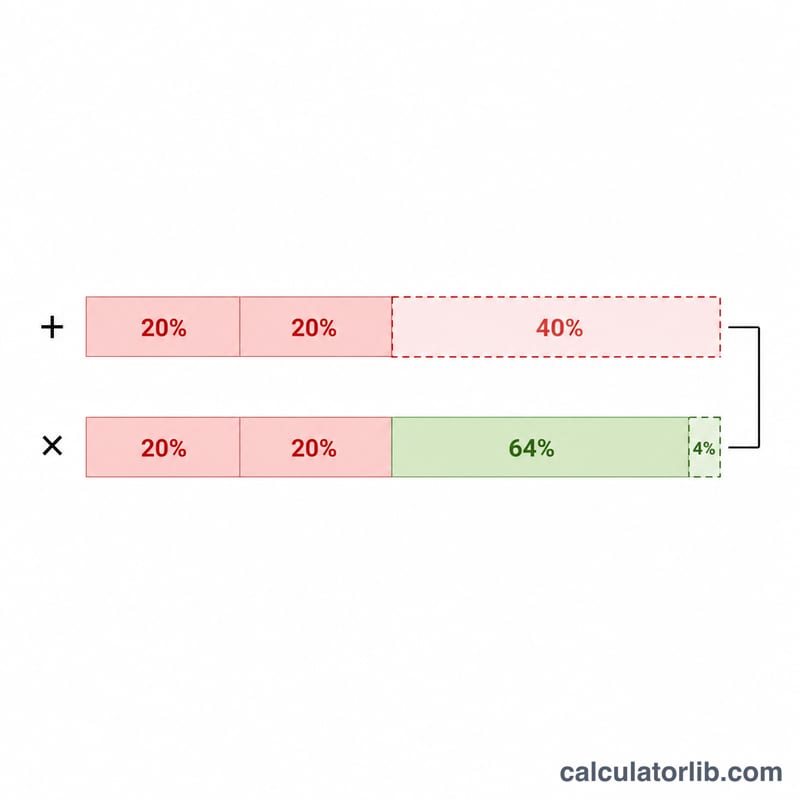
A stacked (or compounding) discount is when more than one percent-off deal is applied to the same item — for example "20% off, then an extra 10% off at checkout." A common mistake is to add the percentages together (20% + 10% = 30%). That is wrong. Each discount applies to the price after the previous one, so stacked discounts always save less than the simple sum. This calculator does the multiplication correctly and shows the true effective discount rate.
How to Use It
Enter the original price, then type up to four discount percentages. Leave any unused discount fields at 0. The calculator multiplies the remaining price fractions together to find the final price, the total amount you save, and the single equivalent discount rate.
The Formula Explained
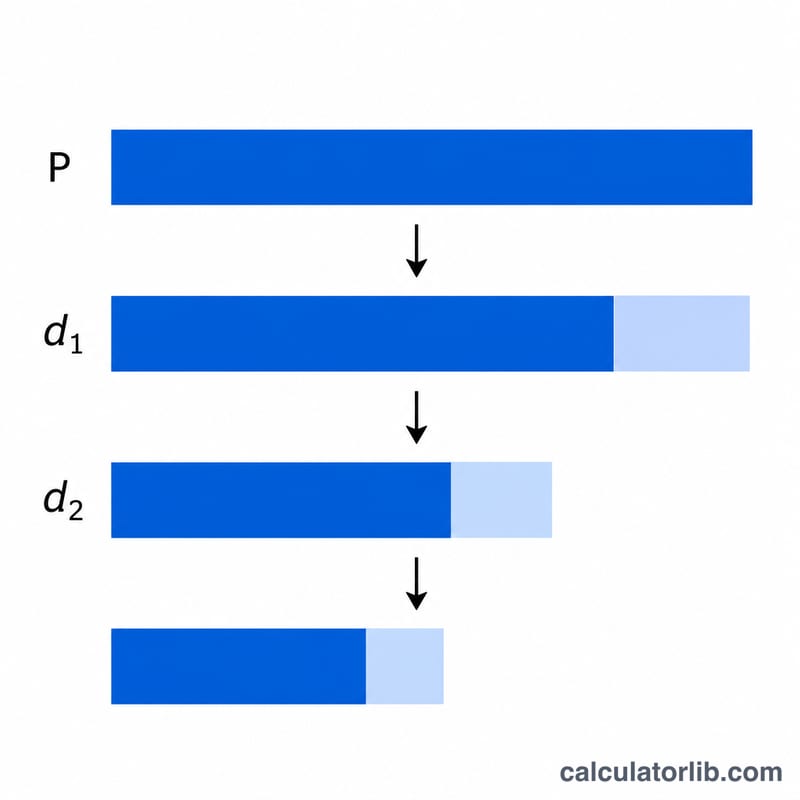
For each discount d expressed as a decimal, the fraction of price that remains is \((1 - d)\). Multiply all of these together and by the original price P:
$$\text{Final} = P \times (1 - d_1) \times (1 - d_2) \times \dots \times (1 - d_n)$$
Total savings is simply \(P - \text{Final}\), and the effective discount is the savings divided by the original price.
Worked Example
A $100 jacket has 20% off, then an additional 10% off. Step one: \(100 \times (1 - 0.20) = \$80\). Step two: \(80 \times (1 - 0.10) = \$72\). The final price is $72, total savings is $28, and the effective discount is 28% — not the 30% you'd get by naively adding the two percentages.
FAQ
Does the order of discounts matter? No. Because multiplication is commutative, applying 20% then 10% gives the same result as 10% then 20%.
Why is the effective discount less than the sum? Later discounts are taken on an already-reduced price, so they remove fewer dollars than they would on the full price.
Can I use this for coupons plus a sale? Yes, as long as both apply as percent-off on the running price. If a coupon is a flat dollar amount, it is not a percentage and won't fit this model.