
What Is a Zero-Based Budget?
A zero-based budget is a method where you give every single dollar of your income a job — spending, saving, or paying down debt — until the amount left to assign is exactly zero. Unlike percentage-based rules, zero-based budgeting forces intentional choices about every dollar, which is why it is the backbone of popular systems like the envelope method and the "give every dollar a job" philosophy. The formula is universal and works in any currency.
How to Use This Calculator
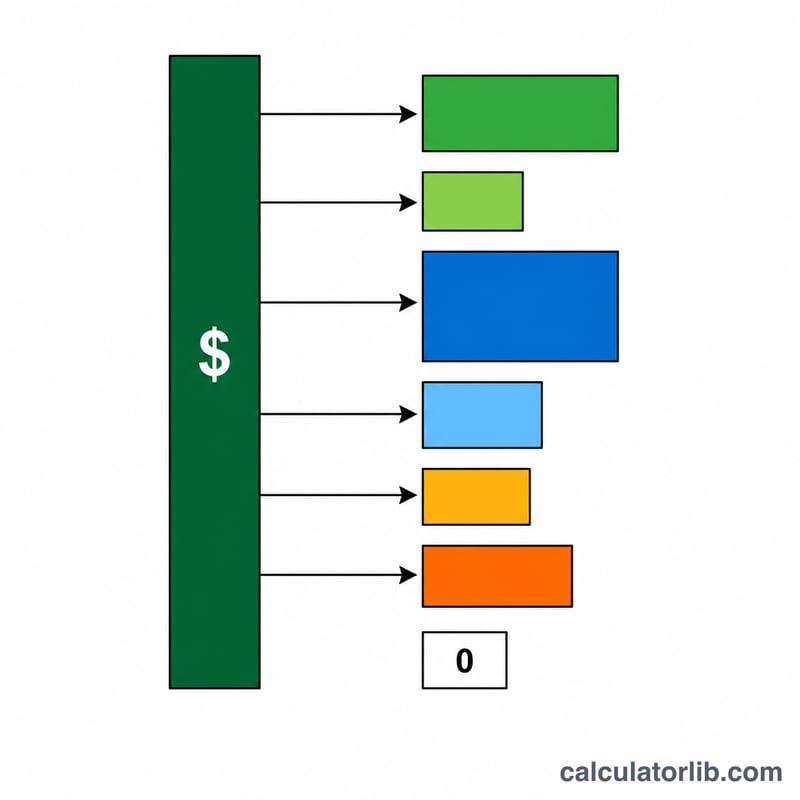
Enter your total monthly income at the top, then distribute it across the category fields: housing, food, transportation, utilities, savings, debt, and discretionary spending. The calculator subtracts the sum of all categories from your income to show your unassigned balance. Keep adjusting the categories until the unassigned amount reads $0 — at that point your budget is balanced and every dollar has a purpose.
The Formula Explained
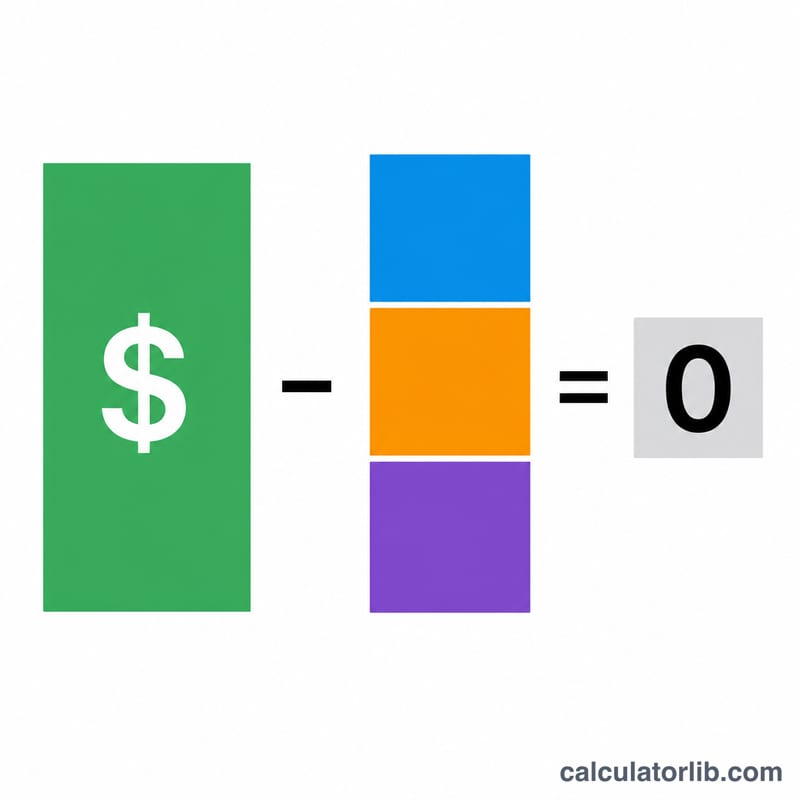
The core equation is simply
$$\text{Unassigned} = \text{Income} - \left( \text{Housing} + \text{Food} + \text{Transport} + \text{Utilities} + \text{Savings} + \text{Debt} + \text{Other} \right)$$A positive unassigned balance means you still have money to assign. A negative balance means you have over-budgeted and need to cut a category. When the balance equals zero, the budget is balanced.
Worked Example
Suppose your monthly income is $5,000. You allocate $1,500 to housing, $600 to food, $400 to transportation, $300 to utilities, $800 to savings, $500 to debt, and $900 to discretionary spending. The allocations total $5,000, so the unassigned balance is
$$\$5{,}000 - \$5{,}000 = \$0$$Your budget is balanced.
FAQ
What if my unassigned balance is negative? You have assigned more money than you earn. Reduce one or more categories until the balance returns to zero.
Does a $0 balance mean I spend everything? No. Savings and debt payments are categories too, so "assigning" a dollar includes saving or investing it.
Can I add my own categories? Use the "Other / Discretionary" field to lump in any spending not covered by the named categories.