
What Is the 50/30/20 Budget?
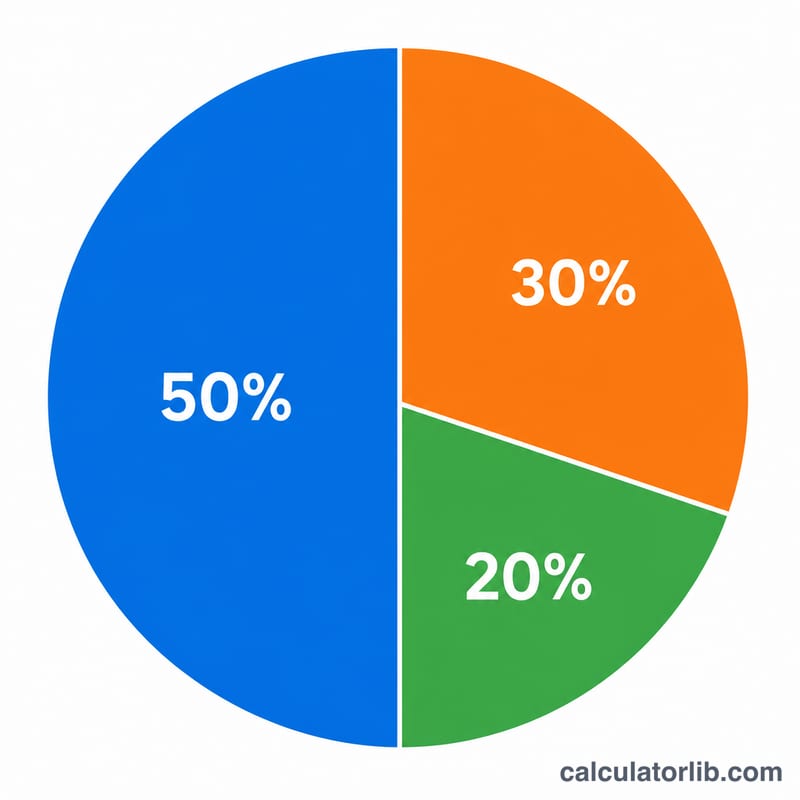
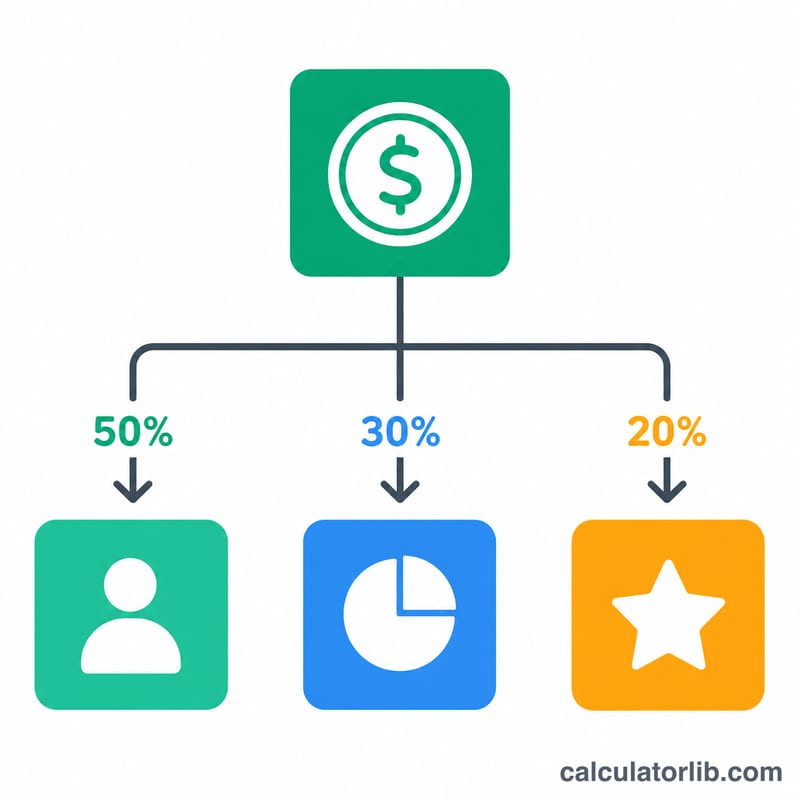
The 50/30/20 rule is a simple budgeting framework popularized by Senator Elizabeth Warren. It divides your monthly after-tax income into three categories: 50% for needs, 30% for wants, and 20% for savings and debt repayment. It works in any currency because it is based purely on proportions of your income.
How to Use This Calculator
Enter your monthly take-home (after-tax) income. The calculator instantly shows how much should go to each category. Use your net pay — the amount that actually lands in your bank account — for the most realistic plan.
The Formula Explained
The math is straightforward multiplication:
$$\text{Needs} = \text{Income} \times 0.50$$ — rent or mortgage, groceries, utilities, insurance, minimum debt payments, transport.
$$\text{Wants} = \text{Income} \times 0.30$$ — dining out, hobbies, streaming, vacations, and other non-essentials.
$$\text{Savings \& Debt} = \text{Income} \times 0.20$$ — emergency fund, investments, retirement, and extra debt payments beyond the minimum.
Worked Example
Suppose your monthly after-tax income is 5,000. Then $$\text{Needs} = 5{,}000 \times 0.50 = 2{,}500$$ $$\text{Wants} = 5{,}000 \times 0.30 = 1{,}500$$ $$\text{Savings} = 5{,}000 \times 0.20 = 1{,}000$$ The three amounts add back up to your full 5,000 income.
FAQ
Should I use gross or net income? Use net (after-tax) income, since that's what you actually have available to spend and save.
What if my needs exceed 50%? That's common in high-cost areas. Treat 50/30/20 as a target — trim wants first and gradually shift toward the ideal split.
Can I adjust the percentages? Yes. The rule is a guideline. If you can save more than 20%, do so; the categories should always sum to 100%.