What Is This Calculator?
The How Long Will My Money Last Calculator estimates your financial "runway" — how many months your current savings will cover your living expenses if you stop adding new income. It's useful when planning a career break, sabbatical, early retirement, job loss buffer, or simply understanding how long an emergency fund could keep you afloat.
How to Use It
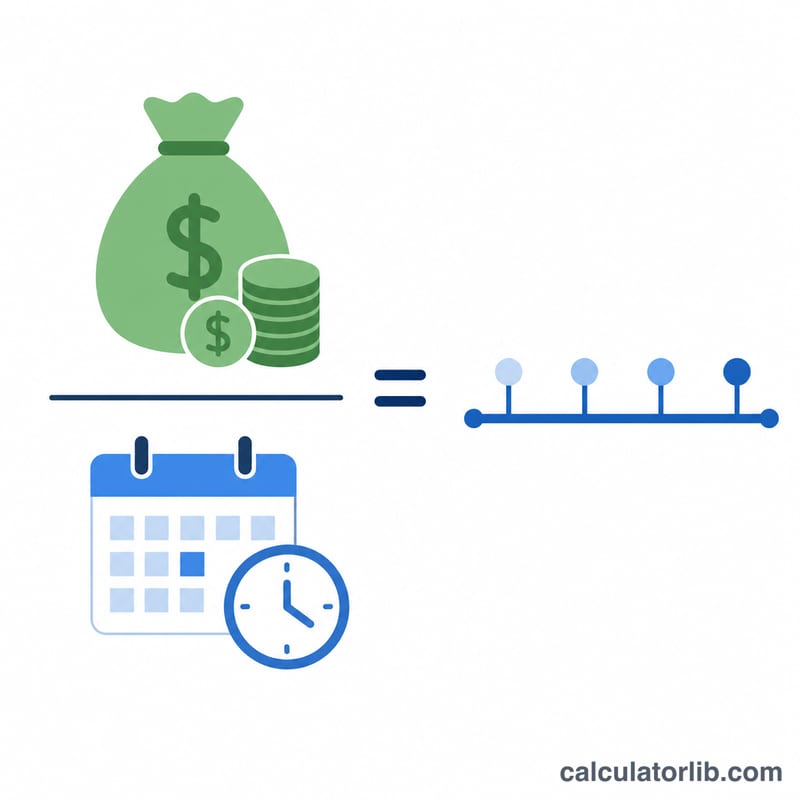
Enter your Current Savings (the total amount of money you have available to spend) and your Monthly Spending (your typical total expenses each month). The calculator divides one by the other to show how many months — broken down into years and months — your money will last.
The Formula Explained
The math is straightforward division:
$$\text{Months} = \frac{\text{Current Savings (\$)}}{\text{Monthly Spending (\$)}}$$
This simple model assumes your spending stays constant and ignores investment growth, interest, inflation, and any future income. For a quick reality check it's powerful, but for long-horizon planning you may want to add expected returns and inflation adjustments.
Worked Example
Suppose you have $50,000 in savings and spend $2,500 per month. Then $$\text{Months} = 50{,}000 \div 2{,}500 = 20 \text{ months},$$ which is exactly 1 year and 8 months. So your money would last roughly 20 months at that spending rate.
Interpreting Your Runway Result
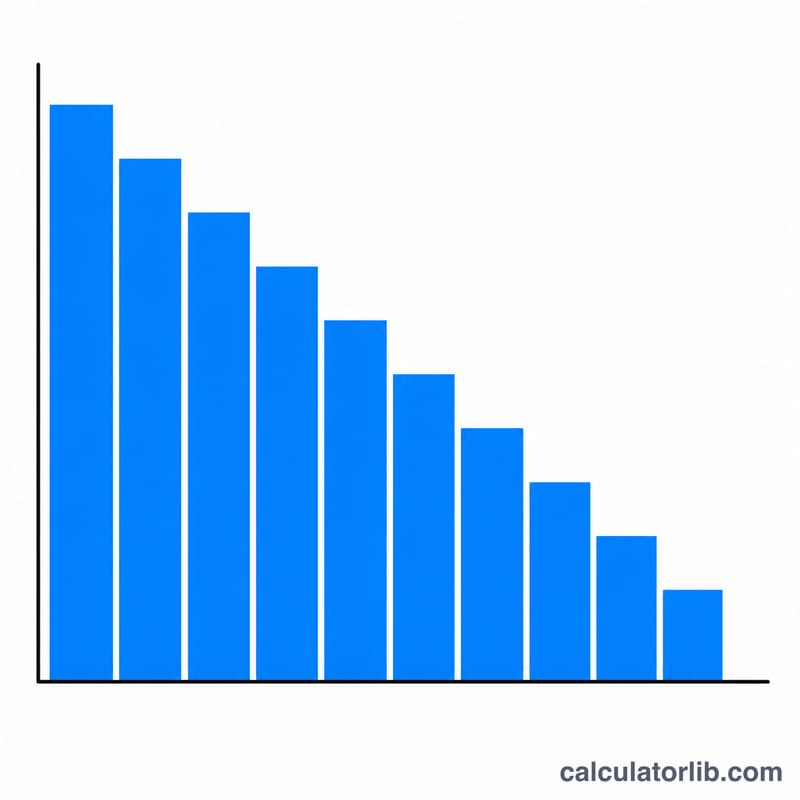
The result is a simple baseline: how many months your current balance would cover if you spent the same amount every month, earned no income, received no interest and saw no price increases. It is a snapshot of how long a lump sum lasts, not a forecast.
Common benchmarks
Many consumer finance sources commonly cite an emergency fund of about 3 to 6 months of essential expenses. Some suggest more for people with irregular income or dependents. These are general rules of thumb, not personal recommendations, and the right level depends on your circumstances. A runway below 3 months is shorter than the commonly cited range; 6 months or more is at or above it.
How the result changes
- Spending rises: the runway shortens in proportion. If spending increases by 20%, the runway falls to about 83% of the original (\(1 \div 1.2\)).
- Returns are earned: interest or investment gains on the remaining balance extend the runway beyond the simple figure. Losses or market declines shorten it.
- Inflation applies: if prices rise, the same lifestyle costs more each year, so the real runway is shorter than the baseline, especially over multi-year horizons.
- Income continues: any part-time pay, benefits or other income reduces the net monthly drawdown and lengthens the runway.
Because those factors can offset each other, treat the result as an estimate and recalculate when your balance or spending changes.
This is general information, not financial advice. Consider consulting a qualified financial professional about your own situation.
Key Terms: Runway, Burn Rate and Liquid Savings
- Financial runway
- The length of time, usually in months or years, that your savings can cover your spending before running out.
- Burn rate (monthly spending)
- The average amount of money you spend each month. A higher burn rate means a shorter runway.
- Liquid savings
- Cash and funds you can access quickly without significant loss of value, such as checking and savings accounts or money market balances. Illiquid assets like a home, vehicles, or retirement accounts with withdrawal restrictions or penalties are generally excluded.
- Emergency fund
- Money set aside for unexpected events such as job loss, medical bills or urgent repairs. It is often discussed as a multiple of monthly expenses, commonly 3 to 6 months.
- Inflation
- The general rise in prices over time, which reduces what a fixed amount of money can buy.
What to enter in each field
- savings: your current liquid savings in dollars (for example 50000), without commas or currency symbols.
- spending: your average monthly spending in dollars (for example 3000). Include rent or mortgage, food, utilities, insurance, debt payments and other regular costs. For a leaner estimate, use essential expenses only.
FAQ
Does this account for interest or investment growth? No. This is a simple division to give a conservative baseline. Real returns would extend the runway, while inflation would shorten it.
What spending number should I use? Use your total average monthly outflow, including rent/mortgage, food, utilities, insurance, transport, and discretionary spending.
How can I make my money last longer? Reduce monthly spending, increase savings, or add a source of income. Even small spending cuts can add several months to your runway.