
What Is a Price Increase Percentage?
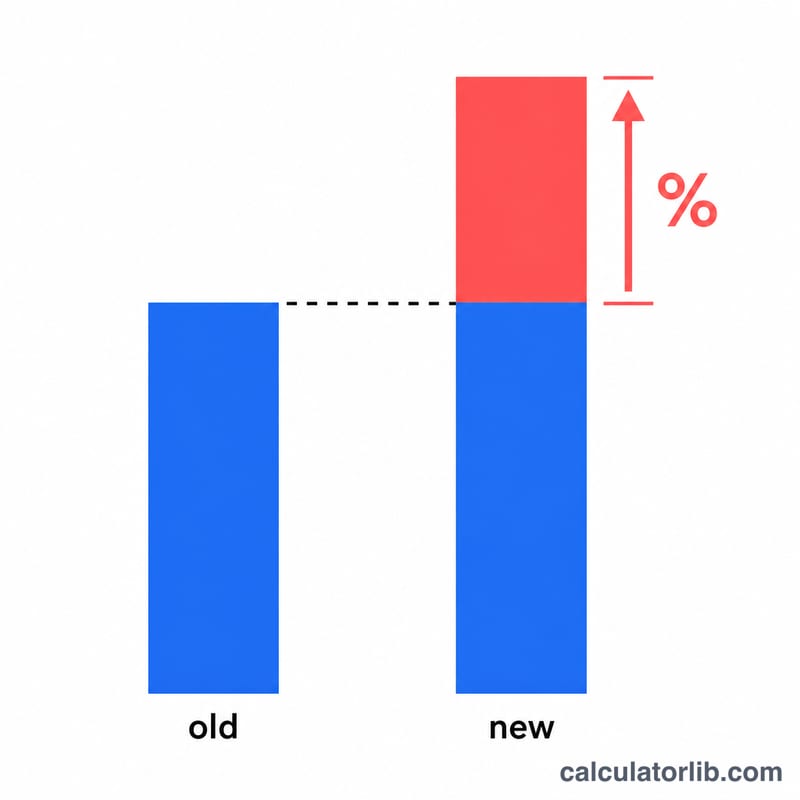
A price increase percentage measures how much a price has grown relative to its original value, expressed as a percent. It turns a raw dollar (or any currency) change into a comparable rate, making it easy to judge whether a 5-unit rise on a 50-unit item is large or small. This calculator works for any currency, product, subscription, rent, or service fee.
How to Use This Calculator
Enter the Old Price (the original or previous price) and the New Price (the current or proposed price). The calculator returns the percentage increase, the absolute change, and both prices for reference. If the new price is lower, the result is shown as a negative percentage, which represents a price decrease.
The Formula Explained
The percent increase is calculated as:
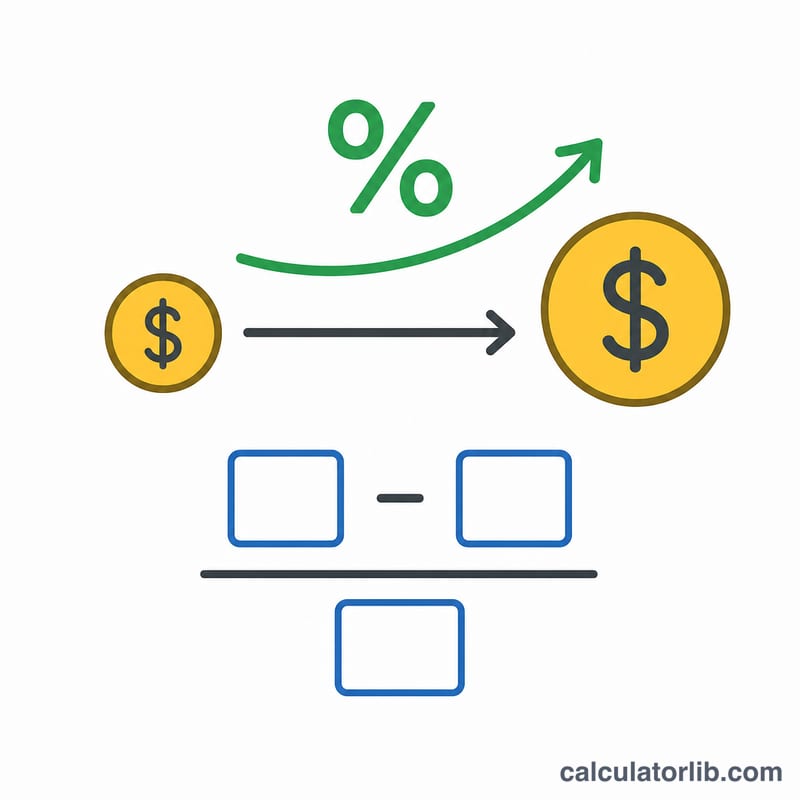
$$\text{Percent Increase} = \frac{\text{New Price} - \text{Old Price}}{\text{Old Price}} \times 100$$First, subtract the old price from the new price to get the absolute change. Then divide that change by the old price to express it as a fraction of the original, and multiply by 100 to convert it to a percentage.
Worked Example
Suppose a monthly subscription rises from 100 to 125. The absolute change is \(125 - 100 = 25\). Dividing by the old price gives \(25 \div 100 = 0.25\), and multiplying by 100 gives a 25% increase. So the subscription went up by a quarter of its original cost.
FAQ
What if the new price is lower than the old price? The result will be negative, indicating a price decrease rather than an increase. For example, going from 100 to 80 yields \(-20\%\).
Can I use this for any currency? Yes. The percentage is unitless, so the calculator works identically for dollars, euros, pounds, or any other currency.
Why divide by the old price and not the new price? The increase is measured relative to the starting value. Dividing by the old price answers "how much did it grow compared to where it began," which is the standard definition of percent increase.