
What Is Markup Percentage?
Markup percentage measures how much you add to a product's cost to arrive at its selling price, expressed as a percentage of the cost. It is one of the most common pricing metrics used by retailers, wholesalers, and manufacturers to set prices and track profitability. A higher markup means a larger profit relative to what you paid for the item.
How to Use This Calculator
Enter the cost — what you paid for the item — and the selling price — what you charge the customer. The calculator instantly returns the markup percentage along with the dollar profit and the profit margin. Use it to compare suppliers, test new price points, or check whether your prices meet a target markup.
The Formula Explained
The markup percentage is calculated as:
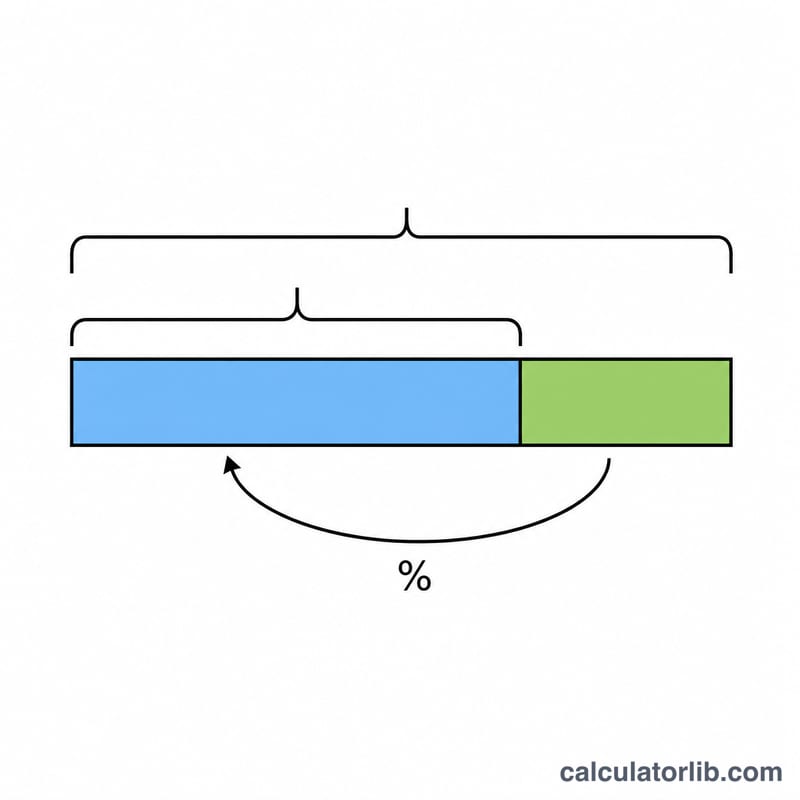
$$\text{Markup \%} = \frac{\text{Price} - \text{Cost}}{\text{Cost}} \times 100$$First subtract the cost from the price to get the profit. Then divide that profit by the cost and multiply by 100 to convert it to a percentage. Note that markup is based on cost, while margin is based on the selling price — the two are related but not the same number.
Worked Example
Suppose a store buys a jacket for $80 and sells it for $100. The profit is \(\$100 - \$80 = \$20\). The markup is $$(\$20 \div \$80) \times 100 = 25\%.$$ By comparison, the profit margin is \((\$20 \div \$100) \times 100 = 20\%\).
FAQ
Is markup the same as margin? No. Markup is profit divided by cost; margin is profit divided by selling price. Markup is always higher than margin for the same product.
Can markup be over 100%? Yes. If you sell an item for more than double its cost, the markup exceeds 100%. For example, a $50 cost sold at $150 has a 200% markup.
What if cost is zero? Markup percentage is undefined when cost is zero because you cannot divide by zero, so the calculator returns 0 in that case.