
What Is Osmolarity?
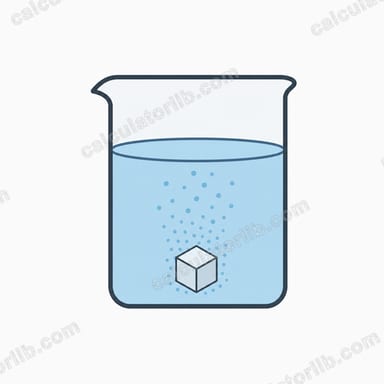
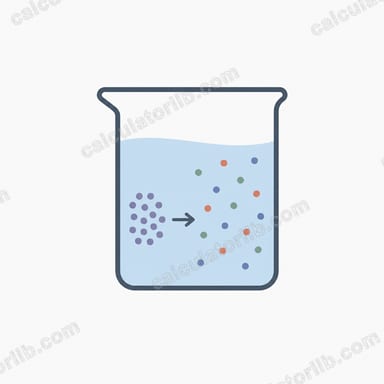
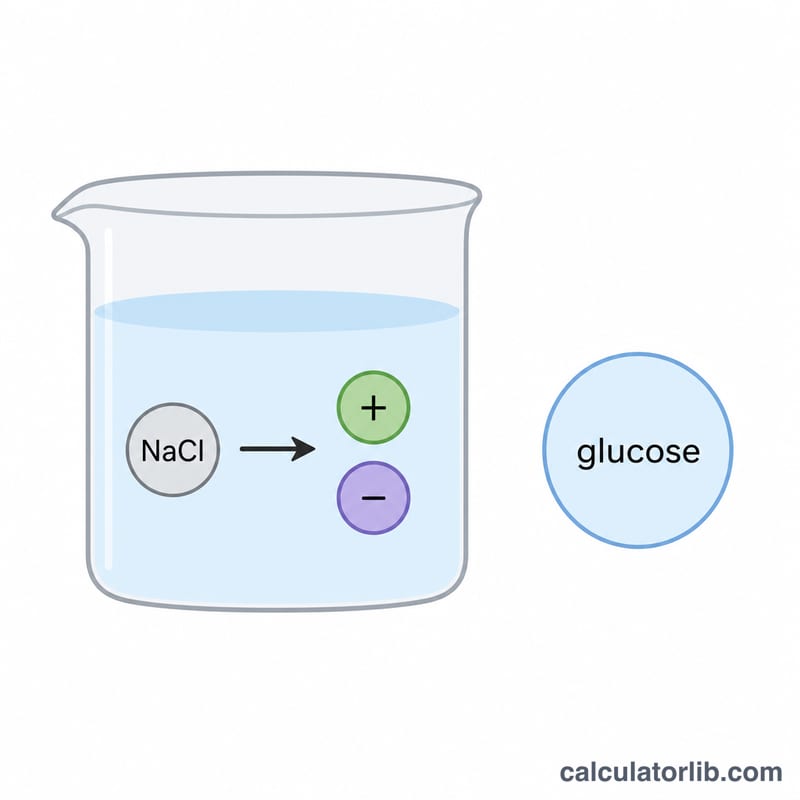
Osmolarity is a measure of the total concentration of solute particles in a solution, expressed in osmoles per litre (Osmol/L). Unlike molarity, which counts molecules of solute, osmolarity counts the individual dissociated particles. A salt like NaCl splits into two ions (Na⁺ and Cl⁻) in water, so its osmolarity is twice its molarity. This calculator multiplies the solute molarity by the van't Hoff factor to give osmolarity in both Osmol/L and mOsmol/L.
How to Use the Calculator
Enter the molar concentration of your solute in mol/L, then enter the van't Hoff factor \(i\) — the number of particles each formula unit produces when it dissolves. Use \(i = 1\) for non-dissociating molecules such as glucose, \(i = 2\) for NaCl or KCl, and \(i = 3\) for CaCl₂ or Na₂SO₄. The result updates instantly.
The Formula Explained
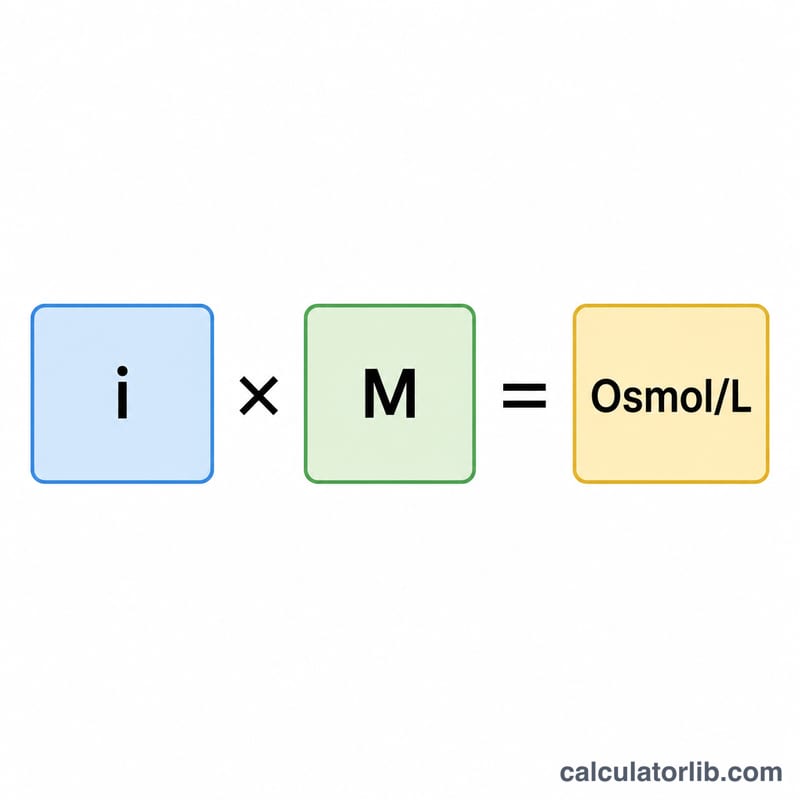
The governing equation is $$\text{Osmolarity} = i \times M$$ Here \(M\) is molarity (mol/L) and \(i\) is the dimensionless number of dissociated particles. For a mixture of solutes, the total osmolarity is the sum of \(i \times M\) for each component. To convert to milliosmoles, multiply by 1000.
Worked Example
Consider a 0.15 mol/L NaCl solution (normal saline approximation). NaCl dissociates into 2 ions, so \(i = 2\). $$\text{Osmolarity} = 2 \times 0.15 = 0.30 \text{ Osmol/L}$$ which equals 300 mOsmol/L — close to the physiological value of human plasma.
FAQ
What is the difference between osmolarity and osmolality? Osmolarity is per litre of solution; osmolality is per kilogram of solvent. They are nearly equal for dilute aqueous solutions.
What van't Hoff factor should I use? Use the number of ions a compound dissociates into. Real factors are slightly lower than ideal at high concentrations due to ion pairing.
Can I use this for mixtures? Yes — calculate each solute separately and add the osmolarity values together.