
What is the Rectangular Weir Discharge Calculator?
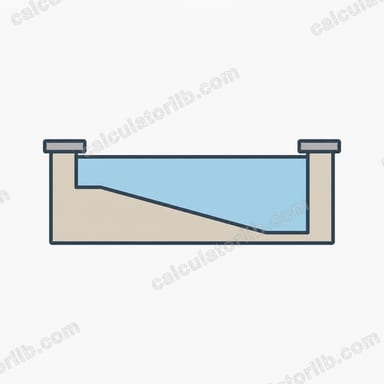
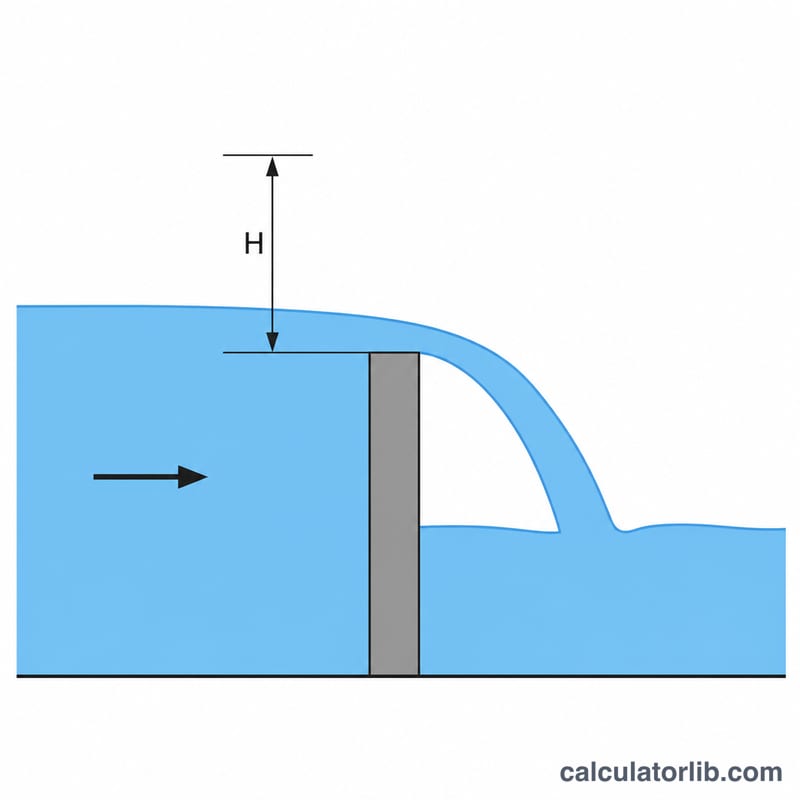
A rectangular weir is a notch of rectangular shape cut into a wall across an open channel, used to measure or control the flow of water. By measuring only the head (the height of water above the crest), you can determine the discharge with good accuracy. This calculator applies the classic weir equation to convert head, crest width and a discharge coefficient into a flow rate. It is a universal hydraulics tool and is not specific to any country.
How to Use It
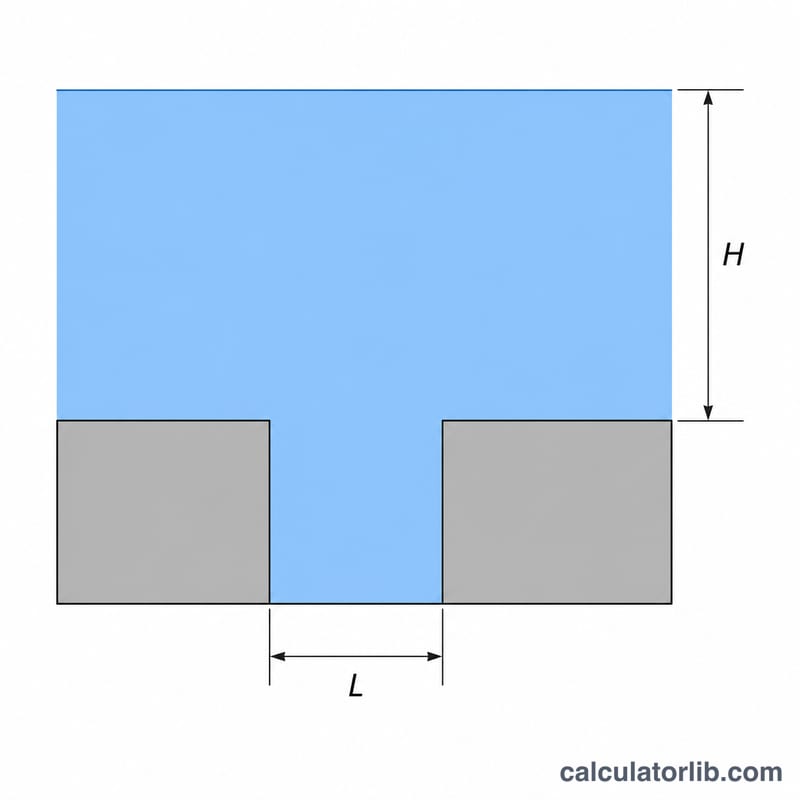
Enter the discharge coefficient (Cd), typically around 0.60–0.62 for a sharp-crested weir; the crest width L in metres; the head H over the crest in metres; and the gravitational acceleration g (9.81 m/s² by default). The calculator returns the discharge in both cubic metres per second and litres per second.
The Formula Explained
The governing equation is $$Q = \frac{2}{3} \, \text{C}_d \cdot \text{L} \cdot \sqrt{2 \, \text{g}} \cdot \text{H}^{1.5}$$. The factor \(\frac{2}{3}\) arises from integrating the velocity profile over the depth of flow assuming a triangular velocity distribution. The \(\sqrt{2\text{g}}\) term comes from Torricelli theorem relating velocity head to discharge velocity. Discharge grows with the \(\frac{3}{2}\) power of head, so small increases in water level produce large increases in flow.
Worked Example
For Cd = 0.62, L = 1.0 m, H = 0.3 m and g = 9.81 m/s²: \(\sqrt{2 \cdot 9.81} = 4.429\), \(\text{H}^{1.5} = 0.1643\), so $$Q = 0.6667 \times 0.62 \times 1.0 \times 4.429 \times 0.1643 \approx 0.3008 \ \text{m}^3/\text{s}$$ or about 300.8 L/s.
FAQ
What value of Cd should I use? For a sharp-crested, fully ventilated rectangular weir, Cd is usually 0.60–0.62. Broad-crested weirs have lower effective coefficients.
Does this account for end contractions? No — it uses the suppressed (full-width) form. For a contracted weir, reduce the effective length L by about 0.1H per contraction.
What units does it use? Metres for length and head, m/s² for gravity, giving discharge in m³/s (and litres/second).