
What is the RC Discharge Calculator?
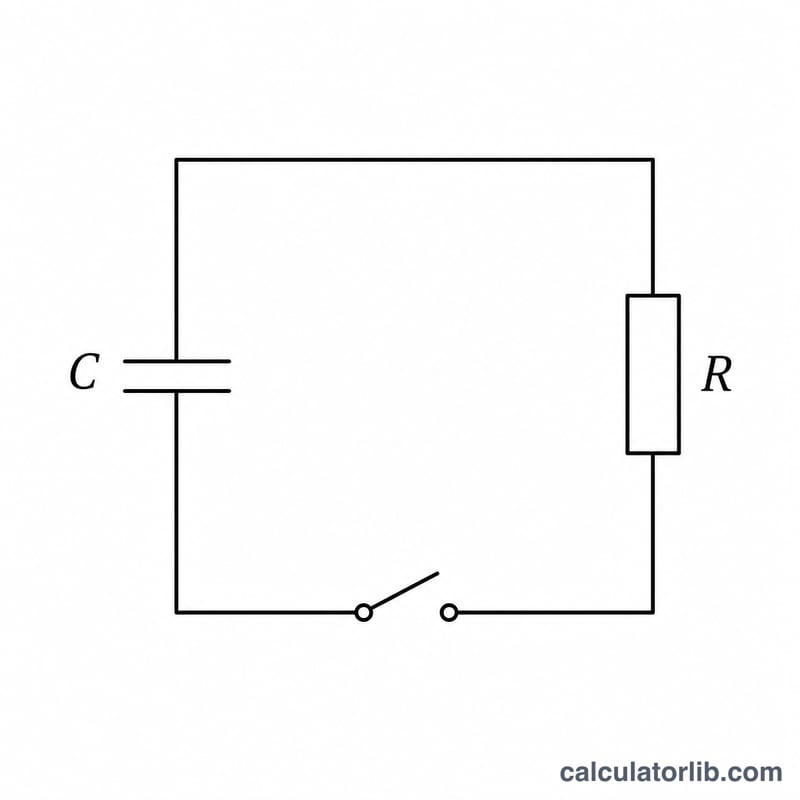
This calculator models how the voltage across a capacitor decays as it discharges through a resistor in a series RC circuit. Given the initial voltage \(V_0\), resistance \(R\), capacitance \(C\) and elapsed time \(t\), it returns the instantaneous voltage \(V(t)\), the time constant \(\tau\), the percentage of the initial charge remaining, and the resulting discharge current. It applies universally to any linear RC circuit.
How to use it
Enter the starting voltage in volts, the resistance in ohms, and the capacitance in microfarads (µF). Then enter the time in seconds at which you want the voltage. The tool converts µF to farads internally and evaluates the exponential decay equation.
The formula explained
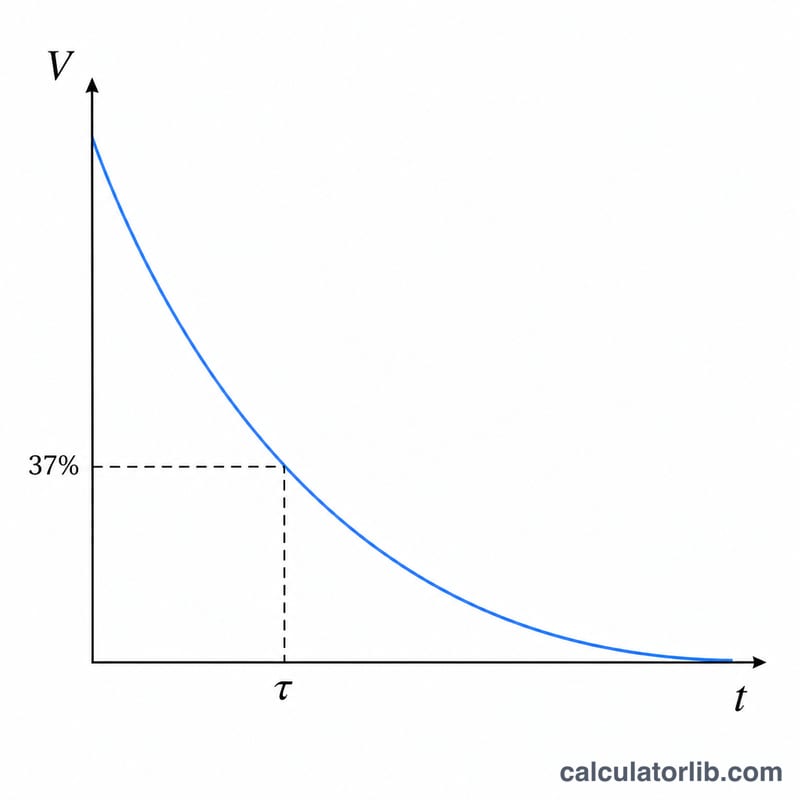
The governing equation is $$V(t) = V_0 \, e^{-t / (R\,C)}$$ The product \(RC\) is the time constant \(\tau\), measured in seconds. After one time constant the voltage drops to \(e^{-1} \approx 36.8\%\) of \(V_0\); after five time constants (\(5\tau\)) the capacitor is considered fully discharged (under 1% remaining). The current at any moment equals \(V(t)\) divided by \(R\).
Worked example
Suppose \(V_0 = 10\,\text{V}\), \(R = 1000\,\Omega\) and \(C = 100\,\text{µF}\), and we want the voltage after \(t = 0.1\,\text{s}\). The time constant $$\tau = 1000 \times 100 \times 10^{-6} = 0.1\,\text{s}.$$ Then \(t/\tau = 1\), so $$V(t) = 10 \times e^{-1} = 10 \times 0.3679 \approx 3.679\,\text{V}$$ — about 36.8% remaining, with a current of 3.679 mA.
FAQ
Why microfarads? Most real capacitors are rated in µF or nF; the calculator converts µF to farads (\(\times 10^{-6}\)) before computing.
How long until fully discharged? Practically, after \(5\tau\) the capacitor retains less than 1% of its charge and is treated as discharged.
Does this work for charging? No — this models discharge. Charging follows \(V(t) = V_0(1 - e^{-t / (R\,C)})\).