
What this calculator does
The Capacitor Size Calculator helps you pick the right capacitance for two common engineering situations: storing a known electric charge at a given voltage, and smoothing the ripple voltage in a DC power supply. Enter your values and the tool returns the required capacitance in farads, microfarads and nanofarads.
How to use it
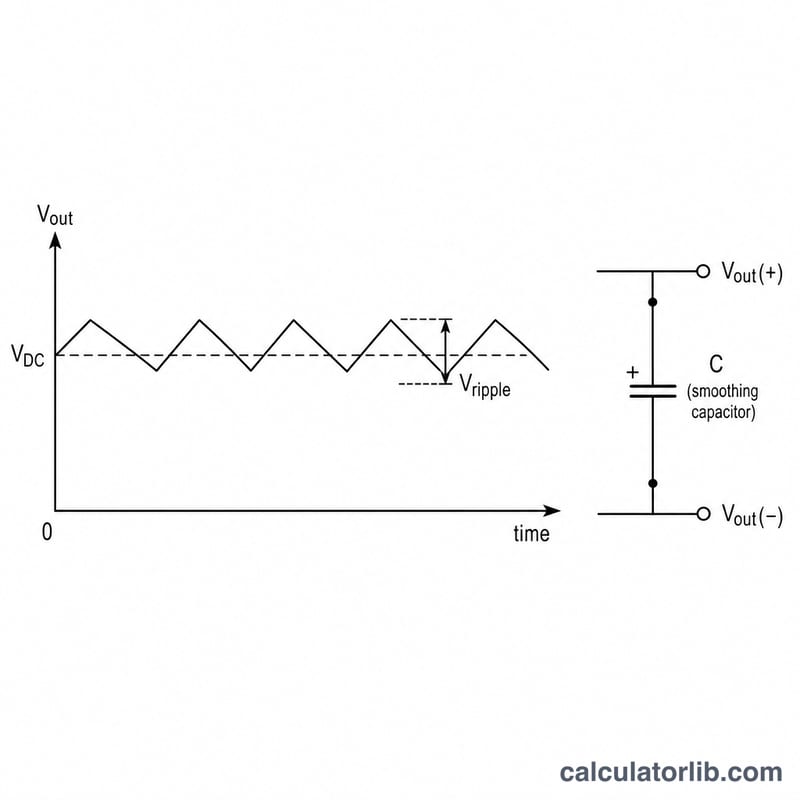
Choose a mode. In Charge & Voltage mode, enter the charge Q in coulombs and the voltage V in volts. In Ripple Smoothing mode, enter the load current I in amps, the ripple frequency f in hertz (100 Hz for a full-wave rectifier on 50 Hz mains, 120 Hz on 60 Hz mains), and the maximum ripple voltage you can tolerate. Read the answer from the highlighted box and the conversion table below it.
The formula explained
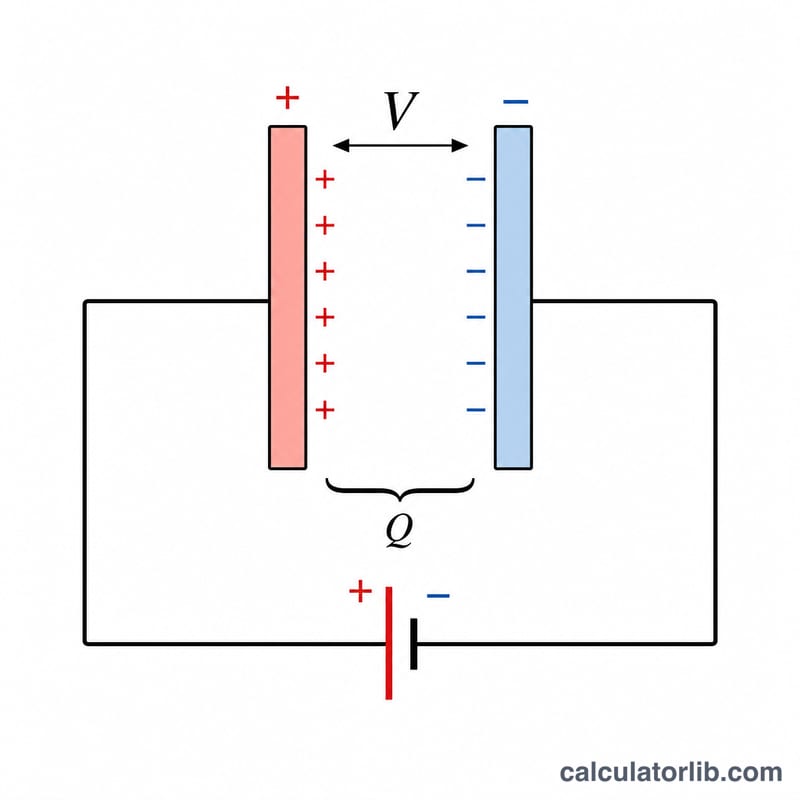
Capacitance is defined by $$C = \frac{Q}{V}$$ the charge a capacitor holds divided by the voltage across it, measured in farads. For a smoothing capacitor we use the approximation $$C = \frac{I}{f \times V_{ripple}}$$ which comes from the fact that the capacitor must supply the load current I for roughly one ripple period (\(1/f\)) while the voltage is allowed to droop by \(V_{ripple}\).
Worked example
A 1 A load on a full-wave rectified 50 Hz supply (\(f = 100\) Hz) with 1 V of allowed ripple needs $$C = \frac{1}{100 \times 1} = 0.01 \text{ F} = 10{,}000 \text{ µF}$$ Choosing a slightly larger standard value gives margin for tolerance and aging.
FAQ
What ripple frequency should I use? A full-wave bridge doubles the mains frequency, so use 100 Hz for 50 Hz mains and 120 Hz for 60 Hz mains. A half-wave rectifier uses the mains frequency itself.
Why is the answer so large? Smoothing capacitors are big because they must deliver real current for milliseconds. Tens of thousands of microfarads is normal for amp-level loads.
What voltage rating do I need? Choose a capacitor rated well above your peak DC voltage — at least 1.25× to 1.5× the working voltage for reliability.