
What is the Breaker Size Calculator?
This tool estimates the minimum circuit breaker amperage needed to safely supply an electrical load. It is based on US electrical practice (NEC), where a continuous load — one expected to run for three hours or more — must be served by a breaker rated for at least 125% of the load current (the "80% rule"). Always confirm sizing with a licensed electrician and your local code.
How to use it
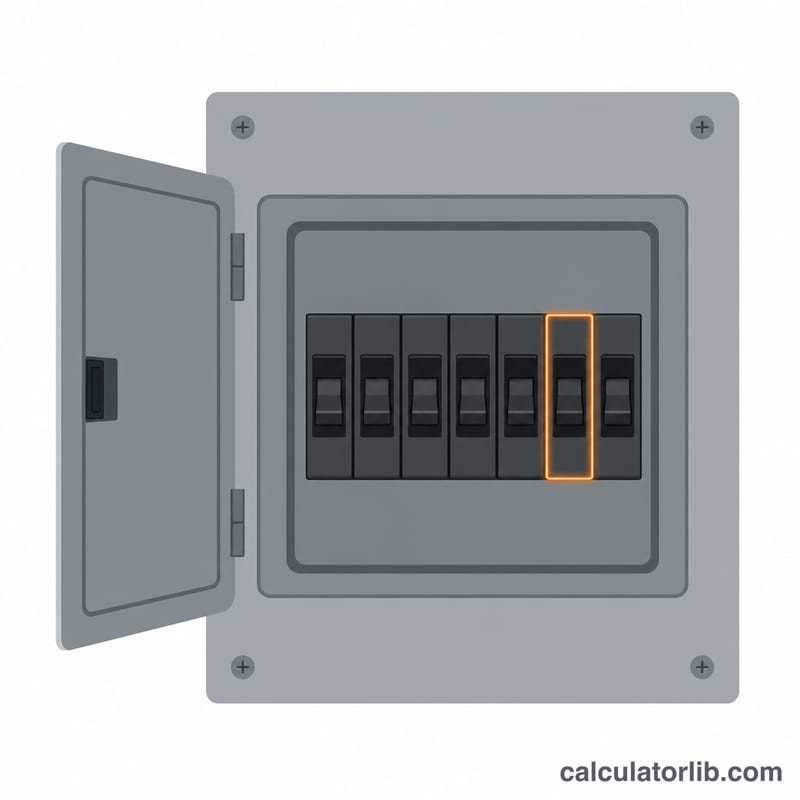
Enter the load power in watts, the supply voltage (typically 120 V or 240 V in the US), and choose whether the load is continuous or non-continuous. The calculator returns the load current and the recommended breaker amperage. Round the result up to the next standard breaker size (15, 20, 30, 40, 50 A, etc.).
The formula explained
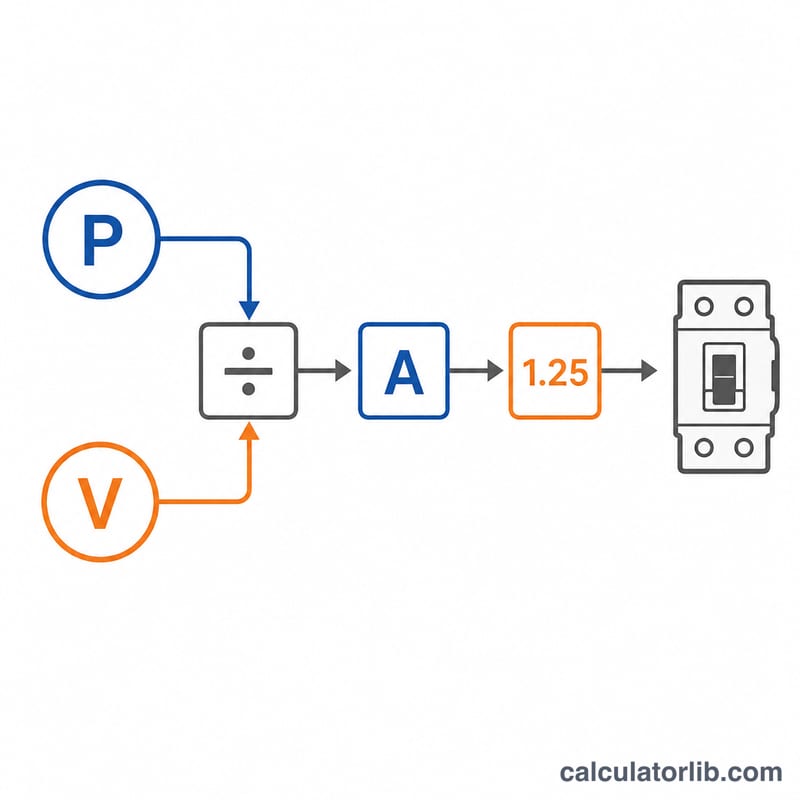
Current is found from Ohm's power relationship, I = P ÷ V. For a continuous load that current is multiplied by 1.25 to give headroom and avoid nuisance trips: Breaker = (P ÷ V) × 1.25. For a non-continuous load the factor is 1.00.
Worked example
A 1,500 W continuous heater on a 120 V circuit draws 1500 ÷ 120 = 12.5 A. Applying the safety factor: 12.5 × 1.25 = 15.625 A. You would install the next standard size up, a 20 A breaker (since the load exceeds a 15 A breaker's 80% limit of 12 A).
Standard Breaker Sizes and Their Continuous-Load Limits
In the US, the National Electrical Code (NEC) requires that a circuit breaker (and the conductors it protects) be sized so that a continuous load — one expected to run for three hours or more — does not exceed 80% of the breaker's rating. This is the practical equivalent of the 1.25 sizing multiplier: dividing by 0.80 and multiplying by 1.25 give the same result. The table below lists common standard breaker ratings from NEC 240.6(A) and the maximum continuous load each can legally carry.
| Breaker Rating (A) | Continuous-Load Limit at 80% (A) | Max Continuous Load (W) @ 120 V | Max Continuous Load (W) @ 240 V |
|---|---|---|---|
| 15 | 12 | 1,440 | 2,880 |
| 20 | 16 | 1,920 | 3,840 |
| 25 | 20 | 2,400 | 4,800 |
| 30 | 24 | 2,880 | 5,760 |
| 40 | 32 | 3,840 | 7,680 |
| 50 | 40 | 4,800 | 9,600 |
| 60 | 48 | 5,760 | 11,520 |
| 70 | 56 | 6,720 | 13,440 |
| 80 | 64 | 7,680 | 15,360 |
| 90 | 72 | 8,640 | 17,280 |
| 100 | 80 | 9,600 | 19,200 |
For a non-continuous load (running less than three hours), the breaker may be loaded up to its full rating, so the limits in the first two columns would be equal. Always verify with local code and a licensed electrician — this is general reference information, not professional design advice.
How to Calculate Breaker Size by Hand
The breaker size comes directly from the load power, the supply voltage, and whether the load is continuous. The governing relationship is:
$$\text{Breaker} = \frac{\text{Load Power (W)}}{\text{Voltage (V)}} \times \text{Load Factor}$$- Divide watts by volts to find the load current. For a 1,500 W heater on a 120 V circuit:
\(I = \dfrac{1500}{120} = 12.5\text{ A}\). You can confirm this conversion with an 12.5 A watts-to-amps check. - Apply the load factor. A space heater runs more than three hours, so it is a continuous load and gets the 1.25 multiplier:
\(12.5 \times 1.25 = 15.625\text{ A}\). For a non-continuous load you would multiply by 1.00 and keep 12.5 A. - Round up to the next standard breaker size. The required current of 15.625 A exceeds a 15 A breaker, so you must move up to the next standard rating: a 20 A breaker. Never round down — the breaker must be at least as large as the calculated value.
Second example (240 V, continuous): A 4,000 W water heater on 240 V gives \(I = \dfrac{4000}{240} = 16.67\text{ A}\); applying 1.25 yields \(16.67 \times 1.25 = 20.8\text{ A}\), which rounds up to a 25 A breaker. The conductors must also be rated for at least the breaker size. This is general guidance only; always confirm final sizing with a qualified electrician and current code.
FAQ
Why multiply by 1.25? Breakers should carry no more than 80% of their rating continuously; 1 ÷ 0.8 = 1.25, so sizing at 125% of load satisfies the rule.
Should I round up? Yes — always choose the next standard breaker size at or above the calculated value, never below.
Does this size the wire? No. Wire/conductor sizing is a separate step that must also satisfy ampacity and code; this tool only estimates breaker amperage.