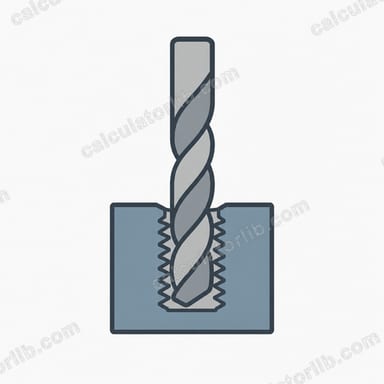

What Is a Tap Drill Size Calculator?
Before you can cut internal threads with a tap, you must first drill a hole of exactly the right diameter. Too small and the tap binds or breaks; too large and the threads are shallow and weak. This calculator returns the recommended drill diameter for both imperial (inch/TPI) and metric (mm pitch) thread standards based on your desired percentage of thread engagement.
How to Use It
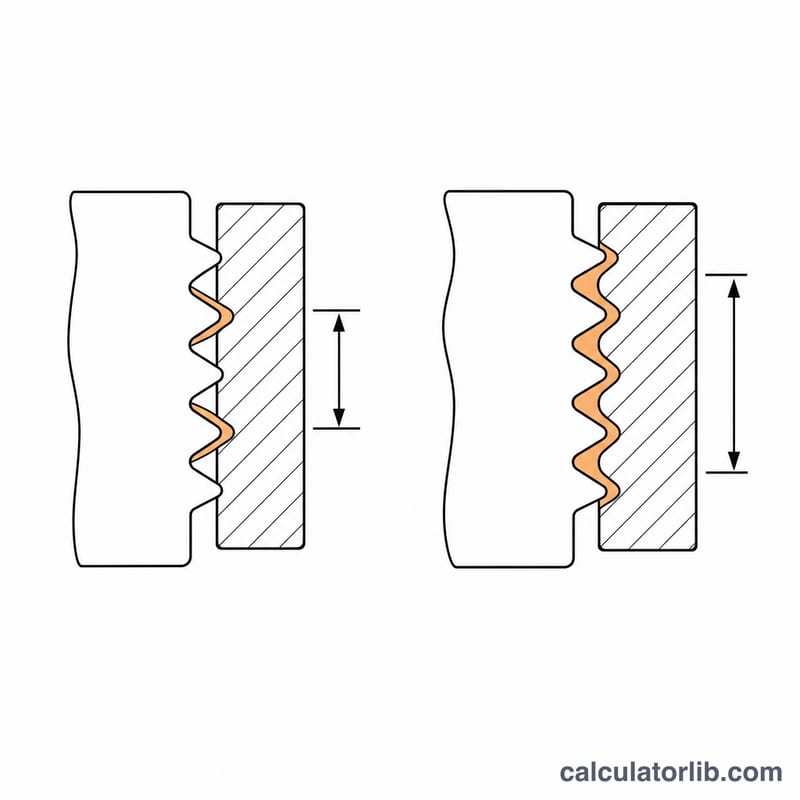
Select your thread system. For imperial threads, enter the major diameter in inches and the threads per inch (TPI). For metric threads, enter the major diameter and the thread pitch, both in millimeters. Then set the thread engagement percentage — 75% is the standard machining choice, balancing strength against tapping torque. Lower percentages (50–65%) reduce the chance of breaking a tap in hard materials.
The Formula Explained
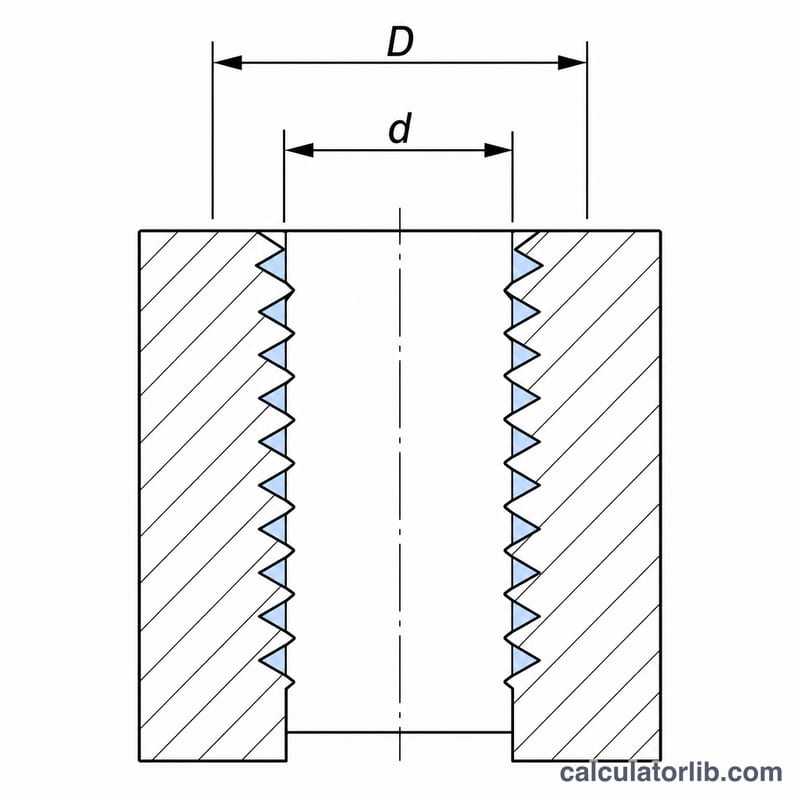
For imperial threads the depth of thread is approximated as \(0.6495 / TPI\). A 75% engagement removes 75% of that depth from each side, giving the constant 0.0130 in the working equation:
$$D_{drill} = D_{major} - \left( 0.0130 \times \frac{\%\,thread}{TPI} \right)$$
For metric threads, the single-side thread depth is roughly the pitch, so: $$D_{drill} = D - \left( pitch \times \frac{\%}{100} \right)$$
Worked Example
For a 1/4-20 UNC screw (major diameter 0.25", 20 TPI) at 75% engagement: $$D_{drill} = 0.25 - \left( 0.0130 \times \frac{75}{20} \right) = 0.25 - 0.04875 = \mathbf{0.20125\text{"}}$$ The nearest standard drill is a #7 (0.201"), which is exactly the published tap drill for 1/4-20.
FAQ
Why 75% thread engagement? It delivers roughly 95% of the holding strength of a full thread while dramatically lowering tapping torque and tap breakage.
Can I round to a standard drill bit? Yes — pick the closest available drill at or slightly above the computed size.
Does this work for soft materials? Use higher engagement (around 75%) for steel and lower (around 60%) for tough alloys to protect your tap.