What is the Intermittent Fasting Window Calculator?
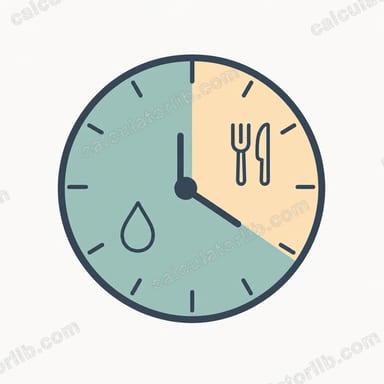
This tool turns a popular intermittent fasting (IF) protocol into exact clock times. Choose a schedule such as 16:8, 18:6, 20:4 or OMAD (23:1), tell it when you want to start eating, and it instantly shows when your eating window closes, how long you'll fast, and when the next eating window opens.
How to use it
Pick your protocol from the dropdown. The first number is the fasting hours, the second is the eating hours (they always sum to 24). Then enter the hour and minute you plan to take your first bite. The calculator does the rest using a 24-hour clock, wrapping past midnight automatically.
The formula explained
If your protocol allows \(h_{eat}\) eating hours, the eating window ends at \(\text{start} + h_{eat}\). The fast then lasts the remaining \(24 - h_{eat}\) hours, so the next eating window opens at \(\text{eating end} + (24 - h_{eat})\). Both end times are taken modulo 24 so an 8 PM finish correctly rolls into the next day.
$$t_{eatEnd} = (t_{start} + h_{eat}) \bmod 24$$
$$t_{fastEnd} = (t_{eatEnd} + (24 - h_{eat})) \bmod 24$$

Worked example
On a 16:8 plan starting at 12:00, the eating window runs 8 hours and ends at 20:00. The 16-hour fast then runs from 20:00 to 04:00... wait — adding 16 hours to 20:00 gives 12:00 the next day, confirming an 8-hour eating window opening again at noon. The fast period is reported as 16 hours.
$$\text{eating end} = 12{:}00 + 8 = 20{:}00$$
$$\text{fast end} = (20{:}00 + 16) \bmod 24 = 12{:}00$$

Protocol Comparison: 16:8, 18:6, 20:4 and OMAD
Protocols are written as fasting hours : eating hours. The table assumes an eating window that opens at 12:00 (noon) and shows when it closes. The calculator also offers a 14-hour fast (14:10).
| Protocol | Fasting hours | Eating hours | Eating window (start 12:00) | Eating ends | Fast length |
|---|---|---|---|---|---|
| 16:8 | 16 | 8 | 12:00 to 20:00 | 20:00 | 16 hours |
| 18:6 | 18 | 6 | 12:00 to 18:00 | 18:00 | 18 hours |
| 20:4 | 20 | 4 | 12:00 to 16:00 | 16:00 | 20 hours |
| OMAD (23:1) | 23 | 1 | 12:00 to 13:00 | 13:00 | 23 hours |
Because the fasting and eating hours always add up to 24, the schedule repeats daily: the next eating window opens at the same clock time (12:00 in this example) the following day, right when the fast ends.
Key Terms in Intermittent Fasting
- Intermittent fasting (IF): an eating pattern that alternates set periods of eating with set periods of not eating (only water, or other non-caloric drinks depending on the approach).
- Protocol notation (fast:eat): two numbers that add up to 24. For example, 16:8 means 16 hours of fasting and 8 hours of eating per day.
- Eating window: the daily block of hours during which food is consumed.
- Fasting window: the remaining hours of the 24-hour day outside the eating window.
- OMAD (23:1): “one meal a day”, usually treated as a 23-hour fast with roughly a 1-hour eating window.
- Time-restricted eating: a form of IF that limits food intake to a fixed number of hours each day, without necessarily specifying what or how much is eaten.
- Modulo 24 clock wrap-around: the calculator finds the end of the eating window with \(\text{Eating Ends} = (\text{Start} + (24 - F)) \bmod 24\), where \(F\) is the fasting hours. Taking the remainder after dividing by 24 keeps the result on a 24-hour clock. For example, starting at 18:00 with \(F = 16\): \(18 + 8 = 26\), and \(26 \bmod 24 = 2\), so eating ends at 02:00 the next day.
Interpreting Your Fasting and Eating Windows
- Longer fast, shorter window: since the two windows total 24 hours, each extra hour of fasting removes one hour from the eating window. A 20:4 schedule leaves 4 hours for eating, while 16:8 leaves 8.
- The schedule repeats daily: the eating window opens and closes at the same clock times each day. Shifting the start time shifts the whole schedule by the same amount, and times past midnight roll over to the next day.
- Timing only: this calculator handles clock times. It says nothing about calories, nutrients, meal composition or hydration.
- Evidence is mixed: research on intermittent fasting and outcomes such as weight, blood markers or energy is mixed, and results differ between individuals. A schedule that suits one person may not suit another.
- Check with a clinician when relevant: people who are pregnant or breastfeeding, have diabetes or take medication affected by meal timing, or have a history of eating disorders are commonly advised to speak with a healthcare professional before fasting.
This is general information, not medical or professional advice.
FAQ
Does the next eating window always equal my start time? Yes — because eat hours plus fast hours always equal 24, the cycle repeats at the same clock time each day.
What is OMAD? One Meal A Day, modeled here as a 23-hour fast with a 1-hour eating window.
Is this medical advice? No. Intermittent fasting may not suit everyone; consult a healthcare professional before starting.