
What this calculator does
The IoT Sensor Battery Life Calculator estimates how long a battery-powered device — a wireless sensor, beacon, GPS tracker, or any low-power microcontroller node — will operate before its battery is depleted. It works from three simple inputs: the battery capacity in milliamp-hours (mAh), the device's average current draw in milliamps (mA), and a usable-capacity derating percentage to account for the fact that batteries rarely deliver 100% of their rated capacity.
How to use it
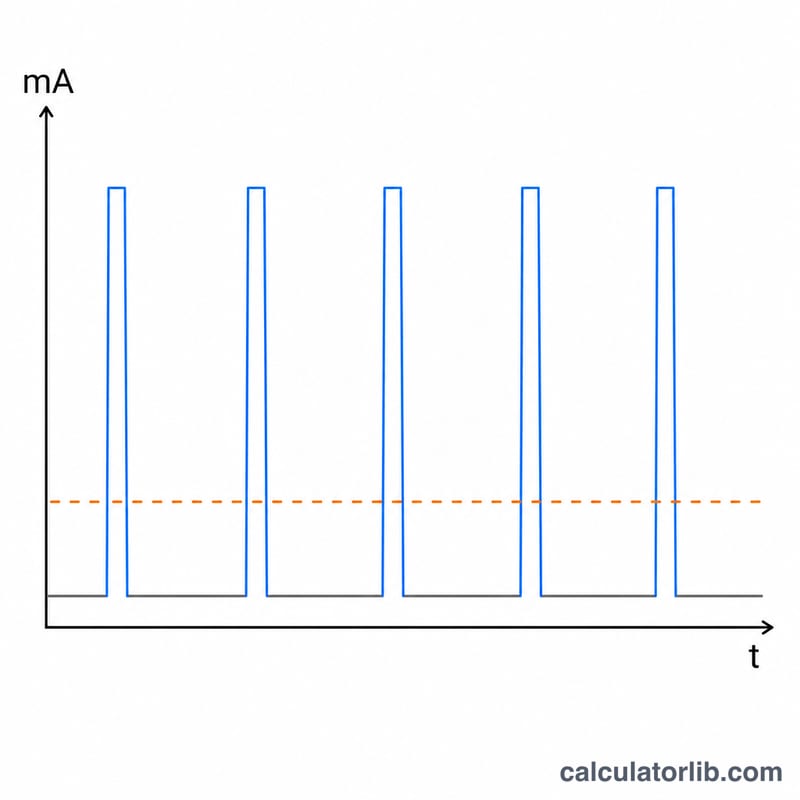
Enter your battery capacity (for example a CR2032 coin cell is roughly 220 mAh, a AA alkaline around 2000–2500 mAh). Enter the device's average current — this is the time-weighted average over a full duty cycle, blending deep-sleep current with the short bursts of radio transmission and sensing. Finally set a derating factor (80–90% is common) to allow for self-discharge, temperature, and voltage cutoff. The result shows runtime in hours, days, and years.
The formula explained
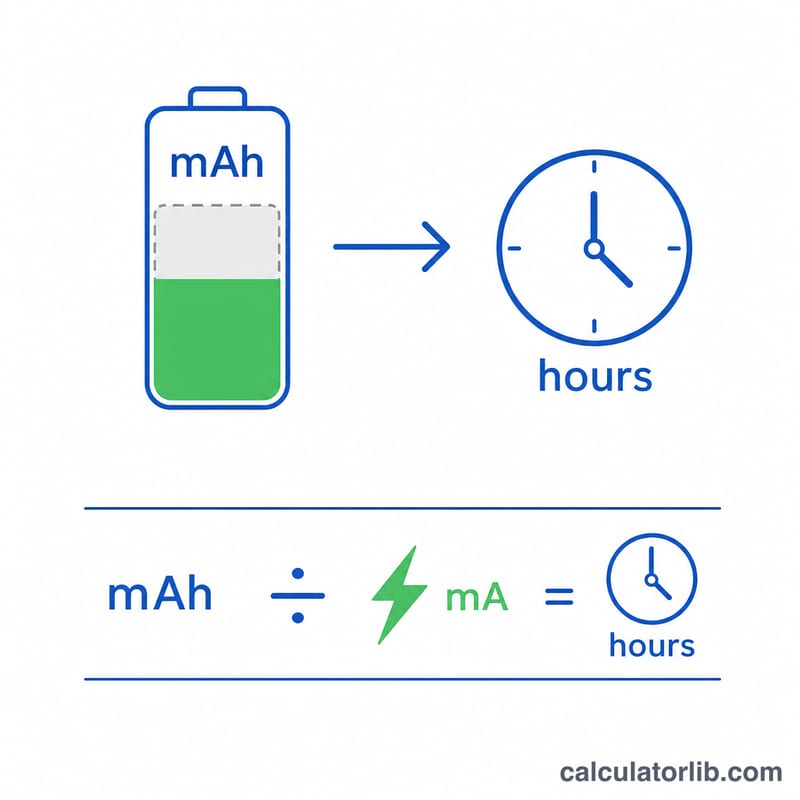
The core relationship is simply Life (hours) = usable capacity (mAh) ÷ average current (mA), because mAh ÷ mA cancels to hours. Usable capacity is the rated capacity multiplied by the derating fraction. Dividing the hours by 24 gives days and by 8760 gives years.
$$\text{Life}_{hours} = \dfrac{\text{Capacity}_{mAh} \times (\text{Derating}/100)}{\text{Current}_{mA}}$$
$$\text{Life}_{years} = \dfrac{\text{Life}_{hours}}{8760}$$
Worked example
A sensor uses a 2000 mAh battery and draws an average of 0.05 mA, with 85% usable capacity. Usable capacity = \(2000 \times 0.85 = 1700\) mAh. Life = \(1700 \div 0.05 = 34{,}000\) hours ≈ 1,416.7 days ≈ 3.88 years.
Typical Battery Capacities and Sensor Current Draws
Battery life depends on two numbers: how much charge the battery holds (capacity in mAh) and how much current the device draws on average (mA or µA). The tables below list representative values for common cells and IoT operating modes. Use the average current — including sleep periods between transmissions — not the peak transmit current.
Common Battery Capacities
| Battery | Nominal Voltage | Typical Capacity |
|---|---|---|
| CR2032 coin cell | 3.0 V | ~220 mAh |
| AAA alkaline | 1.5 V | ~1000 mAh |
| AA alkaline | 1.5 V | ~2500 mAh |
| AA lithium (Li-FeS₂) | 1.5 V | ~3000 mAh |
| 18650 Li-ion | 3.7 V | ~3000 mAh |
Typical IoT Current Draws
| Operating Mode | Typical Average Current |
|---|---|
| Deep sleep (MCU + RTC) | 5–15 µA |
| BLE beacon (averaged) | 20–50 µA |
| LoRaWAN sensor (averaged) | 30–100 µA |
| Wi-Fi sensor (averaged) | 1–5 mA |
These capacities are nominal: real usable capacity is lower at high current, low temperature, or near end of voltage cutoff, which is why a derating factor is applied in the runtime formula.
Current and Capacity Unit Conversions
Datasheets mix amps, milliamps and microamps, so convert everything to a single unit before dividing. This calculator expects capacity in mAh and current in mA.
| Quantity | Conversion |
|---|---|
| Current | 1 A = 1000 mA |
| Current | 1 mA = 1000 µA |
| Current | 1 A = 1,000,000 µA |
| Capacity | 1 Ah = 1000 mAh |
Microamps to Milliamps Examples
| Microamps (µA) | Milliamps (mA) |
|---|---|
| 10 µA | 0.01 mA |
| 30 µA | 0.03 mA |
| 50 µA | 0.05 mA |
| 100 µA | 0.10 mA |
| 500 µA | 0.50 mA |
| 1000 µA | 1.00 mA |
To convert microamps to milliamps, divide by 1000 (move the decimal three places left). For example, a 50 µA average draw is entered as 0.05 in the current field.
FAQ
What is "average current"? It is the mean current over a complete cycle. If a device sleeps at 10 µA and wakes for 2 seconds at 20 mA every 5 minutes, you must compute the weighted average over those 5 minutes.
Why a derating factor? Real batteries lose capacity to self-discharge, cold temperatures, and an effective voltage cutoff before they are fully empty, so usable capacity is below the printed rating.
Is the result exact? No — it is a planning estimate. Actual life depends on temperature, peak currents, regulator efficiency, and battery chemistry. Always add margin.