What This Calculator Does
Rimadyl is a common brand name for carprofen, a non-steroidal anti-inflammatory drug (NSAID) prescribed for dogs to control pain and inflammation from osteoarthritis, surgery, and other conditions. This calculator estimates the total daily dose and the per-dose amount based on your dog's body weight, using the widely cited label rate of 4.4 mg per kilogram of body weight per day. It is an educational tool, not a substitute for veterinary advice.
How to Use It
Enter your dog's weight and choose the unit (kilograms or pounds). The default dose rate of 4.4 mg/kg/day matches the standard carprofen labeling; you can adjust it if your veterinarian prescribed a different rate. Pick whether the medication is given once or twice daily. The calculator returns the total milligrams per day and the milligrams to give at each dose.
If you enter a rate above the Rimadyl (carprofen) FDA label dose of 4.4 mg/kg once daily or 2.2 mg/kg twice daily, the calculator caps it and uses 4.4 mg/kg/day, and the result shows that the dose was capped at the label maximum.
The Formula Explained
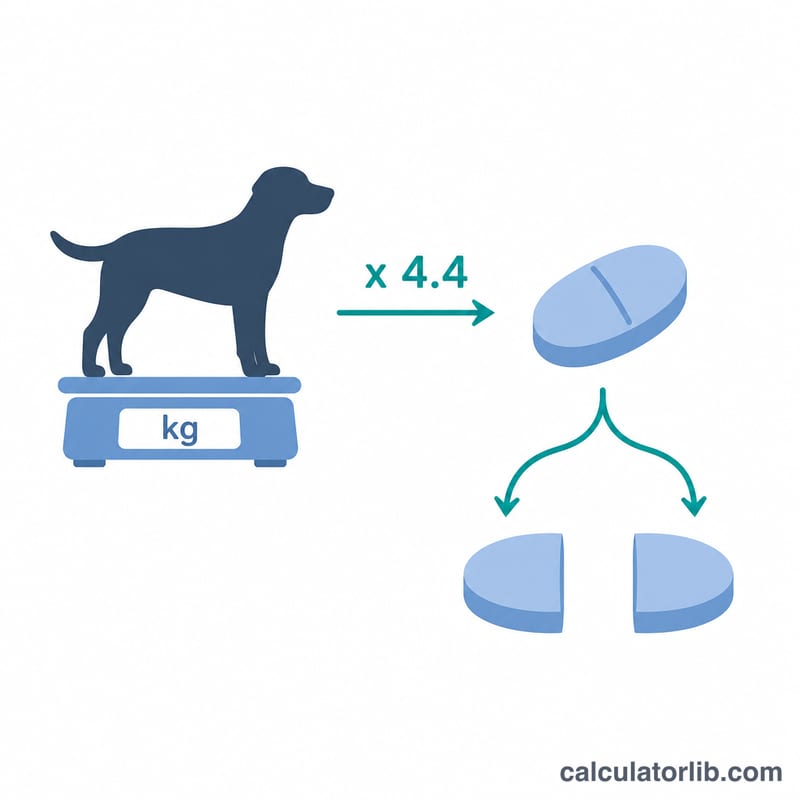
First, the weight is converted to kilograms if needed (\(1\ \text{lb} = 0.45359237\ \text{kg}\)). The total daily dose is then:
$$\text{Daily Dose (mg)} = 4.4\ \text{mg/kg/day} \times \text{weight in kg}$$To find each dose, the daily total is divided by the number of doses per day:
$$\text{Per Dose} = \frac{\text{Daily Dose}}{\text{Doses/day}}$$When given twice daily, each dose is half the daily amount (equivalent to about \(2.2\ \text{mg/kg}\) per dose).
Worked Example
Consider a 20 kg dog dosed twice daily. The total daily dose is:
$$4.4 \times 20 = 88\ \text{mg/day}$$Split across two doses, each dose is:
$$88 \div 2 = 44\ \text{mg}$$So this dog would receive 44 mg of carprofen in the morning and 44 mg in the evening.
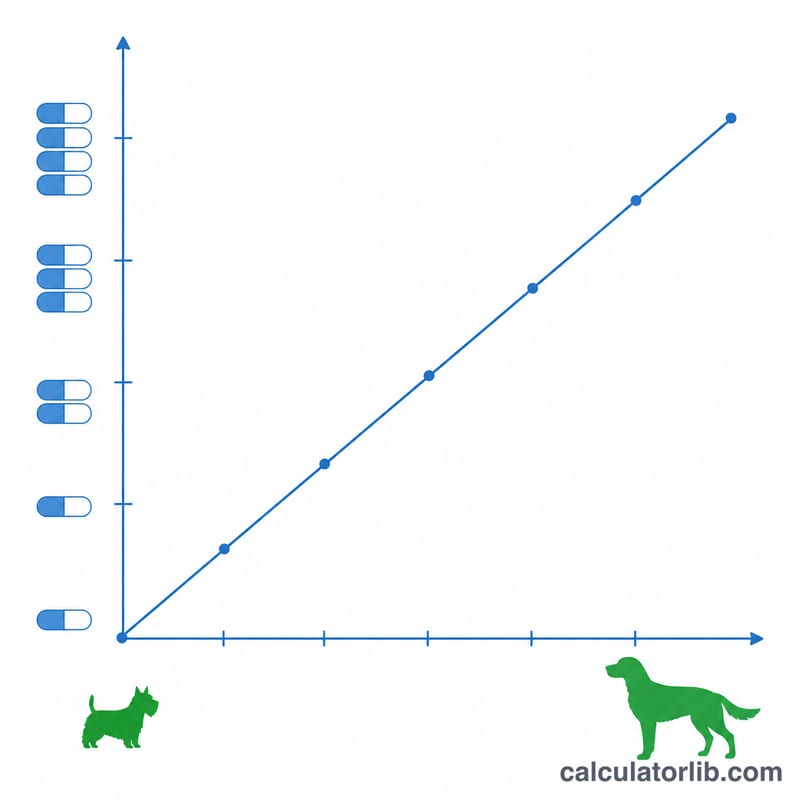
Carprofen Daily Dose by Dog Weight
The table applies the label rate of 4.4 mg/kg/day (the same as 2 mg/lb/day). That daily total can be given once a day or split into two doses of 2.2 mg/kg each. Values are label-based arithmetic estimates, not a prescription.
| Dog weight | Total daily dose (mg) | Once daily: per dose (mg) | Twice daily: per dose (mg) |
|---|---|---|---|
| 5 kg (11 lb) | 22 mg | 22 mg | 11 mg |
| 10 kg (22 lb) | 44 mg | 44 mg | 22 mg |
| 20 kg (44 lb) | 88 mg | 88 mg | 44 mg |
| 30 kg (66 lb) | 132 mg | 132 mg | 66 mg |
| 40 kg (88 lb) | 176 mg | 176 mg | 88 mg |
Worked example for a 20 kg dog: \(4.4 \times 20 = 88\) mg per day. Split into two doses, \(88 \div 2 = 44\) mg per dose. Pound figures are rounded to the nearest whole pound.
Interpreting Your Result
The number shown is a label-based estimate of milligrams, calculated from body weight and the standard rate of 4.4 mg/kg/day (2.2 mg/kg twice daily). It is not a prescription and not personal medical advice for your dog.
- Matching to tablet strengths: Carprofen is commonly supplied as 25 mg, 75 mg and 100 mg caplets or chewables. A calculated dose such as 44 mg rarely matches a strength exactly, so a veterinarian decides the practical dose, such as a whole or partial tablet, and rounds appropriately.
- Your vet may differ from the label: A veterinarian may choose a different dose, frequency or treatment duration based on your dog's condition, age, other medications and test results.
- Why supervision matters: Like other NSAIDs, carprofen can cause adverse effects. These include gastrointestinal problems (vomiting, diarrhea, ulcers) and, less commonly, liver or kidney problems. Veterinary supervision and periodic monitoring, including bloodwork for longer-term use, are standard practice.
- Safety: Do not combine carprofen with other NSAIDs or corticosteroids unless your vet directs it. Contact a veterinarian promptly if your dog shows vomiting, black stools, loss of appetite, lethargy, or changes in drinking or urination.
This is general information only. Confirm every dose with your veterinarian before giving any medication.
Key Terms
- Carprofen
- A non-steroidal anti-inflammatory drug used in dogs to relieve pain and inflammation, for example from osteoarthritis or after surgery.
- Rimadyl
- A brand name for veterinary carprofen. Generic carprofen products are also available.
- NSAID
- Non-steroidal anti-inflammatory drug. NSAIDs reduce pain and inflammation by inhibiting cyclooxygenase (COX) enzymes, which can also affect the stomach lining, kidneys and liver.
- mg/kg/day
- Milligrams of drug per kilogram of body weight per 24 hours. Carprofen's label rate is 4.4 mg/kg/day.
- Total daily dose vs per-dose amount
- The total daily dose is the full amount given over 24 hours (\(4.4 \times \text{kg}\)). The per-dose amount is that total divided by the number of doses per day.
- Dosing interval
- How often a dose is given. Carprofen may be given once daily (the full daily amount) or twice daily (half the daily amount every roughly 12 hours), as directed by your veterinarian.
FAQ
Is 4.4 mg/kg accurate? 4.4 mg/kg/day is the standard label dose for carprofen in dogs, commonly split as 2.2 mg/kg twice daily. Your vet may adjust this based on your dog's health.
Can I give Rimadyl without a prescription? No. Carprofen is a prescription medication and requires veterinary supervision, including bloodwork in many cases.
Is this safe for cats? No. This calculator is for dogs only. Carprofen dosing for cats is very different and carries higher risk.