What is the Prednisone for Dogs Dosage Calculator?
Prednisone is a corticosteroid commonly prescribed for dogs to reduce inflammation, suppress an overactive immune system, and treat allergies, arthritis, autoimmune disease and certain cancers. The correct dose depends mainly on your dog's body weight and the reason for treatment. This calculator converts your dog's weight to kilograms and multiplies it by the standard mg/kg rate to estimate a daily dose range. It is an educational tool — your veterinarian sets the final dose, frequency and tapering plan.
How to use it
Enter your dog's weight, choose pounds or kilograms, and select the treatment purpose. Anti-inflammatory dosing uses 0.5–1 mg/kg per day, while immunosuppressive dosing uses 2 mg/kg per day. The calculator shows a low-to-high range plus a convenient midpoint figure. Dogs over 25 kg are dosed by body surface area instead (40–50 mg/m² per day, Merck Veterinary Manual); this calculator does not compute that dose.
The formula explained
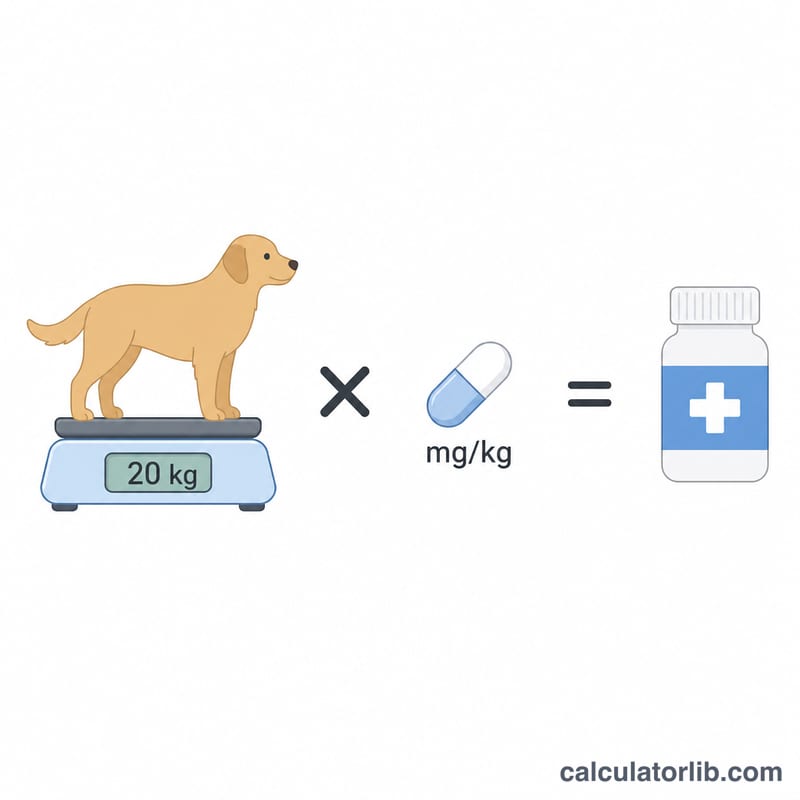
The core equation is simply
$$\text{Dose} = \text{Weight (kg)} \times \text{Rate (mg/kg)}$$Pounds are first converted to kilograms (\(1\ \text{lb} = 0.45359237\ \text{kg}\)). Each purpose has a low and high rate, so the tool produces a dose range. The midpoint is the average of the low and high doses, giving a typical starting estimate.
Worked example
A 20 kg dog needing anti-inflammatory treatment: low = \(20 \times 0.5 = 10\) mg/day, high = \(20 \times 1 = 20\) mg/day, midpoint = 15 mg/day. If the same dog needed immunosuppressive dosing: \(20 \times 2 = 40\) mg/day.
Prednisone Dose Ranges by Dog Weight
The table applies the calculator's formula, \(\text{Dose (mg/day)} = \text{Weight (kg)} \times \text{rate (mg/kg)}\), to some example dog weights. Anti-inflammatory dosing uses 0.5–1 mg/kg and immunosuppressive dosing uses 2 mg/kg. Pounds are converted to kilograms by multiplying by 0.4536, so 11 lb is about 5 kg, 22 lb about 10 kg, and so on.
| Dog weight | Anti-inflammatory (0.5–1 mg/kg) mg/day | Immunosuppressive (2 mg/kg) mg/day |
|---|---|---|
| 5 kg (≈11 lb) | 2.5 – 5 mg | 10 mg |
| 10 kg (≈22 lb) | 5 – 10 mg | 20 mg |
| 20 kg (≈44 lb) | 10 – 20 mg | 40 mg |
| 30 kg (≈66 lb) | 15 – 30 mg | by body surface area (40–50 mg/m²); ask your vet |
| 40 kg (≈88 lb) | 20 – 40 mg | by body surface area (40–50 mg/m²); ask your vet |
Example: a 20 kg dog at the anti-inflammatory rate gives \(20 \times 0.5 = 10\) mg to \(20 \times 1 = 20\) mg per day. At the immunosuppressive rate it gives \(20 \times 2 = 40\) mg per day.
These figures are illustrative estimates, not prescriptions. Only a veterinarian who has examined your dog can decide whether prednisone is appropriate and at what dose.
Interpreting Your Result
The result is a range, not a single number, because it reflects general veterinary dosing guidelines. The right amount within or outside that range depends on the individual dog.
- Anti-inflammatory dosing (0.5–1 mg/kg/day): aims to reduce inflammation and itching, as in some allergic or inflammatory conditions.
- Immunosuppressive dosing (2 mg/kg/day): aims to suppress an overactive immune system, as in some autoimmune diseases. These doses are higher and carry a greater risk of side effects, so they are closely monitored. Dogs over 25 kg are dosed by body surface area instead (40–50 mg/m² per day, Merck Veterinary Manual); this calculator does not compute that dose.
- The midpoint is only an average. For example, 0.75 mg/kg for the anti-inflammatory range. It is not a recommended dose, and it is simply the middle of the range.
- Tablet strengths affect practical dosing. Tablets are commonly sold in strengths such as 5, 10 and 20 mg, though availability varies by country. Your vet may round the dose to a practical number of tablets or halves, or prescribe a liquid or compounded form for small dogs.
- Vets adjust the dose. They take into account the condition being treated, how the dog responds, other medications (for example NSAIDs, which should not usually be combined with prednisone), and other health issues. Doses are often tapered rather than stopped suddenly, and the schedule can include alternate-day dosing.
This is general information, not veterinary advice. Do not start, change or stop prednisone without your veterinarian's confirmation.
FAQ
Can I give prednisone to my dog without a vet? No. Dosing, duration and tapering must be supervised by a veterinarian; stopping abruptly can be dangerous.
How often is it given? The daily total may be given once or split into two doses, depending on the condition and your vet's instructions.
Are there side effects? Increased thirst, urination, appetite and panting are common. Report any severe or unusual signs to your vet.