What this calculator does
This tool estimates how much Imodium (the brand name for loperamide) might be given to a dog based on its body weight. The Merck Veterinary Manual lists loperamide for dogs at 0.08 mg per kilogram of body weight, given by mouth every 6 to 8 hours. Enter your dog's weight in kilograms or pounds and the calculator returns the per-dose amount in milligrams.
How to use it
Select your dog's weight unit, type in the weight, and leave the dose rate at the default 0.08 mg/kg, which is also the highest rate the calculator accepts. The result shows the milligrams per dose plus the converted weight and dose rate so you can double-check the math.
The formula explained
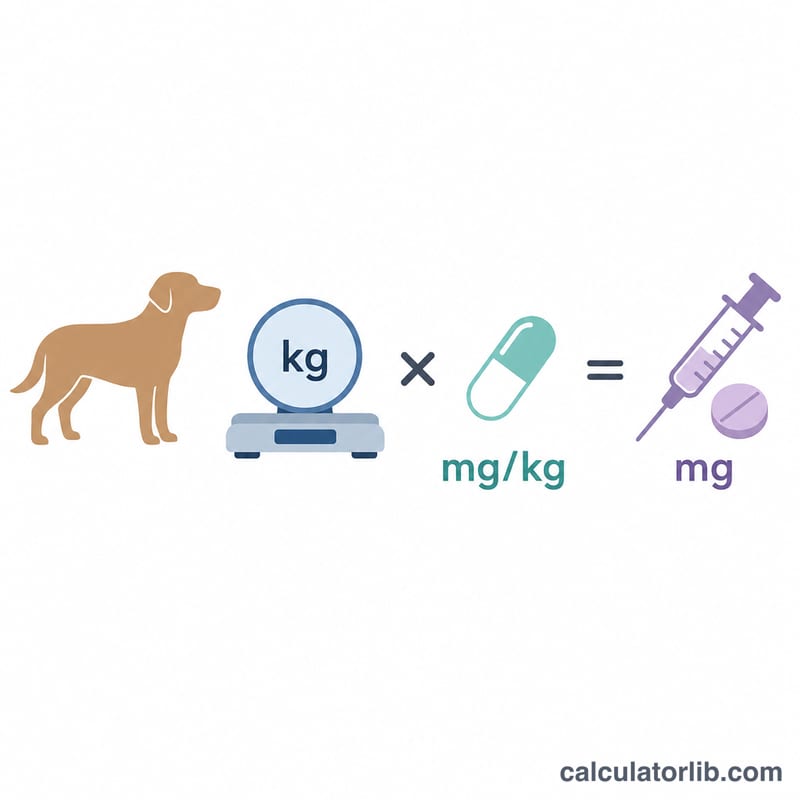
The calculation is simply $$\text{Dose (mg)} = \text{Dose (mg/kg)} \times \text{Weight (kg)}$$ If you enter pounds, the calculator first converts to kilograms by multiplying by \(0.453592\). Standard Imodium tablets are 2 mg and Imodium A-D liquid is 1 mg per 7.5 mL, so you may need a partial tablet or measured liquid — another reason to confirm with your vet.
Worked example
A 20 kg dog at 0.08 mg/kg needs $$20 \times 0.08 = 1.6 \text{ mg per dose}$$ about four-fifths of a 2 mg tablet, every 6–8 hours. A 10 lb dog converts to 4.54 kg, giving about 0.36 mg per dose.
Estimated Dose by Dog Weight
The table applies the Merck Veterinary Manual rate of 0.08 mg/kg per dose, using \(\text{Dose (mg)} = 0.08 \times \text{Weight (kg)}\). Pounds are converted with 1 kg ≈ 2.205 lb. The tablet column assumes a 2 mg tablet and the liquid column assumes Imodium A-D liquid at 1 mg per 7.5 mL. These are arithmetic illustrations of the guideline, not a recommendation to give the drug. Your vet decides whether loperamide is appropriate and what amount to use.
| Weight (kg) | Weight (lb) | Dose at 0.08 mg/kg | Fraction of a 2 mg tablet | mL of 1 mg/7.5 mL liquid |
|---|---|---|---|---|
| 5 | ≈ 11.0 | 0.4 mg | ≈ 0.2 | 3 mL |
| 10 | ≈ 22.0 | 0.8 mg | ≈ 0.4 | 6 mL |
| 20 | ≈ 44.1 | 1.6 mg | ≈ 0.8 | 12 mL |
| 30 | ≈ 66.1 | 2.4 mg | ≈ 1.2 | 18 mL |
| 40 | ≈ 88.2 | 3.2 mg | ≈ 1.6 | 24 mL |
Worked example (10 kg dog): \(0.08\ \text{mg/kg} \times 10\ \text{kg} = 0.8\ \text{mg}\), which is 0.4 of a 2 mg tablet or 6 mL of a liquid with 1 mg per 7.5 mL.
Check the product concentration. Imodium A-D liquid contains 1 mg per 7.5 mL according to its label; other products may have a different strength, so the mL volume depends on the product. Capsules generally cannot be divided accurately. Always read the label strength and ask your vet or pharmacist about the exact product.
Interpreting the Result
The number shown is a per-dose estimate from the Merck Veterinary Manual rate of 0.08 mg/kg, which is also the highest rate the calculator accepts. Merck gives the dosing interval as every 6–8 hours. It is an educational calculation, not a prescription. The right amount, frequency and duration depend on the individual dog and the cause of the diarrhea, and only a veterinarian can decide them.
Why rounding matters: the calculated milligrams rarely match a real tablet or liquid measurement. Tablets and liquids come in fixed strengths, and small dogs can be sensitive to even slight overestimates. Any rounding should be decided with a vet or pharmacist, not guessed from the calculator.
Situations that change the picture:
- MDR1 (ABCB1) gene variant: dogs with this variant, common in Collies, Australian Shepherds, Shetland Sheepdogs and related herding breeds, can have much stronger reactions to loperamide. Serious neurological effects can occur at doses that other dogs tolerate.
- Toxin- or infection-related diarrhea: slowing gut movement may keep harmful organisms or toxins in the body longer.
- Young, pregnant, elderly or ill dogs: puppies and dogs with other health conditions or on other medications need individual veterinary guidance.
When to contact a veterinarian: reach out promptly if you see lethargy, wobbliness or loss of coordination, vomiting, bloody or black stool, a swollen or painful belly, or signs of dehydration. Diarrhea that lasts more than a day or two also warrants a call. Loperamide can also cause sedation or bloating in some dogs.
This is general information, not professional veterinary advice. Consult your vet before giving any medication to your dog.
FAQ
Is Imodium safe for all dogs? No. Herding breeds (Collies, Australian Shepherds, and others) often carry the MDR1 gene mutation that makes loperamide neurotoxic. Never use it in these breeds without veterinary guidance.
How often can I give it? The Merck Veterinary Manual interval is every 6 to 8 hours, but only for a short course and only if your vet approves.
When should I avoid it entirely? Avoid loperamide if diarrhea may be caused by ingested toxins or bacterial infection, or if your dog is very young, pregnant, or has other health conditions. Always call your veterinarian first.