
What This Calculator Does
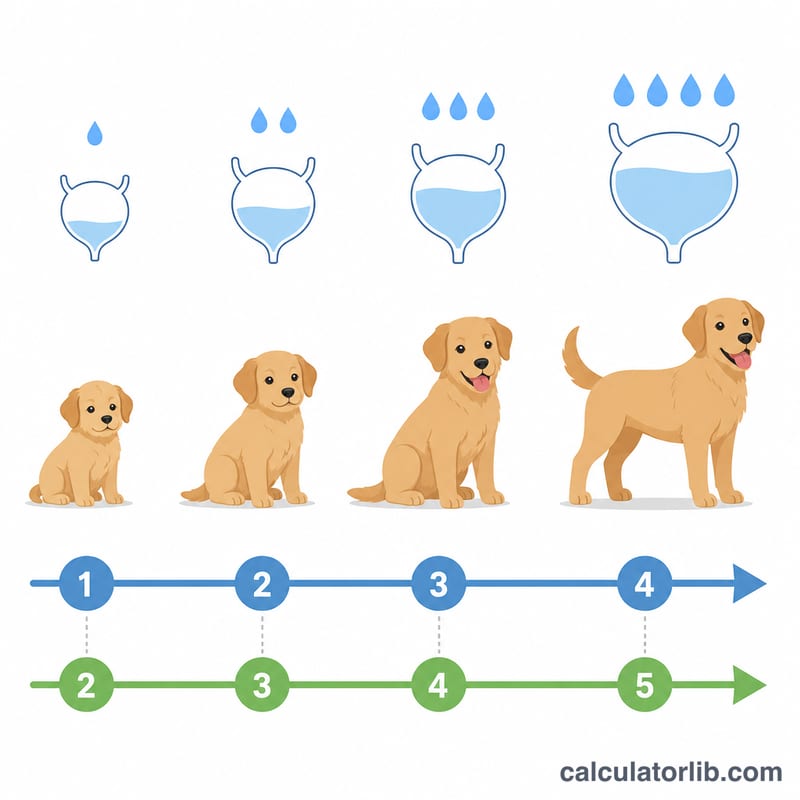
Housetraining a puppy depends largely on bladder control, which improves as the puppy grows. This calculator uses the widely-cited "month plus one" rule of thumb to estimate the maximum number of hours your puppy can comfortably hold its bladder, then translates that into how often you should plan potty breaks throughout the day.
How to Use It
Enter your puppy's age in months. The calculator returns the maximum hold time in hours, the same figure in minutes, and an approximate number of potty breaks across a 24-hour day. Use these as planning targets — always offer more frequent breaks during play, after meals, and right after waking.
The Formula Explained
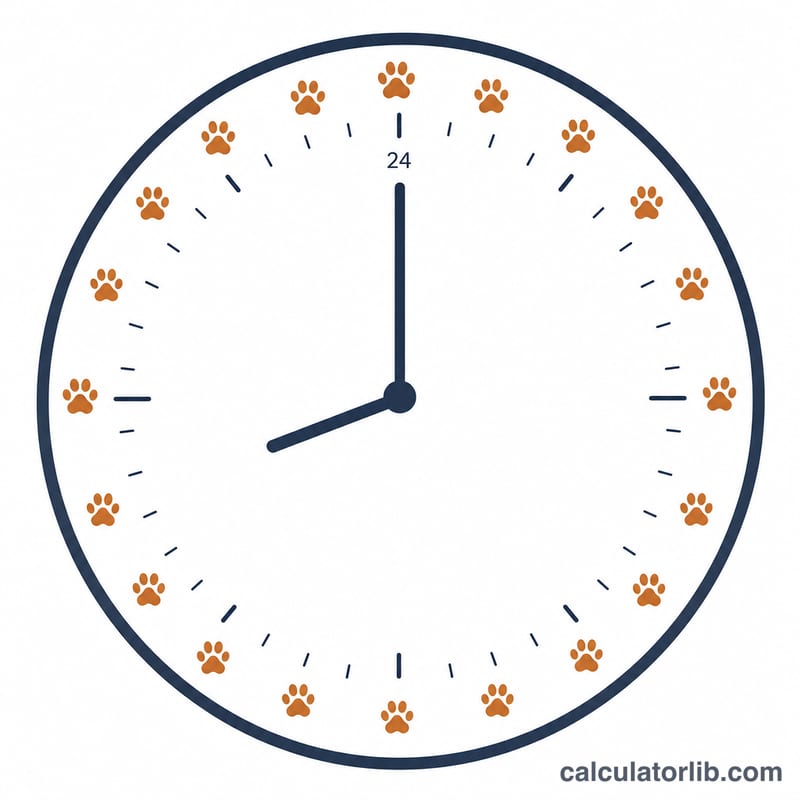
The core rule is: $$\text{Max Hold (h)} = \text{Age (months)} + 1$$ A 2-month-old puppy can hold about 3 hours; a 3-month-old about 4 hours. We cap the result at 8 hours because even adult dogs should not routinely go longer, and we set a floor of 1 hour for very young pups, giving $$\text{Max Hold (h)} = \min\!\left(8,\; \max\!\left(1,\; \text{Age (months)} + 1\right)\right)$$ Daily breaks are found by dividing 24 hours by the hold time: $$\text{Breaks/Day} = \frac{24}{\text{Max Hold (h)}} \qquad \text{Max Hold (min)} = 60 \times \text{Max Hold (h)}$$
Worked Example
For a 4-month-old puppy: \(4 + 1 = 5\) hours. That equals 300 minutes, and \(24 \div 5 = 4.8\), so plan for roughly 5 potty breaks across the day (overnight a young puppy will still need to go).
FAQ
Is this an exact medical figure? No. It is a practical guideline. Individual puppies, breeds, health, and hydration vary.
Should my puppy hold it all night? Most young puppies cannot. Expect overnight breaks until around 4–6 months.
Why is it capped at 8 hours? Holding longer than 8 hours risks accidents and discomfort, so the calculator does not recommend it even for older puppies.