What This Calculator Does
The Puppy Milk Replacer Feeding Calculator estimates how much commercial milk replacer (such as a powdered or liquid puppy formula) to feed an orphaned or hand-reared puppy. It converts the puppy's daily energy requirement into a volume of formula and divides it across the day's feedings so you know exactly how many millilitres to offer each time. This is a general guideline tool — always confirm amounts and schedule with your veterinarian.
How to Use It
Enter the puppy's body weight in kilograms, the recommended caloric need (commonly 200–250 kcal per kg of body weight per day for nursing-age puppies, decreasing as they grow), the energy density of your specific formula (read the label — many reconstituted puppy milk replacers are around 1.0–1.4 kcal/mL), and the number of feedings per day. The calculator returns the volume per feeding plus the total daily volume and daily calories.
The Formula Explained
First we find daily calories: daily kcal = weight × caloric need. We convert calories to volume using the formula's energy density: daily mL = daily kcal ÷ kcal per mL. Finally we split it evenly: per feed = daily mL ÷ feeds. Using calories rather than a fixed mL-per-kg rule lets the result adapt to different formula concentrations.
$$V_{\text{feed}} = \dfrac{\text{Weight (kg)} \times \text{Caloric Need (kcal/kg/day)}}{\text{Formula Energy (kcal/mL)} \times \text{Feedings per Day}}$$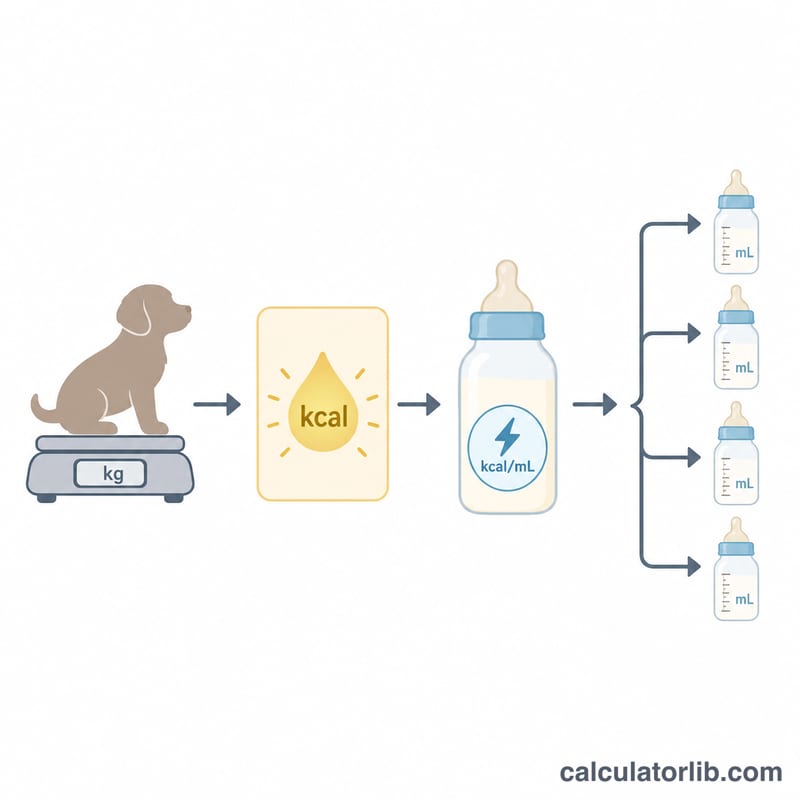
Worked Example
A 0.5 kg puppy needs 200 kcal/kg/day, fed a formula of 1.0 kcal/mL across 4 feedings. Daily energy = \(0.5 \times 200 = 100\) kcal. Daily volume = \(100 \div 1.0 = 100\) mL. Per feeding = \(100 \div 4 = 25\) mL. So you would offer about 25 mL at each of the four feedings.
Typical Feeding Ranges by Puppy Age
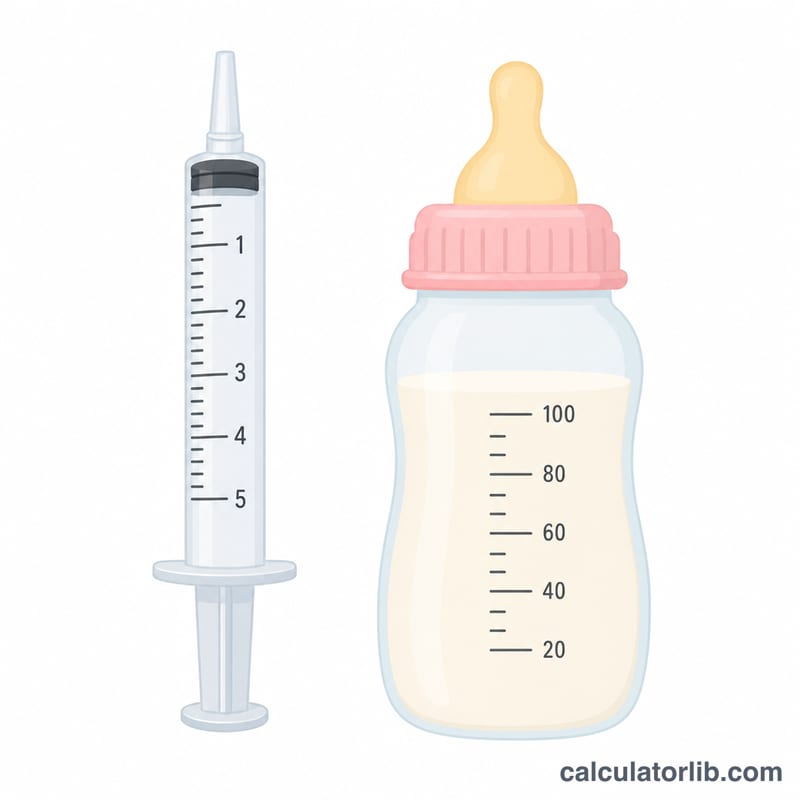
The table below summarizes approximate values from general veterinary neonatal care guidelines (for example the Merck Veterinary Manual and veterinary neonatal care references). Actual needs vary by breed, litter size, health and individual puppy, so treat these as starting points and have a veterinarian confirm the plan.
| Age | Approx. energy (kcal/kg/day) | Approx. feedings per day | Typical interval |
|---|---|---|---|
| Week 1 | about 130 | 6-8 | every 2-3 hours |
| Week 2 | about 150 | 5-6 | every 3-4 hours |
| Weeks 3-4 | about 170-200 | 4-5 | every 4-5 hours |
| Weeks 5-6+ | about 200 or more, with solid food introduced | 3-4 (while weaning) | every 5-6 hours |
These figures are general information, not professional advice. Very small, weak or sick puppies may need a different schedule set by a vet.
Scenario Comparison: Feeding Volumes by Weight and Schedule
Each row uses \(V_{\text{feed}} = \dfrac{\text{weight} \times \text{kcal/kg/day}}{\text{kcal/mL} \times \text{feedings}}\). The daily kcal and daily mL are intermediate steps. These are illustrations of the arithmetic, not feeding prescriptions.
| Weight | Need (kcal/kg/day) | Formula (kcal/mL) | Feedings/day | Daily kcal | Daily mL | mL per feeding |
|---|---|---|---|---|---|---|
| 0.3 kg | 130 | 1.0 | 8 | 39 | 39 | 4.9 |
| 0.3 kg | 130 | 1.3 | 6 | 39 | 30 | 5 |
| 0.5 kg | 150 | 1.0 | 6 | 75 | 75 | 12.5 |
| 1 kg | 180 | 1.3 | 5 | 180 | 138.5 | 27.7 |
| 2 kg | 200 | 1.3 | 4 | 400 | 307.7 | 76.9 |
Worked check for the 1 kg row: daily kcal = 1 × 180 = 180; daily mL = 180 ÷ 1.3 ≈ 138.5; per feeding = 138.5 ÷ 5 ≈ 27.7 mL.
FAQ
How many times a day should I feed a newborn puppy? Very young puppies (under 2 weeks) typically need feeding every 3–4 hours, roughly 6–8 times daily; older puppies can be fed less often. Always follow your vet's guidance.
What caloric need should I use? A common starting point is about 200–250 kcal per kg of body weight per day for nursing puppies, but it varies by age and breed — verify with your veterinarian.
Where do I find kcal per mL? Check your milk replacer's label after mixing to the recommended dilution; it usually lists energy per mL or per 100 mL.