What Is the Puppy Vaccination Schedule Calculator?
This tool turns your puppy's birth date into a clear, dated vaccination plan. Most veterinarians follow a core puppy vaccine series (commonly DHPP — distemper, hepatitis, parainfluenza, and parvovirus) given as a series of boosters every few weeks while the puppy is young. This calculator maps that standard timeline onto real calendar dates so you never miss a dose.
How to Use It
Enter your puppy's birth year, month, and day, then submit. The calculator adds 6, 9, 12, and 16 weeks to the birth date and returns the recommended date for each visit. Bring these dates to your vet — they may fine-tune the plan based on your puppy's health, breed, and local disease risk.
The Formula Explained
The math is simple date arithmetic. One week equals 7 days, so each dose date is the birth date plus the dose's week number multiplied by 7.
$$\text{Date}_n = \text{Birth Date} + (n \times 7)\ \text{days}$$For example, the 12-week dose is birth date + 84 days. The calculator computes all four dates: 6 weeks (42 days), 9 weeks (63 days), 12 weeks (84 days), and 16 weeks (112 days).
$$\text{Dose Date} = \text{Birth Date} + \{6, 9, 12, 16\}\ \text{weeks}$$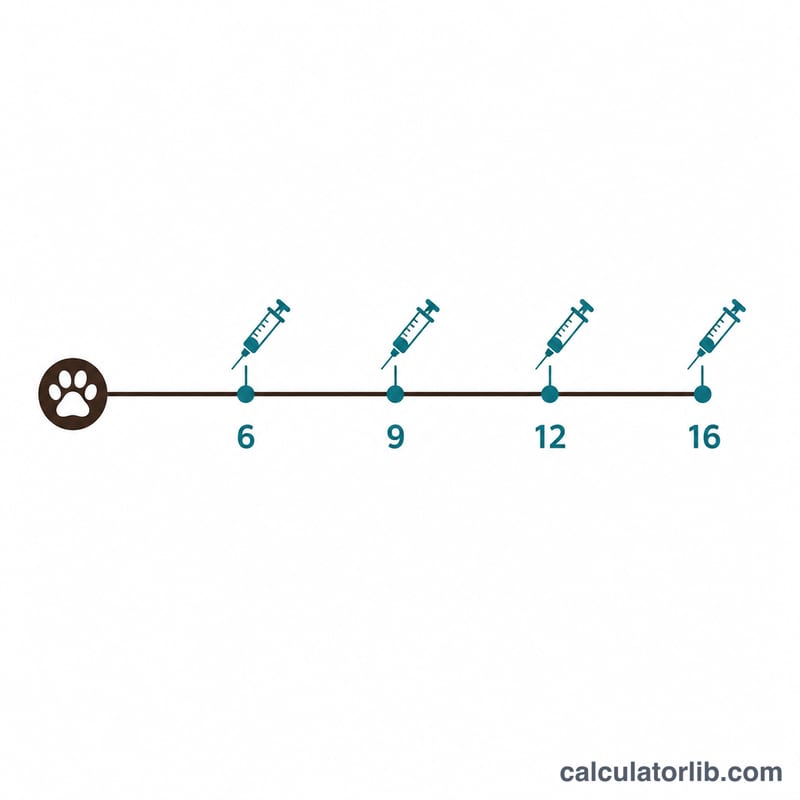
Worked Example
Suppose a puppy was born on January 1, 2024. Adding 6 weeks (\(42\) days) gives February 12, 2024. Adding 9 weeks (\(63\) days) gives March 4, 2024. Adding 12 weeks (\(84\) days) gives March 25, 2024. Adding 16 weeks (\(112\) days) gives April 22, 2024. These four dates form the recommended core vaccination plan.
Core Puppy Vaccine Schedule at a Glance
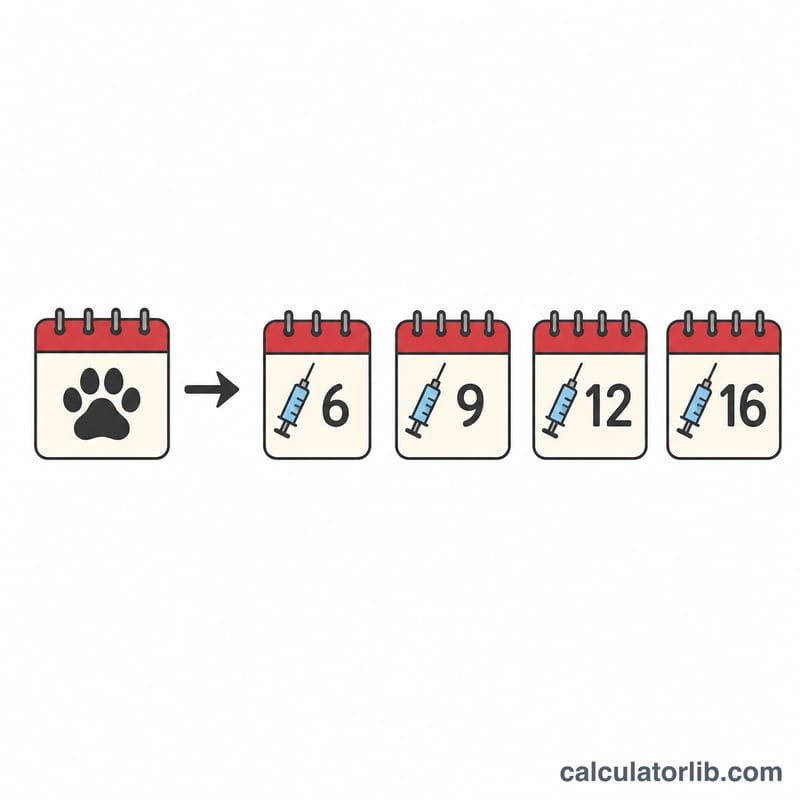
This calculator adds a fixed number of weeks to your puppy's birth date: \(\text{Dose Date} = \text{Birth Date} + (\text{weeks} \times 7)\) days. The table below shows the four planning milestones and the vaccines commonly given at each visit. It follows the general approach in the AAHA and WSAVA canine vaccination guidelines, which recommend a puppy series with the final core dose given at 16 weeks of age or older.
| Age (weeks) | Days after birth | Vaccines commonly given at this visit |
|---|---|---|
| 6 | 42 | First DHPP/DAPP (distemper, adenovirus-2/hepatitis, parvovirus, parainfluenza) dose, per vet protocol |
| 9 | 63 | Second DHPP/DAPP dose; optional non-core vaccines may start here if the vet advises |
| 12 | 84 | Third DHPP/DAPP dose; rabies is often given from about 12 weeks, depending on local law |
| 16 | 112 | Final core DHPP/DAPP dose (at 16 weeks or older); rabies if not yet given and required locally |
Optional (non-core) vaccines such as Bordetella, leptospirosis, Lyme disease and canine influenza are chosen by the veterinarian based on lifestyle, local disease risk and region.
Note: Protocols vary by veterinarian, country and region. Rabies vaccination timing and requirements are set by local law and differ from place to place. Always follow your vet's schedule.
Interpreting Your Vaccination Dates
Maternal antibodies. Puppies receive antibodies from their mother's milk, which protect them early on but fade over the first weeks to months. These antibodies can also block a vaccine from working. The decline varies between puppies, and no single date is known in advance for each one. For this reason, guidelines such as those from WSAVA and AAHA recommend a series of doses spaced several weeks apart, with the last core dose at 16 weeks or older, so that at least one dose is given after maternal antibodies have most likely dropped low enough.
Why protection is not immediate. A puppy is generally not considered fully protected until roughly 1-2 weeks after the final dose in the series, because the immune system needs time to respond. Until your vet says otherwise, a puppy is usually treated as still vulnerable, and the vet can advise on safe exposure to other dogs and public places.
Booster intervals. Guidelines typically describe puppy vaccine doses given about every 3-4 weeks. The calculator's 6, 9, 12 and 16-week dates are spaced 3, 3 and 4 weeks apart, which fits within that range. The intervals are meant to repeatedly catch the moment when a puppy's antibodies decline.
Late or missed doses. If a dose is missed or late, the veterinarian decides how to handle it, such as whether to continue the series or adjust the timing. Contact your clinic rather than guessing.
Use as a planning estimate. The dates are calculated estimates for planning appointments. Your veterinarian's protocol, which accounts for your puppy's health, breed, region and local law, always takes precedence. This is general information, not veterinary advice.
FAQ
Is this a substitute for veterinary advice? No. It provides a typical schedule for planning, but your veterinarian determines the final protocol.
Why does the series end at 16 weeks? Maternal antibodies can interfere with vaccines, so the final core dose is given at 16 weeks or later to ensure full immunity.
What about rabies? Rabies is usually given separately, often around 12–16 weeks, depending on local laws. Check your jurisdiction's requirements.