What is the Trazodone for Dogs Dosage Calculator?
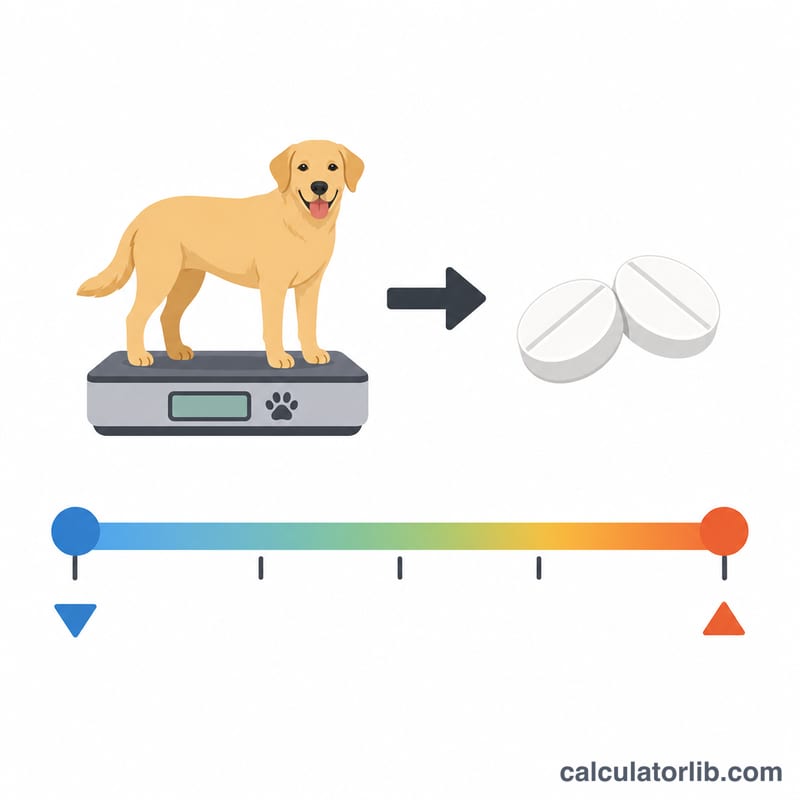
This calculator gives an estimated trazodone dose range for dogs based on body weight. Trazodone is a serotonin antagonist and reuptake inhibitor (SARI) commonly prescribed by veterinarians for situational anxiety — such as thunderstorms, fireworks, vet visits, travel, or post-surgical confinement. A widely cited situational dosing range is roughly 3.5 to 7 mg/kg, given about 1–2 hours before the anticipated stressful event. This tool is educational only and does not replace veterinary advice.
How to use it
Enter your dog's weight and choose kilograms or pounds. The default dosing rates (3.5 and 7 mg/kg) reflect a common situational range, but you can adjust them to match your veterinarian's prescription. The result shows a low-to-high milligram range per dose, which you and your vet can round to available tablet sizes (trazodone commonly comes in 50 mg, 100 mg, 150 mg, and 300 mg tablets).
The formula explained
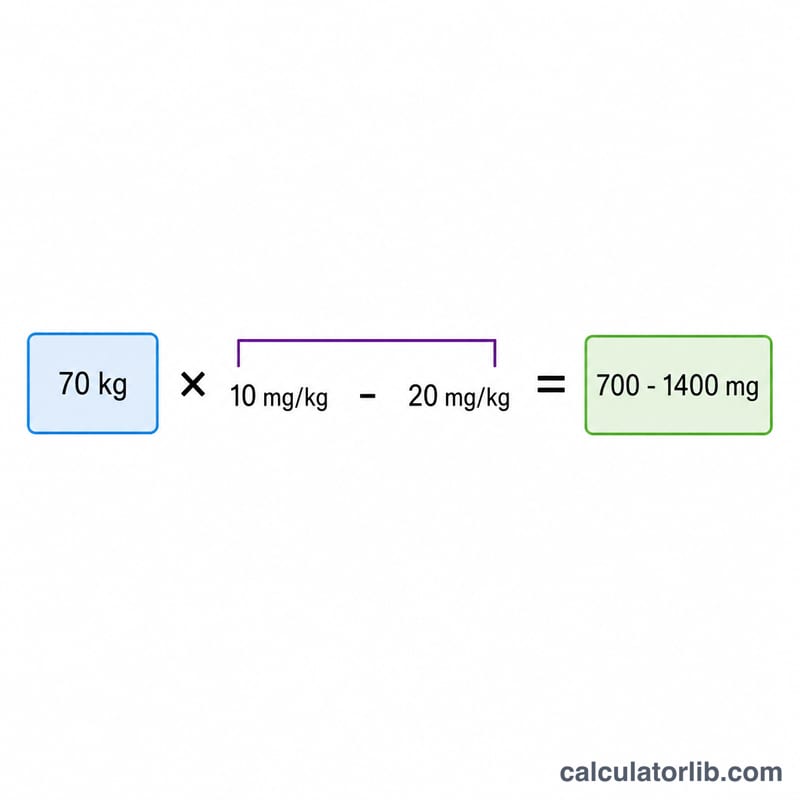
The math is simple: weight in kilograms is multiplied by the dose rate in mg/kg.
$$\text{Dose (mg)} = \text{Weight (kg)} \times (3.5 \text{ to } 7\ \text{mg/kg})$$If you enter pounds, the calculator first converts using \(\text{kg} = \text{lb} \times 0.45359237\). With a 3.5–7 mg/kg range you get a band rather than a single number, because individual dogs respond differently and your vet may target a specific point in that band.
Worked example
A 20 kg dog at 3.5 mg/kg needs
$$20 \times 3.5 = 70 \text{ mg}$$and at 7 mg/kg needs
$$20 \times 7 = 140 \text{ mg}$$So the estimated per-dose range is 70–140 mg. A vet might start near the low end and adjust based on response.
Estimated Dose Range by Dog Weight
The table applies the calculator's default range of 3.5 mg/kg (low) to 7 mg/kg (high) using \(\text{Dose (mg)} = \text{Weight (kg)} \times \text{mg/kg}\). These are illustrative estimates only. A veterinarian must confirm the actual dose, tablet strength, and timing for your dog.
| Dog weight | Low dose (3.5 mg/kg) | High dose (7 mg/kg) | Approximate tablet equivalents (50, 100, 150 mg tablets) |
|---|---|---|---|
| 5 kg (≈ 11 lb) | 17.5 mg | 35 mg | About ⅓–¾ of a 50 mg tablet |
| 10 kg (≈ 22 lb) | 35 mg | 70 mg | About ¾–1½ × 50 mg, or ⅓–¾ of a 100 mg tablet |
| 20 kg (≈ 44 lb) | 70 mg | 140 mg | About 1½–3 × 50 mg, ¾–1½ × 100 mg, or ½–1 × 150 mg |
| 30 kg (≈ 66 lb) | 105 mg | 210 mg | About 1–2 × 100 mg, or ⅔–1⅓ × 150 mg |
| 40 kg (≈ 88 lb) | 140 mg | 280 mg | About 1½–2¾ × 100 mg, or 1–2 × 150 mg |
Example substitution: for a 20 kg dog, \(20 \times 3.5 = 70\) mg and \(20 \times 7 = 140\) mg. Pound conversions use 1 kg ≈ 2.205 lb. Tablet equivalents are rounded, and not every tablet can be split accurately, so your vet or pharmacist may choose a different strength or a compounded form.
Interpreting Your Result
The result is a range, not a single recommended dose. In veterinary references, the lower end (around 3.5 mg/kg) is typically treated as a conservative starting point. The upper end (around 7 mg/kg) is a higher, situational range, sometimes used for short-term events such as travel, storms, fireworks, or vet visits. Many vets begin low and adjust only after seeing how the individual dog responds.
Factors that influence a vet's decision
- Age: Senior dogs and very young dogs may need more cautious dosing.
- Liver or kidney disease: Trazodone is processed by the liver and cleared partly by the kidneys, so impaired function can change how the drug behaves.
- Concurrent serotonergic drugs: Examples include SSRIs, tricyclic antidepressants, MAO inhibitors such as selegiline, and tramadol. Combining them raises the risk of serotonin syndrome.
- Other conditions: Heart disease, glaucoma, and a history of seizures may also affect whether and how trazodone is used.
Common side effects
Sedation or lethargy, gastrointestinal upset (vomiting, diarrhea, reduced appetite), and ataxia (wobbly or uncoordinated walking) are the most commonly reported effects. Some dogs become more agitated instead of calmer.
When to contact a vet immediately
Contact your veterinarian, an emergency clinic, or an animal poison control service right away if you suspect an overdose or see signs of serotonin syndrome. Warning signs include:
- Severe sedation, collapse, or inability to stand
- Tremors, muscle rigidity, or seizures
- Agitation, vocalizing, or unusual restlessness
- Rapid or abnormally slow heart rate
- Elevated body temperature or heavy panting
- Persistent vomiting or diarrhea
This is general educational information, not medical advice. The calculator cannot account for your dog's health history, other medications, or the reason for treatment. Only your veterinarian can determine whether trazodone is appropriate and what the actual dose should be.
FAQ
How often can trazodone be given? For ongoing anxiety some vets prescribe it every 8–24 hours; for situational use it's given once before the event. Follow your vet's instructions.
Can I use this number without a vet? No. Use it only to understand the ballpark range. Dose, frequency, and suitability depend on your dog's health, other medications, and the vet's judgment.
What if my dog takes other medications? Trazodone can interact with other serotonergic drugs (risk of serotonin syndrome). Always disclose all medications to your veterinarian.