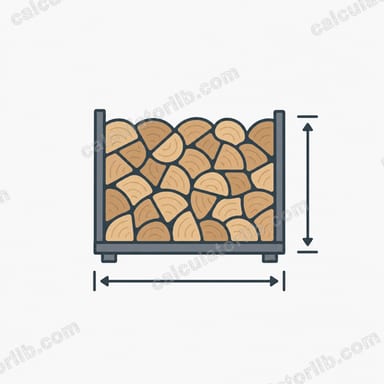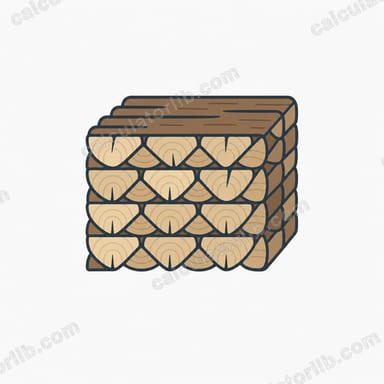

What Is a Cord of Firewood?
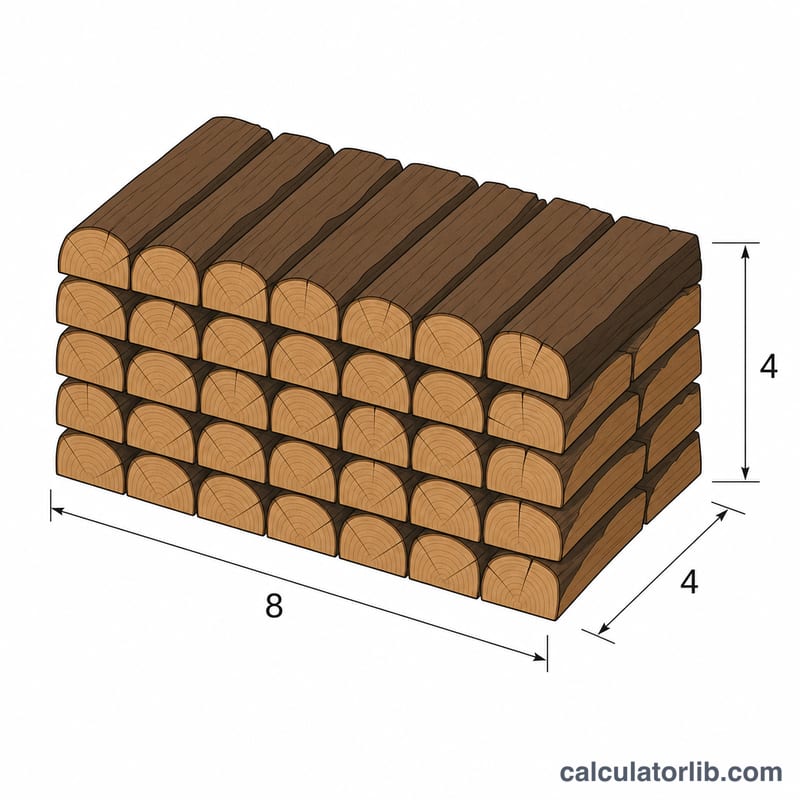
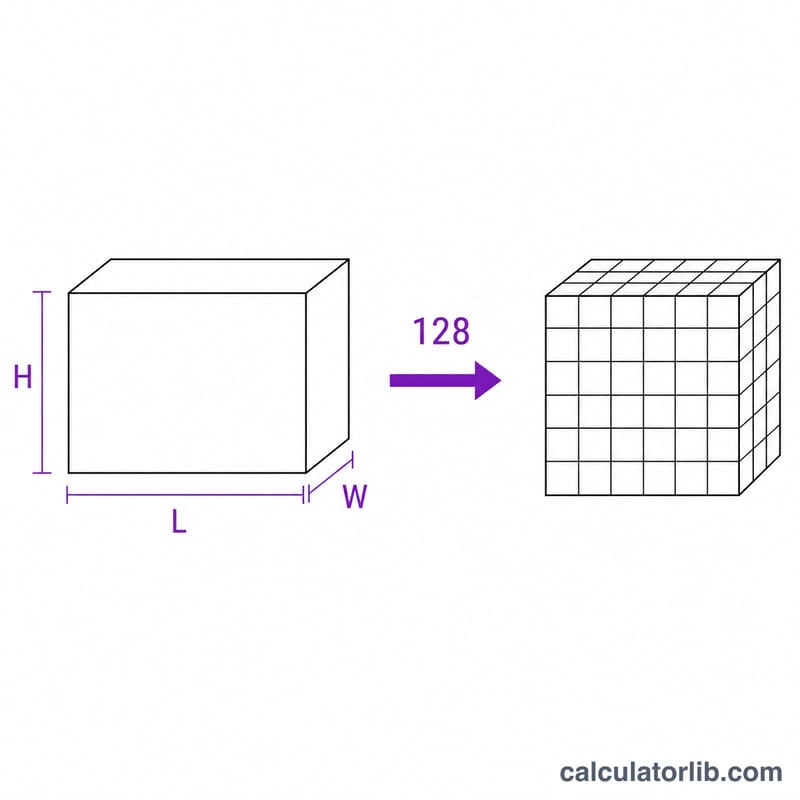
A cord is the standard measure of stacked firewood. By definition, a full cord occupies 128 cubic feet — most commonly seen as a tightly stacked pile 4 feet high, 8 feet long, and 4 feet deep. This calculator converts the measured dimensions of your own wood pile into cords so you know exactly how much you bought or burned.
How to Use It
Measure your neatly stacked woodpile and enter the length, height, and width (depth) in feet. The depth is usually the length of your cut logs — for example 16-inch logs equal about 1.33 feet. The calculator multiplies the three dimensions to get the volume in cubic feet, then divides by 128 to report the number of cords.
The Formula Explained
The math is simple: $$\text{cords} = \dfrac{L \times W \times H}{128}$$ The numerator is the total stacked volume in cubic feet, and 128 is the cubic feet in one full cord. A result of \(0.5\) means a half cord (often called a "face cord" when logs are short).
Worked Example
Suppose your stack is 12 ft long, 4 ft high, and stacked with logs that are 16 inches (1.33 ft) deep. $$V = 12 \times 1.33 \times 4 = 63.84 \text{ cubic feet}$$ $$\text{cords} = \frac{63.84}{128} \approx 0.499$$ just under half a cord.
FAQ
What is a face cord? A face cord is a stack 4 ft high and 8 ft long but only one log-length deep, so its volume depends on the log length and is usually less than a full cord.
Do I measure loosely thrown wood? No — wood should be neatly stacked. Loose, thrown piles contain a lot of air and overstate the true cord count.
What units do I enter? Enter all three dimensions in feet. Convert inches to feet by dividing by 12 (e.g. 18 in = 1.5 ft).