What Is the Macrame Cord Length Calculator?
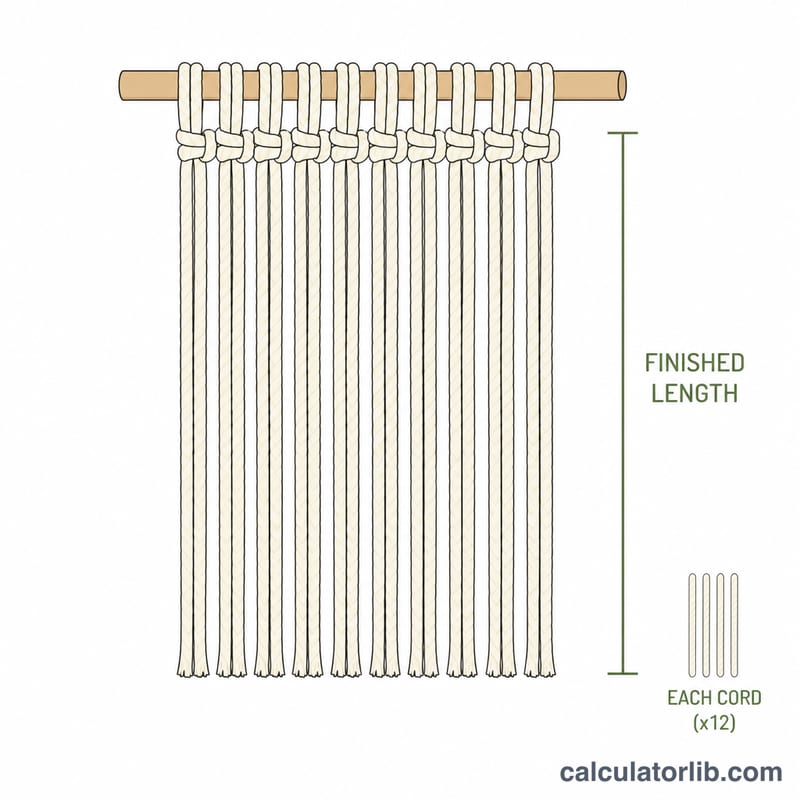
One of the most common mistakes in macrame is cutting cords too short — you cannot splice macrame cord mid-project without an ugly knot. This calculator estimates how much cord to cut per strand and how much total cord to buy, based on the finished length of your piece, how many cords you need, and a length multiplier that accounts for the cord eaten up by knots.
How to Use It
Enter the finished length of your project (the hanging length of the piece in inches or centimeters), the number of cords you plan to mount, and a multiplier. The calculator returns the length to cut each cord and the grand total to purchase. Buy slightly more than the total to be safe.
The Formula Explained
The rule of thumb is that each cut cord should be roughly 4 to 6 times the finished length:
$$\text{Total} = \text{Finished Length} \times \text{Multiplier} \times \text{Number of Cords}$$
Use a multiplier of 4 for loose or simple knots, 5 for typical square-knot patterns, and 6 for very dense designs or pieces with long fringe. Thicker cord and tighter knotting consume more length, so round up.
Worked Example
Suppose you want a wall hanging with a 30-inch finished length, using 8 cords and a multiplier of 4. Each cord should be \(30 \times 4 = 120\) inches. Total cord to buy = \(120 \times 8 = 960\) inches (80 feet). Add 10% extra for safety and you'd buy about 88 feet.
Typical Cord Multipliers and Lengths by Project Type
Macrame cord multipliers are craft rules of thumb, not published standards — no national or international code defines them. They exist because knots consume far more cord than the finished piece shows: every square knot, half hitch and wrap "eats" length, so a hanging that measures 90 cm when done may need five or six times that much cord per strand. The table below collects widely used starting figures from macrame practice; treat them as a first estimate, then confirm with a test knot (see the next section).
| Project | Typical finished length | Recommended multiplier | Typical cord thickness | Typical cord count |
|---|---|---|---|---|
| Bracelet | 6–8 in (15–20 cm) | 5–6× | 1–2 mm | 2–4 |
| Keychain | 4–7 in (10–18 cm) | 4–6× | 2–3 mm | 2–6 |
| Small wall hanging | 12–24 in (30–60 cm) | 4–6× | 3–4 mm | 8–20 |
| Large wall hanging | 36–60 in (90–150 cm) | 5–7× | 4–6 mm | 24–60 |
| Plant hanger | 30–40 in (75–100 cm) | 4–5× | 3–4 mm | 8 (often 4 cords folded) |
| Table runner | 36–72 in (90–180 cm) | 5–6× | 2–3 mm | 20–40 |
| Curtain / room divider | 60–90 in (150–230 cm) | 5–7× | 3–5 mm | 40–100+ |
| Very dense or heavily fringed work (any size) | — | 7–8× | 3–6 mm | — |
Two factors push you toward the high end of each range. Thicker cord needs more length per knot, because each knot has to travel around a fatter core — the same square-knot row swallows noticeably more 5 mm cord than 2 mm cord. Denser knotting does the same: continuous square-knot or half-hitch fields, spiral columns, wrapped bars and long fringe all consume cord fast, while open designs with large unknotted gaps sit near the low end (4×). If you are unsure, round up — a cord that is too long can be trimmed into fringe, but a cord that runs short usually cannot be rescued.
A worked estimate for the plant hanger row: a 36 in finished hanger at 4× with 8 strands needs
$$36 \times 4 \times 8 = 1152 \text{ in}$$or 1152 inches in total — about 96 ft, or roughly 29 m of cord before any waste allowance.
Practical Cutting and Buying Tips
- Round every individual cut up to the next whole unit. If the math says 182.4 in per strand, cut 183 in; in metric, round up to the next 5 cm (464 cm becomes 465 cm, or just 470 cm). Measuring to a fraction of an inch on a 4 m strand is false precision, and the rounding buys you margin at the end of the piece.
- Add a 10–15% waste allowance to the total. Spool ends, crooked cuts, a strand that frays past the knot line and the inevitable re-do all come out of this. Dense knotting, an unfamiliar pattern or a cord you have never used before argue for the full 15%.
- Convert the total into the unit your supplier sells in, then buy the next full spool. Divide inches by 12 for feet and by 36 for yards; multiply inches by 2.54 for centimetres and divide by 100 for metres. Natural-cotton macrame cord is commonly sold on 50 m, 100 m and 200 m spools (some suppliers sell by weight or in yards instead, so check the label), and running out mid-project often means a spool from a different dye lot or twist.
- Cut one test cord first and knot a few rows. Cut a single strand at the calculated length, work 5–10 cm of your actual pattern, then measure how much cord those rows consumed and extrapolate. This one measurement turns a rule-of-thumb multiplier into a number specific to your cord, your knot and your hand tension — and it costs you one strand instead of a whole project.
- Double the length for folded (lark's-head) cords. Mounting a cord onto a dowel or ring with a lark's head knot folds it in half and yields two working ends, each roughly half the cut length. So decide first whether your cord count means cut pieces or working ends: 16 working ends from folded cords means 8 cut pieces, each cut at double the per-end length, plus a few centimetres for the mounting knot itself.
- Give working cords more length than fillers. In a square knot, the two outer working cords wrap around the core and are consumed several times faster than the inner filler cords, which travel almost straight down. A common practical approach is to cut working cords at the full multiplier and fillers noticeably shorter (often around the finished length plus 20–30%), or — simpler and safer for beginners — cut everything at the working-cord length and keep the surplus.
- Seal the ends. Wrap a short piece of masking tape around each cut end of twisted cotton cord, or tie a small overhand knot, so a 3-ply cord does not unwind while you work. Synthetic cord (nylon, polypropylene, paracord) can instead be heat-fused with a lighter or a hot knife in a ventilated space — never heat natural cotton or jute, which simply burns.
- Keep the offcuts. Trimmings and leftover lengths become fringe, tassels, wrapping cord for gathering knots, and test strands for the next project. Store them by thickness so the next test cut matches the real material.
Worked example: a large wall hanging
A 36 in finished wall hanging in 4 mm cord, worked fairly densely at 5×, with 24 cords:
$$\text{Total} = 36 \text{ in} \times 5 \times 24 = 4320 \text{ in}$$That is 4320 inches = 360 ft = 120 yd ≈ 109.7 m, at 180 in (4.57 m) per cord. Adding a 15% waste allowance:
$$4320 \times 1.15 = 4968 \text{ in} \approx 126 \text{ m}$$So buy a 200 m spool, or a 100 m plus a 50 m spool from the same dye lot — a single 100 m spool would leave you about 26 m short. If those 24 cords are mounted folded with lark's head knots, you would cut 12 pieces at roughly double the per-end length instead of 24 single strands.
These are general craft guidelines rather than fixed specifications; cord brands, twist and your own knot tension all shift the real consumption, so the test cord in step 4 remains the most reliable check.
FAQ
Should I fold cords in half when mounting? If you mount cords folded (lark's head knot), each "cord" you count becomes two working strands. Count the number of cut pieces you need and use that as the number of cords.
Why is my project running short? Dense knotting, thick cord, and fringe all use more length. Bump the multiplier from 4 up to 5 or 6.
Inches or centimeters? The calculator is unit-agnostic — just keep your finished length and result in the same unit.