What the loom rubber band bracelet calculator does
This calculator estimates how many stretchy loom bands (Rainbow Loom-style rubber bands) you need to make a bracelet that fits. Instead of guessing and running out mid-project, you enter your wrist size and the weave you plan to use, and it returns a band count plus a recommended amount to buy with a little spare for snaps and mistakes.
Loom-band bracelets are built by interlocking small rubber bands into a chain or weave. Denser weaves pack more bands into the same length, so the pattern you choose changes the total as much as your wrist size does.
How to use it
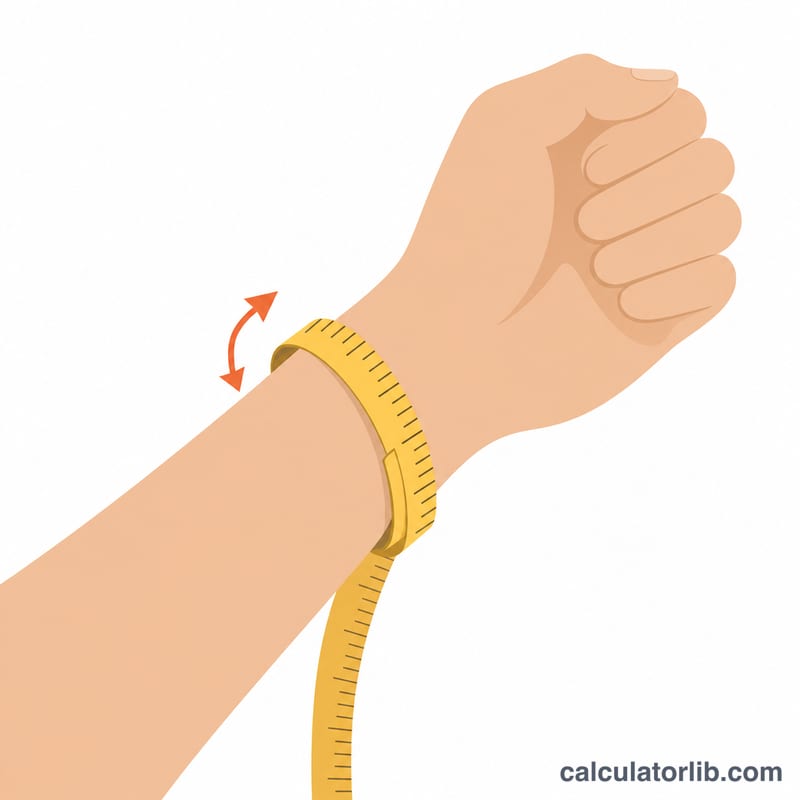
Measure around your wrist snugly with a soft tape or a strip of paper, then read the length in millimetres and enter it as the wrist circumference. Pick your pattern — single chain, fishtail, or triple single — and set a comfort ease, a small allowance so the finished bracelet slips on and sits comfortably (10 to 15 mm is typical). The calculator then shows the bands needed, the target finished length, the band density it used, and a recommended purchase count.
The formula explained
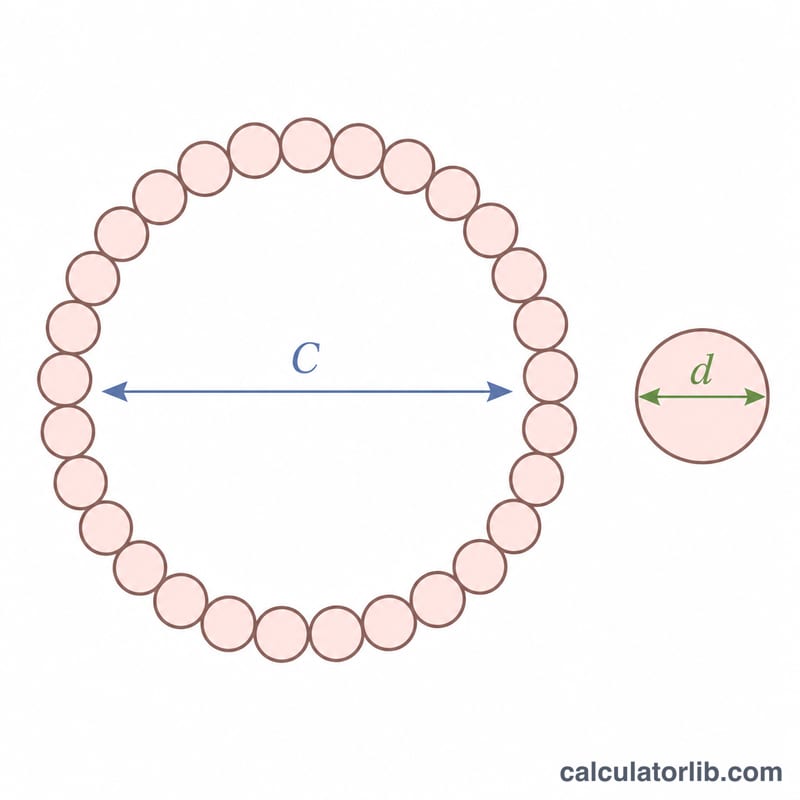
First the target finished length is the wrist size plus a comfort allowance:
$$ L = W + e $$Then the band count is the finished length, converted from millimetres to centimetres, multiplied by the pattern's band density d, and rounded up to a whole band:
$$ B = \lceil \frac{L}{10} \times d \rceil $$Here W is wrist circumference in mm, e is the comfort ease in mm, L is the finished length in mm, and d is bands per centimetre. Typical density estimates are about 1.4 bands/cm for a single chain, 2.8 for a fishtail, and 4.2 for a triple single. These densities depend on band brand and how tightly you weave, so treat the count as a close estimate and keep spares on hand.
Worked example
Suppose your wrist is 160 mm and you add 12 mm of ease, so the target length is L = 160 + 12 = 172 mm, or 17.2 cm. For a single-chain bracelet the density is about 1.4 bands/cm, so B = 17.2 x 1.4 = 24.08, which rounds up to 25 bands. Adding a 15% spare for breakage suggests buying about 29 bands. Switch to a fishtail on the same wrist and the density roughly doubles to 2.8 bands/cm, giving 17.2 x 2.8 = 48.16, or 49 bands for the denser weave.
Band Density by Pattern
The number of bands per centimetre of finished bracelet depends on the weave. The values below are planning estimates used for the tables on this page, not fixed standards.
| Pattern | Bands per cm (estimate) | Look and stretch |
|---|---|---|
| Single chain | 1.5 | A slim, flat chain of linked bands. It is the lightest and quickest weave and stretches the most along its length. |
| Fishtail | 3 | A braided, scale-like look. It is thicker and more textured than a single chain and fairly flexible. |
| Triple single | 4.5 | Three single-style chains worked together. It is wide and chunky, and it is the firmest and least stretchy of the three. |
Caveat: real density varies with the band brand, band thickness, how tightly you pull each band, and how much the finished piece relaxes. Treat these figures as a starting point and check them with a short swatch.
Band Count by Wrist Size and Pattern
These counts use 12 mm of ease and the densities from the table above. The formula is:
$$B = \left\lceil \frac{W + e}{10} \times d \right\rceil$$
Here \(W\) is the wrist circumference in mm, \(e\) is the ease in mm, and \(d\) is bands per cm. Dividing by 10 converts mm to cm. The result is rounded up to a whole band.
| Wrist size | Wrist (mm) | Length with 12 mm ease | Single chain (1.5/cm) | Fishtail (3/cm) | Triple single (4.5/cm) |
|---|---|---|---|---|---|
| Child | 130 | 14.2 cm | 22 | 43 | 64 |
| Small adult | 150 | 16.2 cm | 25 | 49 | 73 |
| Average adult | 170 | 18.2 cm | 28 | 55 | 82 |
| Large | 190 | 20.2 cm | 31 | 61 | 91 |
Worked example (average adult, fishtail): \(\frac{170 + 12}{10} \times 3 = 18.2 \times 3 = 54.6\), which rounds up to 55 bands.
These counts do not include spare bands or the clip. See the tips below.
Practical Tips for Buying and Weaving
- Buy spares: add about 10-15% extra bands to cover snapped or misplaced bands and mistakes. For the 55-band fishtail above, that is roughly 61-64 bands.
- Round up to full packs: bands are sold in packs of a set size, so buy enough whole packs to cover the total, spares included.
- Add a clip: get a C-clip or S-clip to close the bracelet. One clip per bracelet is usually enough, but buy a few spares.
- Keep colors consistent: buy bands of the same brand and batch. Thickness, stretch and color shade can differ between brands and batches, which changes both the look and the density.
- Test a swatch: weave a short piece, about 3-5 cm, measure it, and count the bands to get your real bands per cm. Replace the estimated density with your measured value and recalculate.
- Adjust the ease: the 12 mm used here gives a comfortable, snug fit. Use less (for example 0-6 mm) for a tighter fit, or more (for example 20 mm or above) for a loose, dangly fit. Remember that stretchy weaves like single chain may relax and lengthen with wear.
Frequently asked questions
Why does the pattern change the band count so much? A single chain uses one band per link, while denser weaves like fishtail and triple single stack two or three bands into the same span, so they need roughly two to three times as many bands for the same wrist size.
Should I subtract length because the bands stretch? Most loom bracelets are finished with a C- or S-clip and stretch only a little, so targeting your wrist size plus a small comfort ease gives a good fit. If you prefer a very snug band, reduce the ease toward zero.
How many spare bands should I buy? Rubber bands snap and get dropped, so the calculator suggests about 15% extra. For long projects or with cheaper bands, rounding up to the next full pack is a safe habit.