
What Is the Beading Bead Count Calculator?
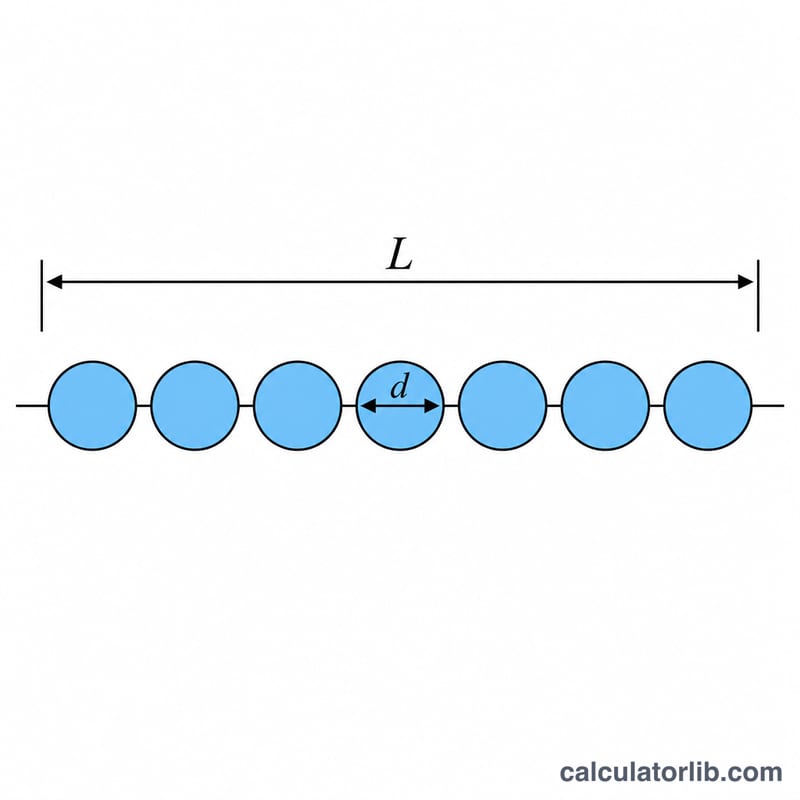
This calculator tells you how many beads you need to fill a strand, necklace, bracelet, or any beading project. By dividing the total strand length by the size (diameter) of a single bead, it returns the whole number of beads that will fit. It works for any consistent unit, but the fields here are in millimeters — the standard sizing used by most bead suppliers.
How to Use It
Enter the finished length you want for your strand in millimeters, then enter the size of one bead in millimeters. The calculator divides the two and rounds down to give the count of whole beads. It also shows the length those beads actually occupy and any small leftover gap, so you can plan spacers, clasps, or knots accordingly.
The Formula Explained
The core formula is $$\text{Beads} = \left\lfloor \frac{\text{Strand length (mm)}}{\text{Bead size (mm)}} \right\rfloor$$ We round down (floor) because a partial bead cannot be used. For example, if a strand is 200 mm and beads are 6 mm, \(200 \div 6 = 33.33\), which floors to 33 beads. Those beads use \(33 \times 6 = 198\) mm, leaving a 2 mm gap.
Worked Example
You want an 18-inch (457.2 mm) necklace using 6 mm round beads. \(457.2 \div 6 = 76.2\), so you need 76 beads. They fill 456 mm, leaving 1.2 mm — plenty close for a clasp. Always buy a few extra beads to allow for breakage and color matching.
Standard Bead Sizes and Beads Per Inch
The number of beads that fit along a strand depends on the bead diameter. Because there are 25.4 mm in one inch, the beads per inch is found by dividing 25.4 by the bead size in millimeters. For a full strand, the bead count is:
$$\text{Beads} = \left\lfloor \frac{\text{Strand length (mm)}}{\text{Bead size (mm)}} \right\rfloor$$The table below lists common round bead diameters with their approximate beads per inch and beads needed for a standard 18-inch (457.2 mm) necklace.
| Bead size | Beads per inch (25.4 mm) | Beads per 18-inch necklace |
|---|---|---|
| 2 mm | 12.7 | 228 |
| 3 mm | 8.5 | 152 |
| 4 mm | 6.4 | 114 |
| 6 mm | 4.2 | 76 |
| 8 mm | 3.2 | 57 |
| 10 mm | 2.5 | 45 |
| 12 mm | 2.1 | 38 |
| Seed beads (size 11/0, ~1.8 mm) | ~14 | ~254 |
Note: seed bead sizes use an aught (\(0\)) scale where a larger number means a smaller bead. A size 11/0 seed bead is roughly 1.8 mm wide, while a size 6/0 is about 4 mm. Exact dimensions vary slightly by manufacturer.
Common Strand Length Conversions
Jewelry lengths are traditionally described by name. Use the millimeter equivalents directly in the strand length field. One inch equals exactly 25.4 mm.
| Name | Length (inches) | Length (mm) |
|---|---|---|
| Bracelet | 7 in | 177.8 mm |
| Anklet | 9 in | 228.6 mm |
| Choker | 16 in | 406.4 mm |
| Princess | 18 in | 457.2 mm |
| Matinee | 22 in | 558.8 mm |
| Opera | 30 in | 762.0 mm |
| Rope | 36 in | 914.4 mm |
Inch-to-Millimeter Quick Guide
| Inches | Millimeters |
|---|---|
| 1 in | 25.4 mm |
| 5 in | 127.0 mm |
| 10 in | 254.0 mm |
| 15 in | 381.0 mm |
| 20 in | 508.0 mm |
To convert a measurement the other way — for example, checking that a 40.6 cm choker matches 16 inches — you can use a 16-inch result from a centimeter-to-inch conversion.
Practical Beading Tips
The bead count formula gives an exact theoretical number, but real-world projects need a few adjustments for the best fit and finish.
- Buy about 10% extra beads. Some beads break, have inconsistent holes, or differ slightly in color between batches. Ordering roughly 10% more avoids running short mid-project. For a 114-bead 4 mm strand, that means buying about 125.4 beads (round up to a full pack).
- Subtract the clasp length. The clasp, jump rings, and connectors add to the finished length. Measure your clasp and subtract it from the target strand length before computing bead count, so the finished piece matches the desired size.
- Account for spacers and knots. If your design uses spacer beads, crimps, or knots between beads (as in knotted pearl strands), each adds length. Include the spacer width in the effective bead size or reduce the bead count accordingly.
- Round the bead count down. Always round down to the nearest whole bead for a snug strand. Rounding up can leave the strand too long or loose, with beads that shift and gap.
- Test the fit. Lay beads along a ruler or string a sample section before committing to the full design, especially with irregular or hand-made beads whose true diameter differs from the nominal size.
This is general crafting guidance; exact requirements vary with bead shape, stringing material, and design.
FAQ
What unit should I use? Millimeters are standard for bead sizing. To convert inches to mm, multiply by 25.4.
Should I subtract space for the clasp? Yes — for a snug fit, reduce the strand length by the clasp length before calculating, or simply round the bead count down.
Why round down instead of up? A fractional bead can't physically be strung, so rounding down ensures your beads fit within the available length.