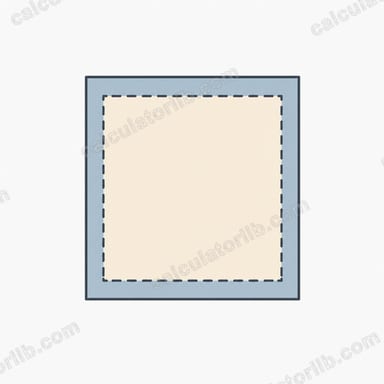

What this calculator does
The Cut Fabric Size Calculator tells you exactly how large to cut your fabric so that the finished piece comes out the right size after sewing. Every seam "eats" a strip of fabric on each side, so you must add the seam allowance to every edge before cutting. This tool adds the allowance to both edges of the width and both edges of the length automatically.
How to use it
Enter the finished width and finished length you want the piece to measure once sewn, then enter the seam allowance for a single edge. Use the same unit (inches or centimetres) for all three boxes. The result shows the cut width, cut length, and the total cut area.
The formula explained
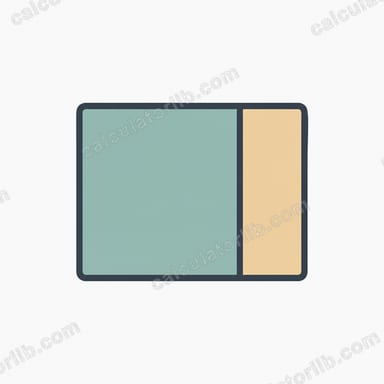
The core formula is \(\text{cut size} = \text{finished size} + 2 \times \text{seam allowance}\). The factor of 2 appears because each dimension has two opposing edges that are each consumed by a seam. For example, the width is reduced once on the left edge and once on the right edge, so you add the allowance twice.
$$\begin{gathered} \text{Cut Width} = \text{Finished Width} + 2 \times \text{Seam Allowance} \\[0.6em] \text{Cut Length} = \text{Finished Length} + 2 \times \text{Seam Allowance} \\[0.6em] \text{Cut Area} = \text{Cut Width} \times \text{Cut Length} \end{gathered}$$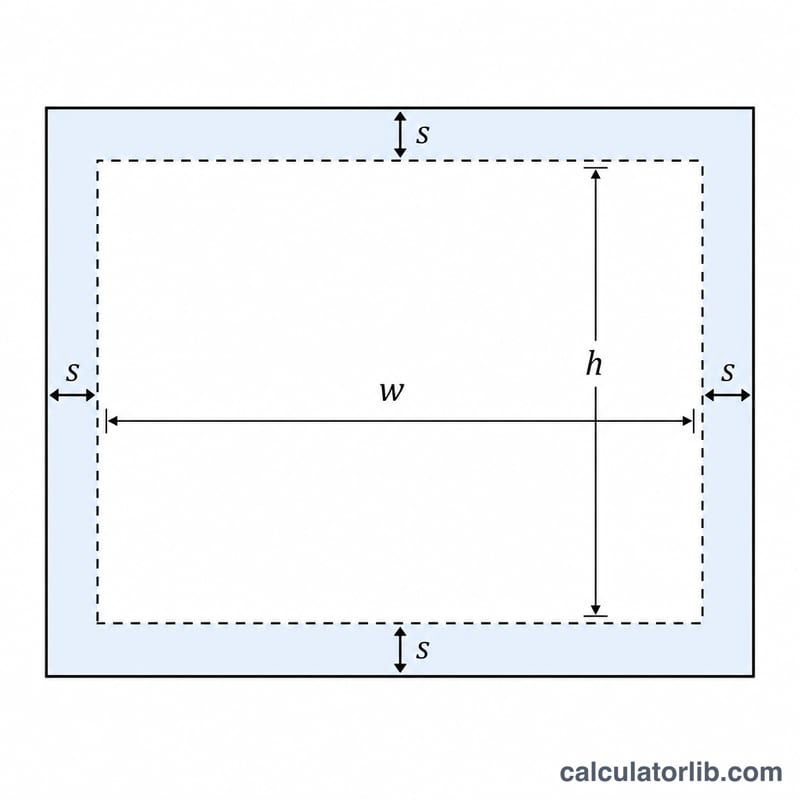
Worked example
Suppose you want a finished quilt block of 12 × 12 inches and you sew with the standard quilting allowance of 0.25 inch. Cut width \(= 12 + 2 \times 0.25 = 12.5\) inches, and cut length \(= 12 + 2 \times 0.25 = 12.5\) inches. So you cut a 12.5 × 12.5 inch square, giving a cut area of 156.25 square inches.
$$\text{Cut Area} = 12.5 \times 12.5 = 156.25 \text{ square inches}$$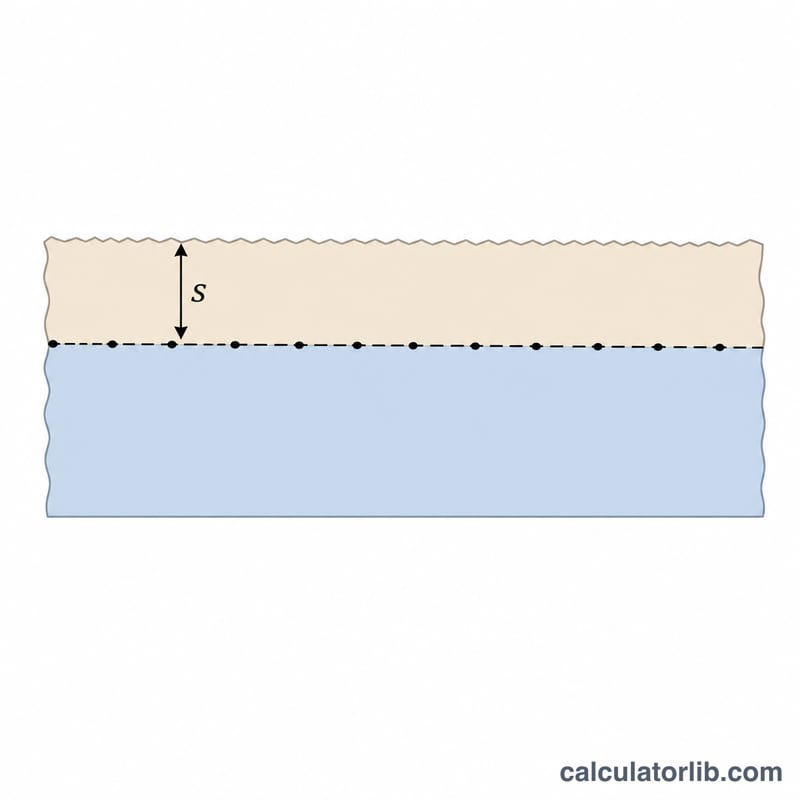
FAQ
What seam allowance should I use? Quilters typically use 0.25 inch, while garment sewing often uses 0.625 inch (1.6 cm). Always follow your pattern's stated allowance.
Does this work in centimetres? Yes — the math is unit-agnostic. Just keep every field in the same unit and the output will be in that unit.
What if the seam allowance differs on each edge? This tool assumes the same allowance on all four edges. If yours differs, add the two opposing-edge allowances together and divide by two to find an equivalent value, or compute each dimension separately.