What is the Scale Model Dimension Calculator?
This calculator converts a real-world measurement into the matching size on a scale model. Whether you build dioramas, military miniatures, model railways, dollhouses or architectural mock-ups, every part must shrink by the same ratio so the scene looks believable. Enter the real dimension, choose a unit, and type the scale denominator — the tool returns the exact model size.
How to use it
1. Enter the real-life dimension (for example a person who is 1800 mm tall). 2. Pick the unit your value is in. 3. Enter the scale ratio denominator: for 1:35 type 35, for 1:87 (HO trains) type 87, for 1:144 type 144. The result shows the model size in your chosen unit plus a handy millimeter equivalent.
The formula explained
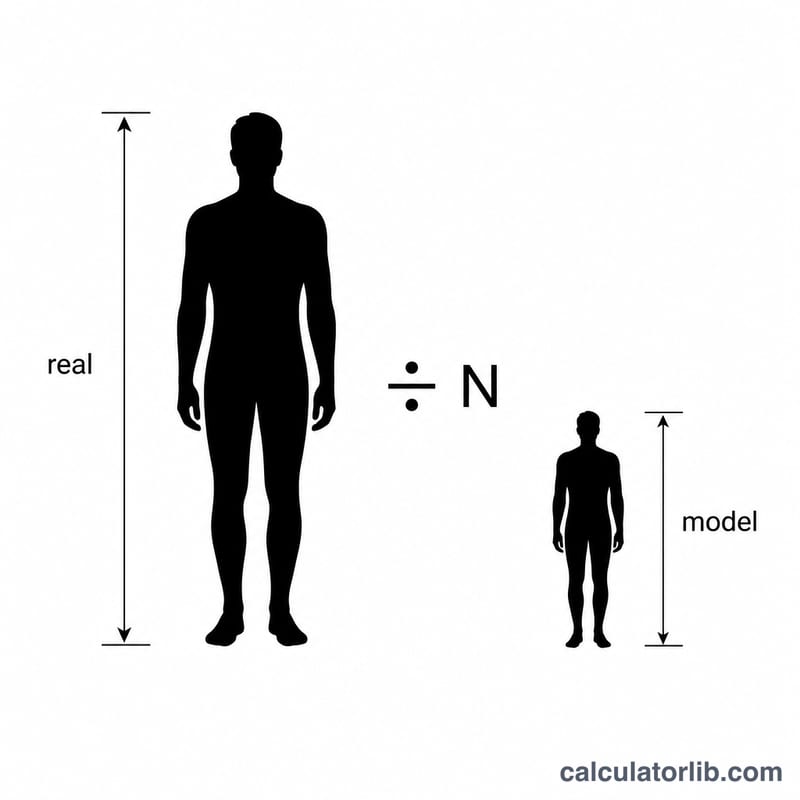
A scale of 1:N means one unit on the model equals N units in real life. To find the model size you simply divide the real size by N:
$$\text{model dim} = \text{real dim} \div N$$
So a doubling of the scale denominator halves every model measurement. The conversion is linear, which is why a single ratio governs height, width and depth alike.
Worked example
Suppose a tank is 7000 mm long and you build at 1:35. Then $$\text{model length} = 7000 \div 35 = 200\ \text{mm}.$$ A 1.8 m (1800 mm) figure at 1:35 becomes \(1800 \div 35 \approx 51.4\ \text{mm}\), a typical 54 mm-ish gaming figure height.
Common Model Scales and Their Typical Uses
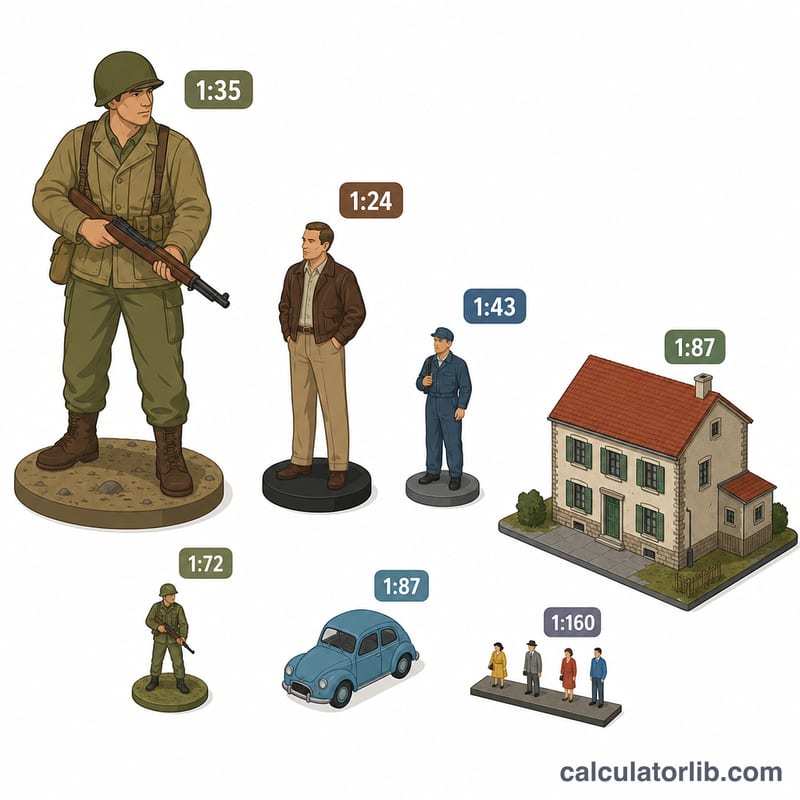
A scale of 1:N means one unit on the model represents N units on the real object. The model size is the real size divided by N, or equivalently the real size times the decimal factor 1/N. The table uses a real object 1800 mm (1.8 m) long or tall, about the height of an adult person. Typical uses are general and vary by manufacturer and region.
| Scale | Decimal factor (1/N) | 1800 mm real object becomes (mm) | Typical use |
|---|---|---|---|
| 1:12 | 0.08333 | 150 | Dollhouse miniatures, large figures |
| 1:16 | 0.06250 | 112.5 | Large figures, farm and construction models |
| 1:24 | 0.04167 | 75 | Model cars |
| 1:32 | 0.03125 | 56.25 | Figures, vehicles, some model railways |
| 1:35 | 0.02857 | 51.43 | Military armor and figures |
| 1:43 | 0.02326 | 41.86 | Die-cast cars |
| 1:48 | 0.02083 | 37.5 | Aircraft, O gauge railway (US) |
| 1:72 | 0.01389 | 25 | Aircraft kits, small military vehicles |
| 1:76 | 0.01316 | 23.68 | OO gauge railway (UK) |
| 1:87 | 0.01149 | 20.69 | HO gauge railway |
| 1:144 | 0.00694 | 12.5 | Small aircraft, ships |
| 1:160 | 0.00625 | 11.25 | N gauge railway |
| 1:220 | 0.00455 | 8.18 | Z gauge railway |
Values are rounded to two decimals (factors to four or five significant digits).
Same Object at Different Scales
Each result is the real length in mm divided by N. The real sizes are 1.8 m = 1800 mm (figure), 4.0 m = 4000 mm (car) and 7.0 m = 7000 mm (tank length). All results are in millimeters, rounded to two decimals.
| Scale | Figure 1800 mm | Car 4000 mm | Tank 7000 mm |
|---|---|---|---|
| 1:12 | 1800 ÷ 12 = 150 | 4000 ÷ 12 = 333.33 | 7000 ÷ 12 = 583.33 |
| 1:35 | 1800 ÷ 35 = 51.43 | 4000 ÷ 35 = 114.29 | 7000 ÷ 35 = 200 |
| 1:72 | 1800 ÷ 72 = 25 | 4000 ÷ 72 = 55.56 | 7000 ÷ 72 = 97.22 |
| 1:87 | 1800 ÷ 87 = 20.69 | 4000 ÷ 87 = 45.98 | 7000 ÷ 87 = 80.46 |
| 1:144 | 1800 ÷ 144 = 12.5 | 4000 ÷ 144 = 27.78 | 7000 ÷ 144 = 48.61 |
Worked example: a 7 m tank at 1:72 gives \(\frac{7000\ \text{mm}}{72} \approx 97.22\ \text{mm}\). Note that the same real object shrinks by the ratio of the two scales, so a 1:35 model is about twice the length of a 1:72 model of the same subject.
Millimeter, Centimeter and Inch Conversion Reference
The unit selector in the calculator converts your input to millimeters using these exact factors:
- 1 in = 25.4 mm (exact)
- 1 ft = 304.8 mm (exact, 12 in)
- 1 cm = 10 mm
- 1 m = 1000 mm
So the formula is \(\text{Model (mm)} = \frac{\text{Real} \times k}{N}\), where k is the factor above for the chosen unit and N is the scale number. Example: 6 ft at 1:35 gives \(\frac{6 \times 304.8}{35} = \frac{1828.8}{35} \approx 52.25\ \text{mm}\).
| Millimeters | Centimeters | Inches (approx.) |
|---|---|---|
| 10 mm | 1 cm | 0.39 in |
| 25.4 mm | 2.54 cm | 1 in (exact) |
| 50 mm | 5 cm | 1.97 in |
| 100 mm | 10 cm | 3.94 in |
| 150 mm | 15 cm | 5.91 in |
| 200 mm | 20 cm | 7.87 in |
To convert millimeters to inches, divide by 25.4. Inch values here are rounded to two decimals.
FAQ
What does 1:35 mean? It means the model is 1/35th the size of the real object — divide every real measurement by 35.
Can I go from model size back to real size? Yes — just multiply the model dimension by N instead of dividing. This tool computes the model size; reverse the operation for the real size.
Which units can I use? Millimeters, centimeters, meters, inches and feet. The output keeps your selected unit and also shows millimeters for precision when cutting parts.