
What Is a Circle Skirt Calculator?
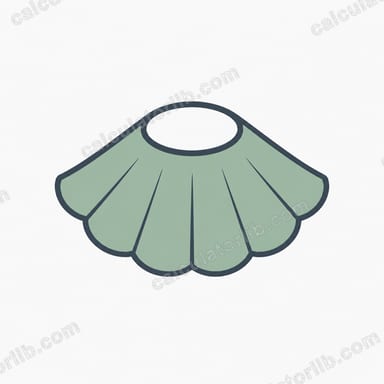
A circle skirt calculator works out the exact measurements you need to cut a flowing, gathered-free skirt from fabric. Instead of guessing or drafting by trial and error, you enter your waist circumference and desired skirt length, pick your fullness (full, 3/4, half, or quarter circle), and the tool returns the radius for the waist opening and the total radius to cut. This works with any unit (inches or centimetres) as long as you stay consistent.
How to Use It
- Measure your waist — wrap a tape measure snugly around where the skirt will sit. Add 1–2 cm (about ½ inch) ease if you want a little breathing room.
- Choose skirt length — measure from your waist down to where you want the hem to fall.
- Select a style — full circle gives maximum twirl and drape, while half and quarter circles use less fabric and produce a slimmer flare.
- Read your results — the calculator gives the waist radius (the small circle you cut out) and the outer radius (waist radius + length).
The Formula Explained
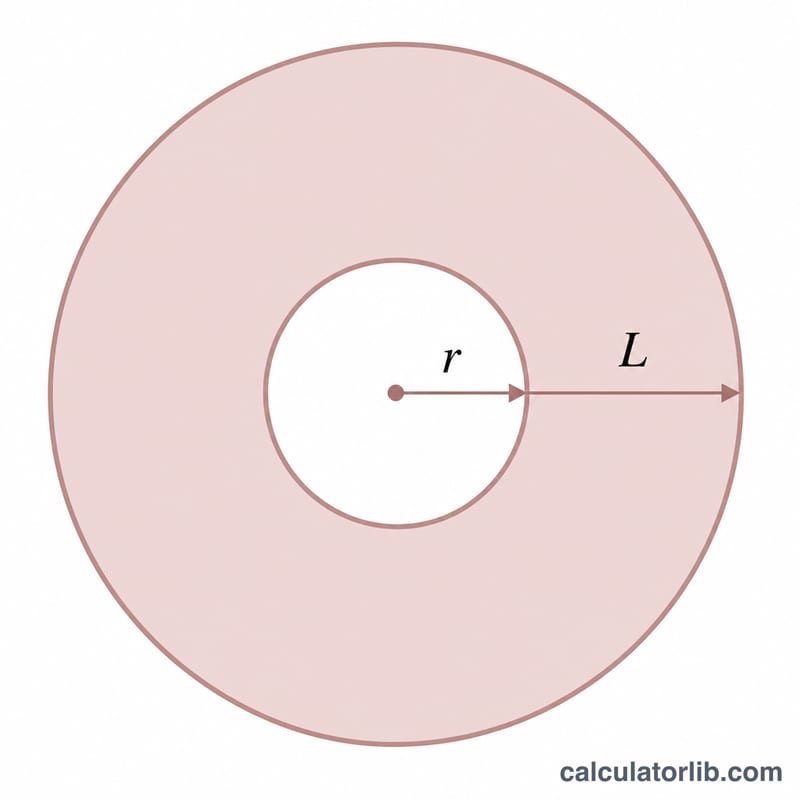
The waist hole is a circle, and its circumference equals your waist measurement. To find the radius, you divide the waist by 2π, then adjust for fullness:
- Full circle: \(\text{Waist radius} = \text{Waist} \div (2 \times \pi)\)
- 3/4 circle: \(\text{Waist radius} = \text{Waist} \div (1.5 \times \pi)\)
- Half circle: \(\text{Waist radius} = \text{Waist} \div \pi\)
- Quarter circle: \(\text{Waist radius} = (2 \times \text{Waist}) \div \pi\)
The outer cutting radius is simply the waist radius plus your skirt length. Mark both arcs from the same centre point, and you have your pattern.
$$\begin{gathered} r_{w} = \frac{\text{Waist}}{2\pi \cdot f} \qquad R = r_{w} + \text{Length} \\[1.5em] \text{Fabric} = \pi \, R^{2} \cdot f \quad\text{where}\quad f = 1 \;(\text{Full circle}) \end{gathered}$$
Worked Example
Say your waist is 28 inches and you want a 20-inch full circle skirt. Waist radius = \(28 \div (2 \times 3.14159) \approx 4.46\) inches. Outer radius = \(4.46 + 20 = 24.46\) inches. Cut a small arc at 4.46 inches and a large arc at 24.46 inches from the same point.
$$\text{Waist radius} = \frac{28}{2 \times 3.14159} \approx 4.46 \text{ inches}$$$$R = 4.46 + 20 = 24.46 \text{ inches}$$FAQ
How much fabric do I need? For a full circle, you usually need a width of at least twice the outer radius, often requiring 2–4 metres depending on length and fabric width.
Should I add a seam allowance? Yes — add about 1.5 cm (⅝ inch) to the waist and hem after marking your arcs.
Why is my waist hole too small? Stretchy fabrics and seam allowances can tighten the opening; always add ease and test before cutting.