
What the Soil Calculator Does
The Soil Calculator works out how much soil you need to fill a rectangular garden bed, planter, or landscaping area. From four simple measurements it calculates the area, the soil volume (in cubic metres, cubic yards and litres) and the total weight (in kilograms, tonnes and pounds). Because it accepts metric dimensions and soil density, it works for gardeners and landscapers worldwide.
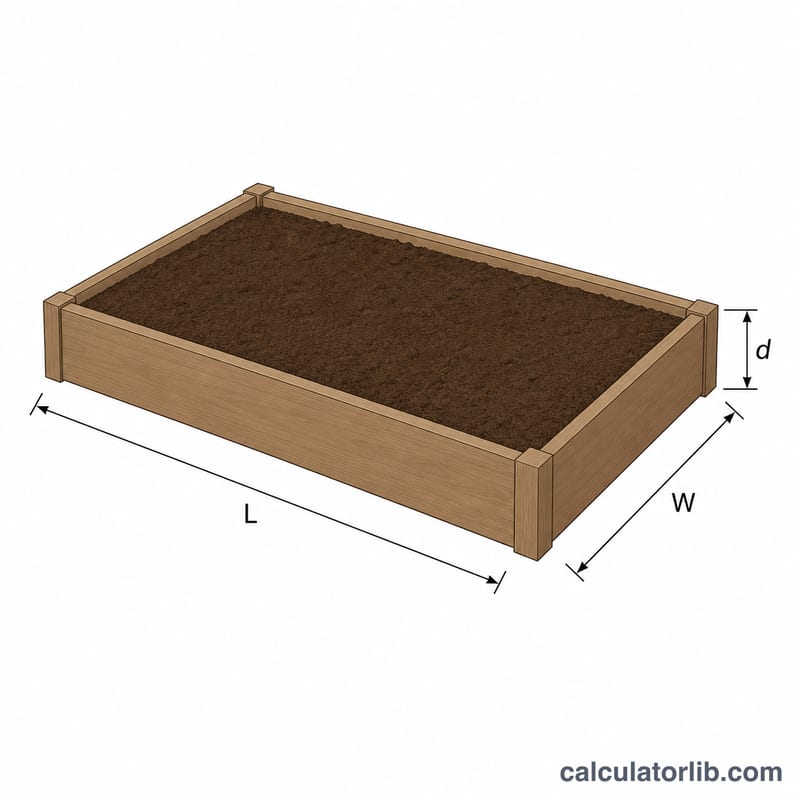
The Input Fields Explained
- Garden Length (metres) – the longest side of your bed or plot.
- Garden Width (metres) – the shorter side; length \(\times\) width gives the surface area.
- Desired Soil Depth (centimetres) – how deep you want the soil layer. This is entered in cm and converted to metres internally by dividing by 100.
- Soil Density (kg/m\(^3\)) – the mass of one cubic metre of your chosen soil. Loose topsoil is roughly 1,200–1,400 kg/m\(^3\); compost is lighter, while wet or sandy soils are heavier.
The Formula
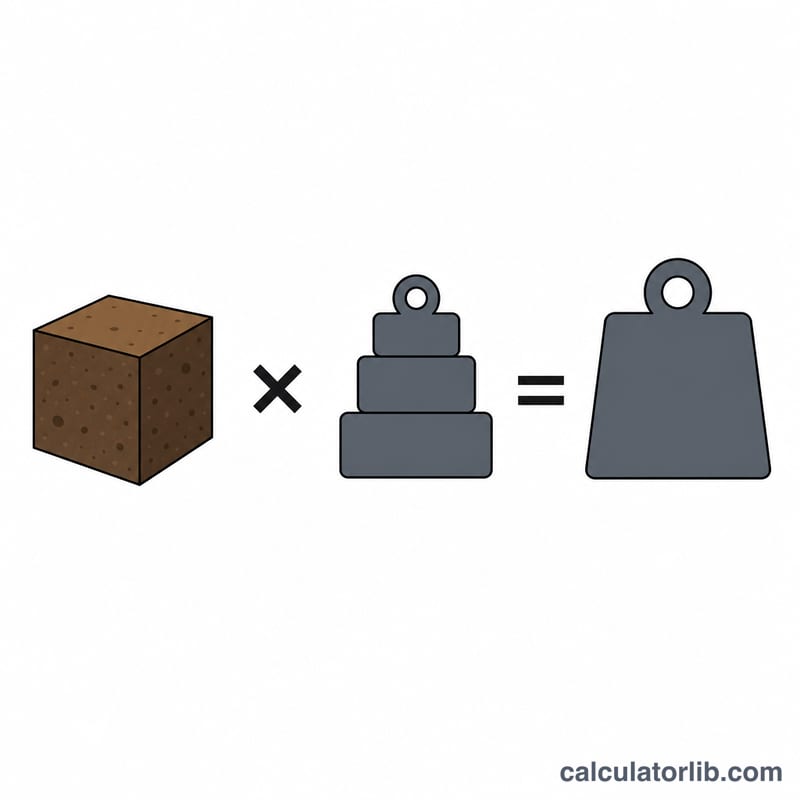
The calculator first finds the volume, then multiplies by density to get weight:
$$V = \text{Length (m)} \times \text{Width (m)} \times \dfrac{\text{Depth (cm)}}{100}$$
$$W = \text{Length (m)} \times \text{Width (m)} \times \dfrac{\text{Depth (cm)}}{100} \times \text{Density (kg/m}^3)$$
It then converts the results: cubic metres \(\times 1.30795 =\) cubic yards, \(\times 1000 =\) litres; and kilograms \(\div 1000 =\) tonnes, \(\times 2.20462 =\) pounds.
Worked Example
Suppose you have a raised bed 4 m long and 2 m wide, and you want 20 cm of topsoil with a density of 1,300 kg/m\(^3\).
- Area \(= 4 \times 2 = 8 \text{ m}^2\)
- Volume \(= 8 \times (20 \div 100) = 1.6 \text{ m}^3\) (≈ 1,600 litres, or about 2.09 cubic yards)
- Weight \(= 1.6 \times 1{,}300 = 2{,}080 \text{ kg}\) (≈ 2.08 tonnes, or about 4,586 lb)
So you would order roughly 1.6 m\(^3\) — a little over two tonnes — of topsoil.
Frequently Asked Questions
What soil density should I use? If you don't know, use 1,300 kg/m\(^3\) as a reasonable average for moist topsoil. Compost is around 800–900 kg/m\(^3\), while heavy clay or wet soil can exceed 1,600 kg/m\(^3\). Your supplier can often provide an exact figure.
Why is depth entered in centimetres but everything else in metres? Soil layers are usually only a few centimetres deep, so cm is more practical. The calculator divides by 100 to convert it to metres before multiplying.
Should I order extra? Yes — soil settles and compacts, so adding about 5–10% to your calculated volume helps avoid running short.