What this calculator does
The Flower Pot Soil Volume Calculator estimates how much potting soil fills a tapered flower pot. Most pots are wider at the top than at the bottom, so the soil cavity is shaped like a truncated cone (a conical frustum) rather than a simple cylinder. By entering the top diameter, bottom diameter, and the height of the soil column, you get the exact soil volume in cubic centimeters (cm³, equal to milliliters) and in liters. This is pure geometry, so it works anywhere — no country-specific rules apply.
How to use it
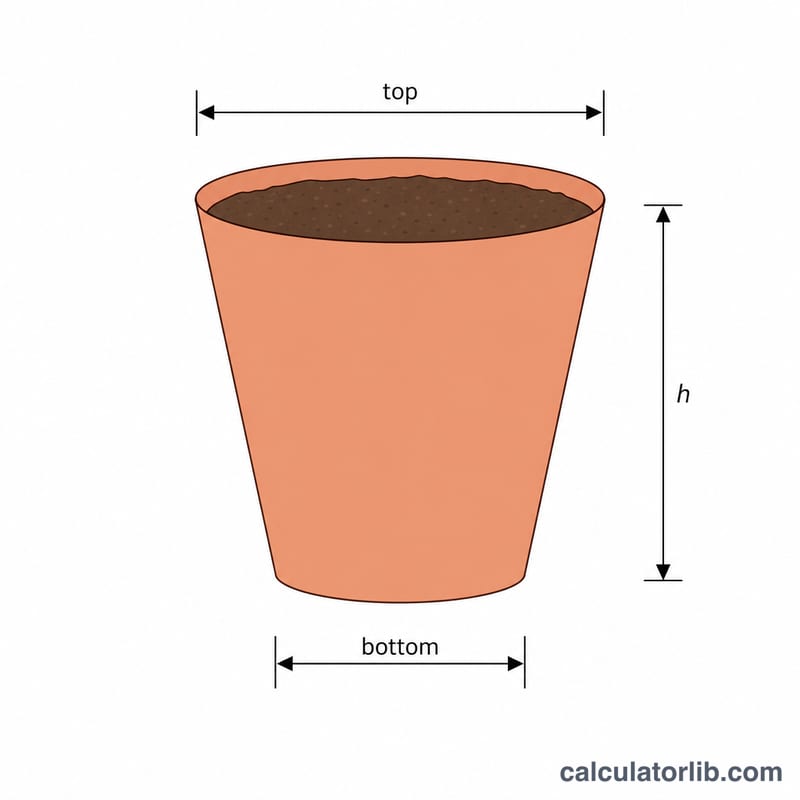
Measure three things with a ruler or tape, all in centimeters: the diameter across the top circular opening of the soil, the diameter across the bottom circle of the soil, and the vertical height of the soil from base to surface. Enter each value and read the result. If your pot has a uniform width, just enter the same value for both diameters and the tool treats it as a cylinder.
The formula explained
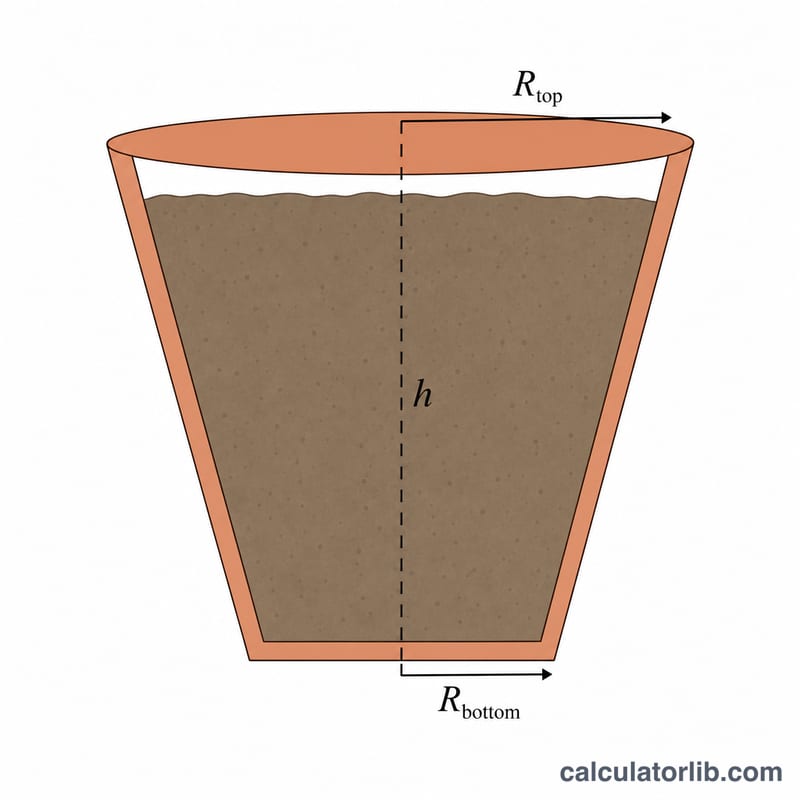
The volume of a conical frustum is $$V = \frac{\pi \times h}{3} \times \left(R_{top}^{2} + R_{top} \times R_{bottom} + R_{bottom}^{2}\right)$$ where \(R_{top}\) and \(R_{bottom}\) are the radii (half of each diameter) and \(h\) is the height. Because diameters are easier to measure, the equivalent diameter form is $$V = \frac{\pi \times h}{12} \times \left(D_{top}^{2} + D_{top} \times D_{bottom} + D_{bottom}^{2}\right)$$ When the top and bottom are equal it reduces to the cylinder formula \(\pi R^{2} h\); when the bottom diameter is zero it becomes a full cone.
Worked example
Suppose the top diameter is 12 cm, the bottom diameter is 10 cm, and the soil height is 8 cm. The radii are 6 cm and 5 cm. Then \(R_{top}^{2} + R_{top} \times R_{bottom} + R_{bottom}^{2} = 36 + 30 + 25 = 91\). So $$V = \frac{\pi \times 8}{3} \times 91 \approx 8.3776 \times 91 \approx 762.36 \text{ cm}^{3}$$ which is about 762 mL or 0.762 liters of soil.
Soil Volume for Common Pot Sizes
The table uses the conical frustum formula \(V = \frac{\pi h}{3}\left(r_t^2 + r_t r_b + r_b^2\right)\), with radii equal to half the diameters. Diameters and height are in cm. The height is the soil height, measured to below the rim, not the full height of the pot.
| Top Ø (cm) | Bottom Ø (cm) | Soil height (cm) | Volume (cm³) | Volume (L) |
|---|---|---|---|---|
| 10 | 7 | 9 | 516 | 0.52 |
| 15 | 11 | 14 | 1,873 | 1.87 |
| 20 | 14 | 18 | 4,128 | 4.13 |
| 25 | 18 | 22 | 8,058 | 8.06 |
| 30 | 22 | 28 | 14,983 | 14.98 |
Worked example for the 20/14/18 pot: \(r_t = 10\), \(r_b = 7\), so \(V = \frac{\pi \cdot 18}{3}(10^2 + 10\cdot 7 + 7^2) = 6\pi \cdot 219 \approx 4{,}128\) cm³, which is about 4.13 L.
Note: the soil height is measured from the bottom of the pot up to the soil surface, which should sit 2–3 cm below the rim. If you measure the full pot height, the result will overstate the soil you need.
Practical Tips for Buying and Filling Soil
- Add about 10% extra. Potting mix settles and compacts after watering. Example: an 8.06 L pot needs about 8.06 × 1.10 ≈ 8.9 L.
- Round up to the next bag size. Common bag sizes are 5, 10, 20 and 50 L, though this varies by region and brand. In the example above, one 10 L bag is enough.
- Leave 2–3 cm below the rim. This space holds water during watering so it does not overflow. Use the soil height, not the full pot height, in the calculator.
- Account for drainage material. A layer of stones, clay pebbles or shards at the bottom takes up space. Subtract its volume, or use a smaller soil height, if you add one.
- Subtract the root ball when repotting. The plant's existing root ball displaces soil. Estimate its volume (for example, as a small cylinder) and subtract it from the pot volume.
- Buy for several pots together. Add up the volumes of all your pots, then apply the 10% allowance once to the total before choosing bags.
These are general gardening guidelines. Plants differ, so follow the planting instructions for your species and potting mix.
Volume Unit Conversions
| Conversion | Value |
|---|---|
| 1 cm³ to millilitres | 1 cm³ = 1 mL |
| Cubic centimetres to litres | 1,000 cm³ = 1 L |
| Litres to US gallons | 1 L = 0.264172 US gal |
| Litres to US quarts | 1 L = 1.05669 US qt |
| US quart to litres | 1 US qt = 0.946353 L |
| US gallon to litres | 1 US gal = 3.78541 L |
| Cubic foot to litres | 1 ft³ = 28.3168 L |
| Litres to cubic feet | 1 L = 0.0353147 ft³ |
| Inches to centimetres | 1 in = 2.54 cm |
| Cubic inch to cm³ | 1 in³ = 16.3871 cm³ |
Gallons and quarts here are US liquid units. Imperial (UK) gallons and quarts are different sizes. To use inch measurements in the calculator, multiply each by 2.54 to get centimetres.
FAQ
Is cm³ the same as milliliters? Yes. One cubic centimeter equals exactly one milliliter, so 762 cm³ is 762 mL.
How many liters does my pot need? Divide the cm³ result by 1000. The calculator shows the liter figure for you, which is handy for matching bagged potting soil sizes.
Should I leave space below the rim? Yes — measure the height only up to where you want the soil surface, not to the top edge of the pot, so you account for a watering gap.