
What this calculator does
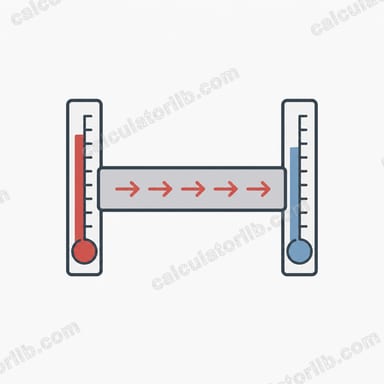
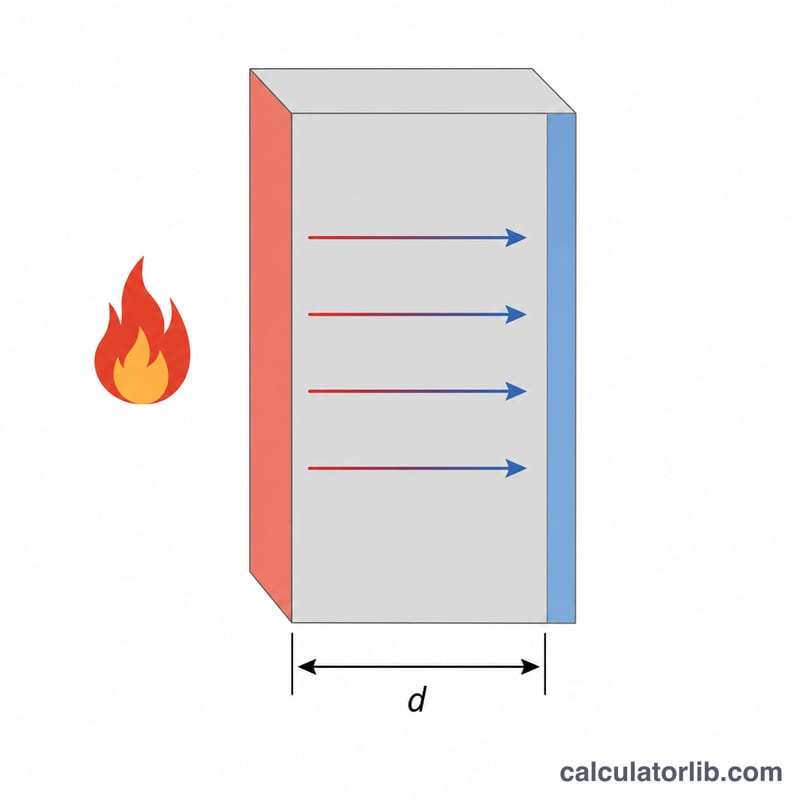
Thermal conductivity measures how readily a material conducts heat. It is expressed in many different unit systems depending on the field and country: metric, SI, calorie-based and imperial (yard-pound). This converter takes a single thermal conductivity value in any one of seven units and instantly reports its equivalent in all seven, so you can compare datasheets and textbooks without manual arithmetic. It is a pure-physics conversion that applies identically everywhere.
How to use it
Enter your thermal conductivity value, then choose the unit it is expressed in from the dropdown. The results table shows the same physical quantity in W/(m·K), kW/(m·K), J/(cm·s·°), kcal/(m·h·°), cal/(cm·s·°), BTU/(ft·h·°F) and BTU/(in·h·°F). The SI value, the watt per metre-kelvin, is highlighted at the top.
The formula explained
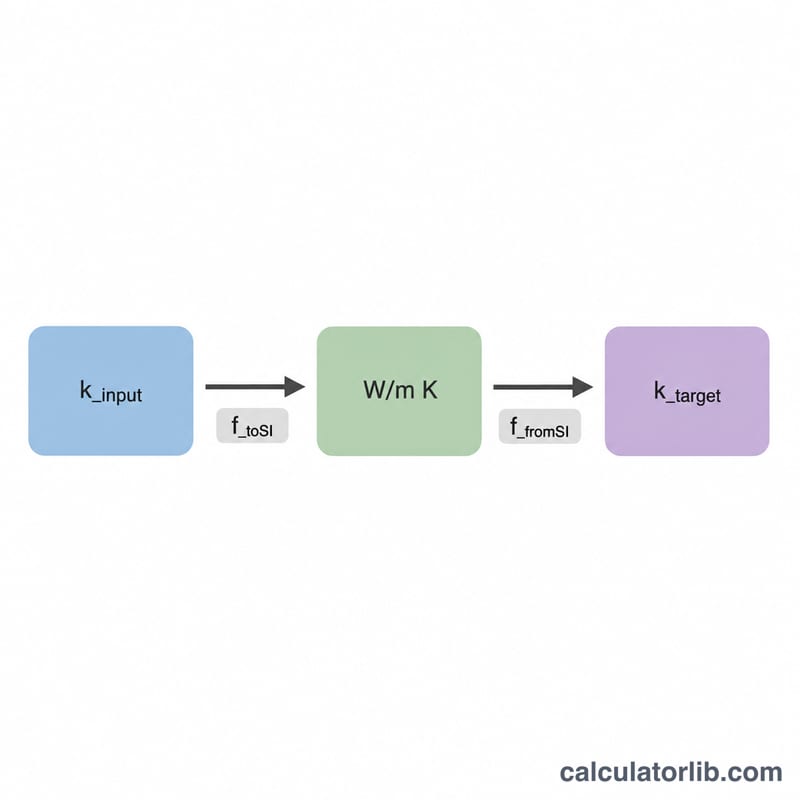
The method is "normalize then scale". First the input is converted to the SI base unit by multiplying by its to-SI factor: W/(m·K)=1, kW/(m·K)=1000, J/(cm·s)=100, kcal/(m·h)=1.163, cal/(cm·s)=418.68, BTU/(ft·h·°F)=1.730735, BTU/(in·h·°F)=20.76882. The SI value is then multiplied by each target unit's from-SI factor (the reciprocal of its to-SI factor) to fill the table:
$$k_{\text{SI}} = \text{Conductivity} \times f_{\text{Unit}} \quad\left[\frac{\text{W}}{\text{m}\cdot\text{K}}\right]$$
Because a temperature interval of 1 K equals 1 °C and 1.8 °F, only the scale of the degree matters here — never the +32 or +273.15 offset.
Worked example
Enter 50 with unit kcal/(m·h·°C). Step 1: \(k_{\text{SI}} = 50 \times 1.163 = 58.15\) W/(m·K). Step 2:
$${\text{BTU/(ft}\cdot{\text{h}\cdot\text{°F)}}} = 58.15 \times 0.577789 = 33.60$$
$${\text{cal/(cm}\cdot{\text{s}\cdot\text{°C)}}} = 58.15 \times 0.00238846 = 0.1389$$
So 50 kcal/(m·h·°C) is about 58.15 W/(m·K).
FAQ
Which calorie is used? The International Table calorie of 4.1868 J, giving the standard factors 0.859845 and 0.00238846. The thermochemical calorie (4.184 J) would differ slightly.
Can I enter 0 or a negative value? Zero converts to zero everywhere. Negative values convert mathematically but are physically meaningless for real materials.
Why is the inch BTU value 12 times the foot value? Because 1 foot equals 12 inches, so the per-inch flux is twelve times larger for the same conductivity.