
What is the Radioactivity Unit Conversion Calculator?
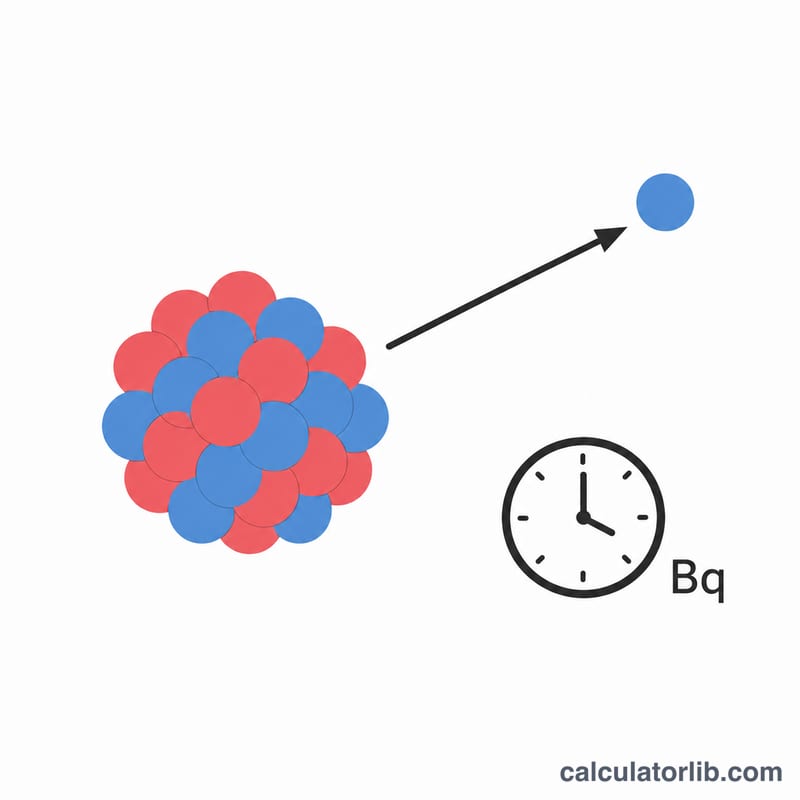
This tool converts a radioactivity (activity) value between the SI Becquerel system and the historical Curie system. Radioactivity measures how many atomic nuclei decay per unit time. It is a pure metrology tool that applies internationally, since the relationship between units is a fixed scientific standard.
How to use it
Enter your activity value, then pick the unit it is expressed in from the dropdown (for example Curie or megaBecquerel). The calculator instantly shows the equivalent value in all twelve supported units, grouped into the Becquerel system (mBq, Bq, kBq, MBq, GBq, TBq) and the Curie system (pCi, nCi, uCi, mCi, Ci, kCi).
The formula explained
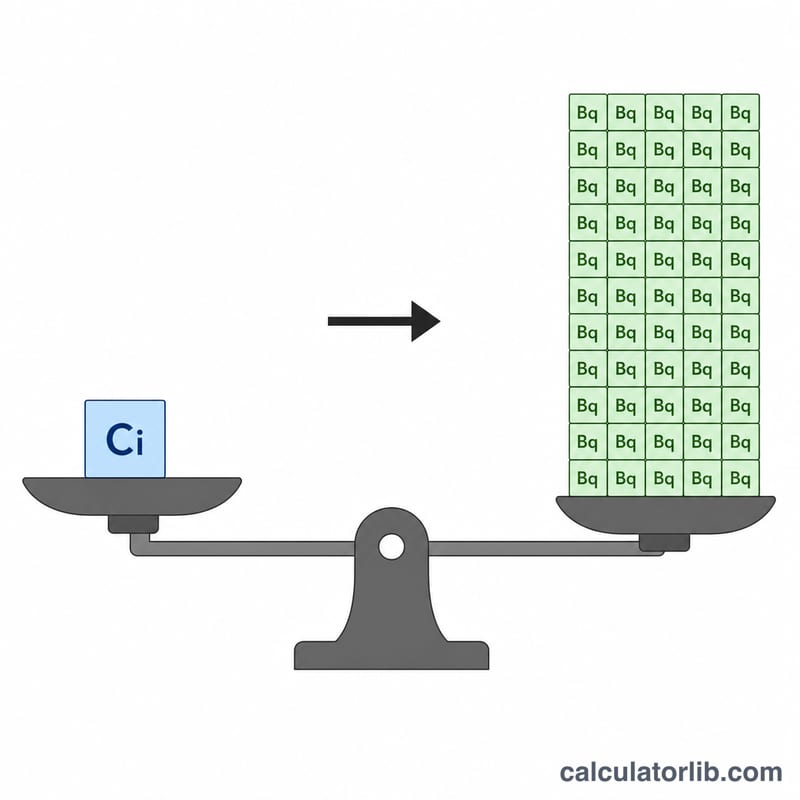
The base SI unit is the Becquerel (Bq), defined as one disintegration per second. The Curie (Ci) is defined exactly as \(1\ \text{Ci} = 3.7 \times 10^{10}\ \text{Bq}\). To convert, the input is first normalized to Becquerel:
$$\text{activityBq} = \text{activity} \times \text{factorToBq}$$Each output unit is then computed as activityBq divided by that unit's factor to Bq.
Worked example
Input: 1 Curie.
$$\text{activityBq} = 1 \times 3.7\mathrm{e}{10} = 37{,}000{,}000{,}000\ \text{Bq}$$This equals 37,000 MBq, 37 GBq, 0.037 TBq, 1,000 mCi, and 0.001 kCi, while \(\text{pCi} = 1\mathrm{e}{12}\). These match standard reference tables exactly.
FAQ
Why is 1 Curie equal to 3.7e10 Bq? The Curie was originally based on the activity of one gram of radium-226; the conventional exact value \(3.7 \times 10^{10}\) disintegrations per second was later fixed by definition.
Can activity be negative? Physically activity is never negative, but the linear conversion still works mathematically. Use non-negative values for meaningful results.
Which unit should I report in? Scientific and regulatory contexts increasingly use SI Becquerel-based units, while older literature and some medical fields still use Curie-based units.