
What is absorbed dose?
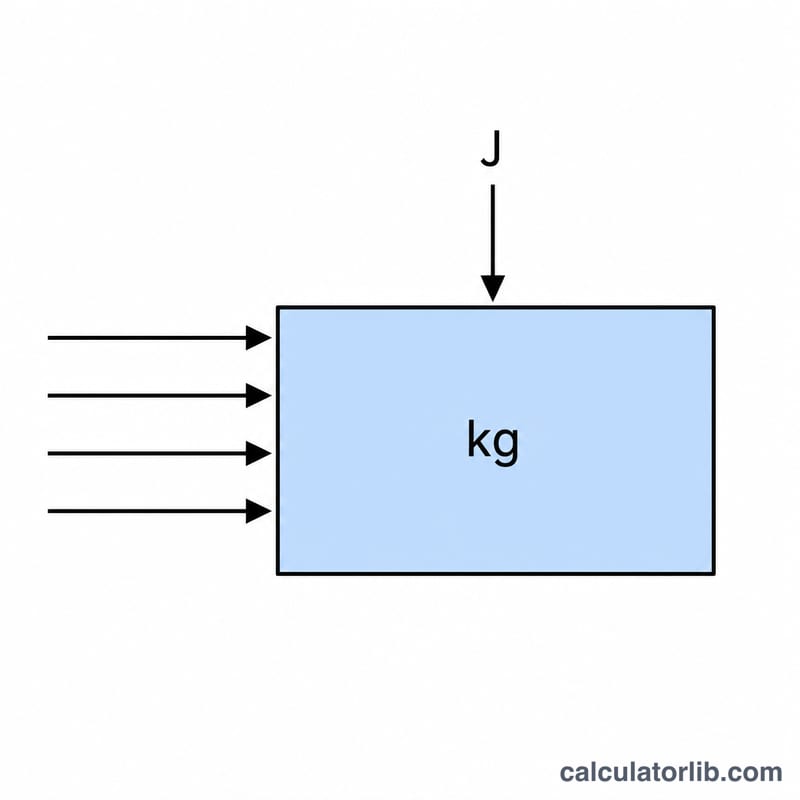
Absorbed dose is the amount of energy deposited by ionizing radiation per unit mass of matter. Its SI unit is the gray (Gy), where 1 Gy equals 1 joule per kilogram (1 J/kg). The older CGS unit is the rad, where 1 rad = 0.01 Gy. This converter changes a value of absorbed dose between gray and its metric prefixes (from petagray down to picogray) and the radiation units rad and millirad.
How to use the converter
Enter the numeric absorbed dose, pick the unit it is expressed in, and the calculator instantly displays the same physical quantity in every supported unit. Because all units are linearly related with no offset, the result is exact scaling.
The formula explained
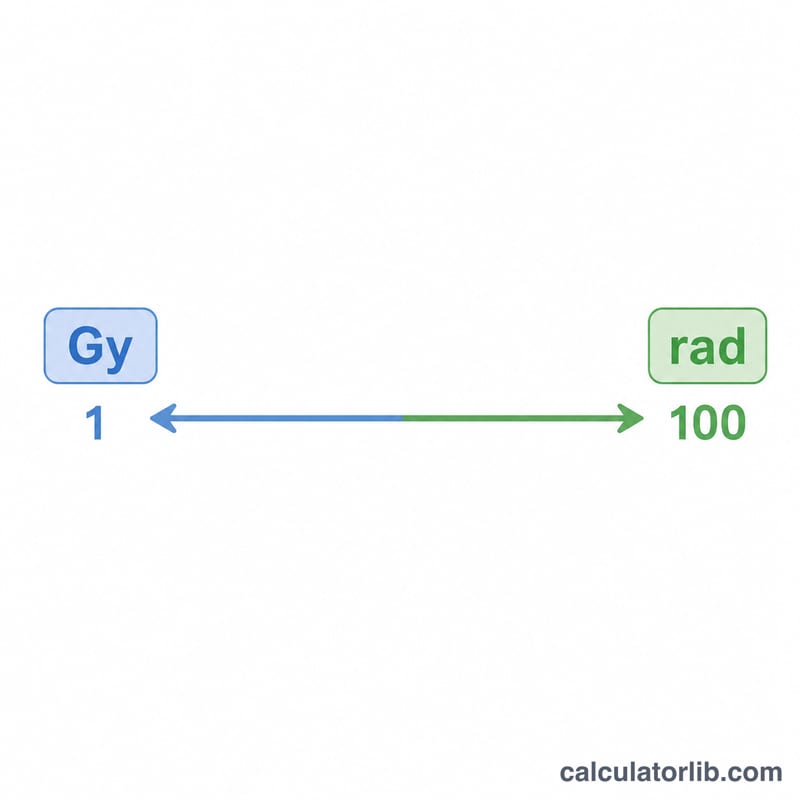
Every unit has a fixed factor that converts it to the base unit gray. First the input is normalised to gray: $$\text{doseGy} = \text{doseValue} \times \text{factor}_{from}$$ Then each output is found by dividing by the target factor: $$\text{value}_{target} = \frac{\text{doseGy}}{\text{factor}_{target}}$$ Combined, $$\text{value}_{target} = \text{doseValue} \times \frac{\text{factor}_{from}}{\text{factor}_{target}}$$ For example, 1 gray uses factor 1; rad uses 0.01, so \(1\ \text{Gy} / 0.01 = 100\ \text{rad}\).
Worked example
Convert 250 rad. The rad factor is 0.01, so $$\text{doseGy} = 250 \times 0.01 = 2.5\ \text{Gy}$$ Centigray = \(2.5 / 0.01 = 250\ \text{cGy}\), milligray = \(2.5 / 0.001 = 2500\ \text{mGy}\), and rad = 250 rad. This confirms the handy relation 1 cGy = 1 rad.
Interpreting Absorbed Dose Values
Absorbed dose describes how much energy ionizing radiation deposits per kilogram of tissue or material. It is a purely physical quantity and says nothing, on its own, about biological harm. To estimate biological risk you must convert to equivalent dose (sieverts) by multiplying by a radiation weighting factor — for example, the Gray to Sievert converter applies factors such as 1 for X-rays and gamma rays, 20 for alpha particles, and energy-dependent values for neutrons. The numbers below are absorbed dose for orientation only.
| Situation | Approximate absorbed dose | Notes |
|---|---|---|
| Single chest X-ray (organ dose) | ~0.1 mGy | Order-of-magnitude; varies with technique and patient size. |
| Abdominal/pelvic CT scan (organ dose) | ~10–25 mGy | Depends heavily on protocol and scanner settings. |
| Average natural background (per year, whole body) | ~2.4 mGy | Global average; locally ranges roughly 1–10 mGy. |
| Threshold for temporary skin reddening (erythema) | ~2 Gy (acute, localized) | Deterministic effect with a dose threshold. |
| Threshold for acute radiation syndrome | ~1 Gy (acute, whole body) | Nausea and blood-count changes begin near this level. |
| LD50/60 (lethal to ~50% within 60 days, untreated) | ~4–5 Gy (acute, whole body) | Medical care raises survivable dose substantially. |
| Typical curative radiotherapy total | ~50–70 Gy | Delivered in many small daily fractions (commonly ~2 Gy each) to limited tissue volumes. |
Two important distinctions:
- Acute vs. fractionated/chronic. The threshold figures above apply to a single short exposure of the whole body. The same total dose spread over many small fractions or over years is far less harmful because tissue repairs between exposures — which is exactly why radiotherapy can use 50–70 Gy safely on a target while sparing surrounding tissue.
- Local vs. whole-body. A high dose to a small volume (e.g. a tumor) has very different consequences from the same dose delivered to the entire body.
A 2 Gy radiotherapy fraction of gamma radiation, where the weighting factor is 1, corresponds to an equivalent dose of 2 Sv; for alpha radiation the same 2 Gy would correspond to a much larger equivalent dose because of its weighting factor of 20.
This section is general scientific information, not medical advice. Radiation exposure should be assessed and managed by qualified medical physicists and clinicians.
FAQ
Is gray the same as sievert? No. Gray and rad measure absorbed dose (energy per mass). Sievert and rem measure equivalent or effective dose, which weights for radiation type and tissue sensitivity. This tool does not convert between those scales.
How many rad are in a gray? Exactly 100 rad = 1 Gy, and 1 rad = 1 cGy.
Can I enter zero or negative values? Mathematically yes; the scaling still works. Physically, absorbed dose is never negative.