
What is the Momentum Unit Converter?
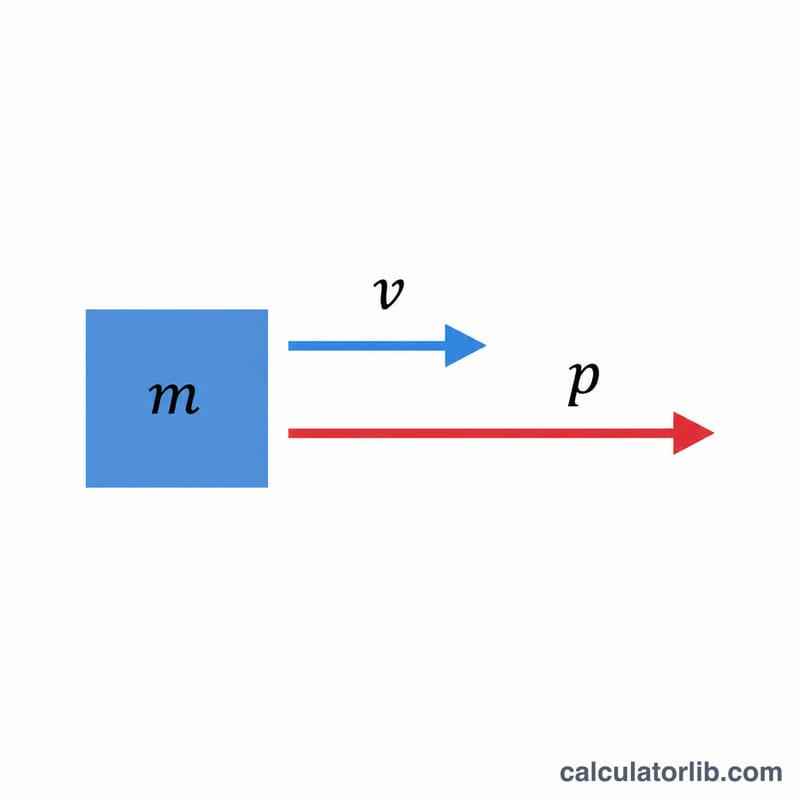
This tool converts a value of momentum (or impulse, the same physical quantity) from one unit to another. Linear momentum is mass times velocity, and its SI unit is the kilogram-meter per second (kg·m/s). Because impulse equals force times time, the newton-second (N·s) is dimensionally identical — 1 N·s = 1 kg·m/s. Every unit in this converter is expressed in, or reduced to, this common SI base, so any pair of units can be converted directly.
How to use it
Type the number you want to convert in the "Value to Convert" box (it may be negative, since a momentum component can point either way). Choose the unit you are converting from and the unit you are converting to, then read the result. The page also shows the exact multiplication factor, so you can reuse it for other quick conversions.
The formula explained
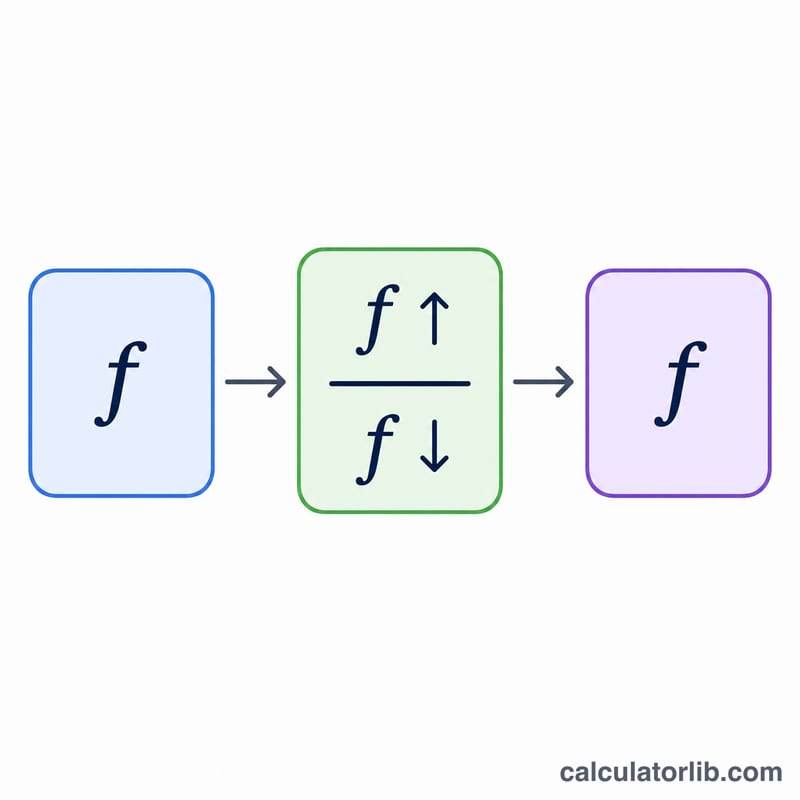
Each unit has a scale factor that turns one of that unit into kg·m/s. For example, 1 N·min = 60 kg·m/s and 1 lbf·s = 4.4482216152605 kg·m/s. The conversion is simply:
$$\text{result} = \text{value} \times \frac{f_{\text{from}}}{f_{\text{to}}}$$
Internally the value is first normalized to SI (\(\text{value} \times f_{\text{from}}\)), then divided by the target unit's factor. Since every factor is a positive nonzero constant, there is never a division-by-zero, and converting a unit to itself returns the original value.
Worked example
Convert 1 pound-force second (lbf·s) to kilogram-meter per second. The factor for lbf·s is 4.4482216152605 and the factor for kg·m/s is 1, so the result is $$1 \times \frac{4.4482216152605}{1} = 4.448 \ \text{kg}\cdot\text{m/s}$$
FAQ
Are momentum and impulse the same unit? Yes. Impulse changes momentum, and both share the unit kg·m/s = N·s, so this converter handles both.
Why does N·s equal kg·m/s? A newton is kg·m/s²; multiply by seconds and the result is kg·m/s. They are exactly equivalent.
Can I enter negative values? Yes. Momentum is a vector, so a negative sign indicates the opposite direction and is preserved in the output.