
What is an Astronomical Unit?
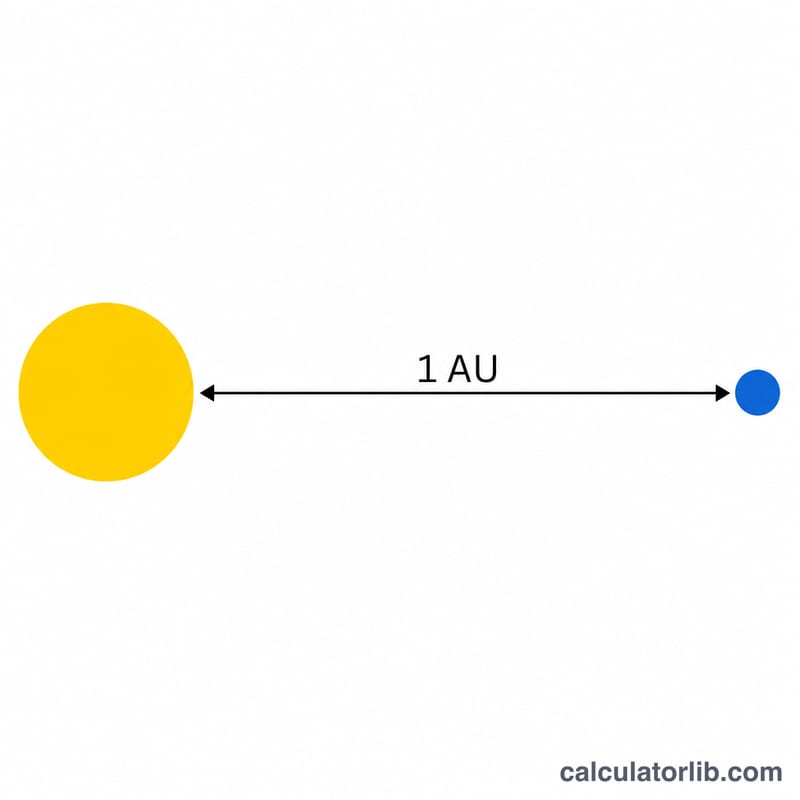
An astronomical unit (AU) is a unit of length used to measure distances within the solar system. It is defined as exactly 149,597,870,700 metres (149,597,870.7 km), which is approximately the mean distance from the Earth to the Sun. Because planetary distances are enormous when expressed in kilometres, astronomers prefer the AU as a more manageable scale — for example, Neptune orbits at roughly 30 AU from the Sun.
How to use this calculator
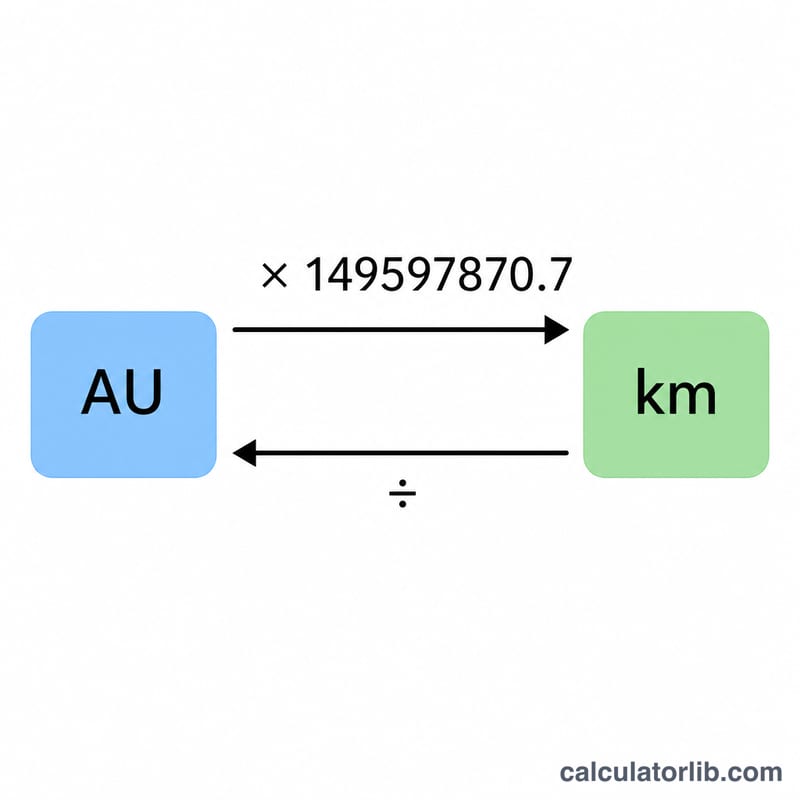
Choose your conversion direction — AU → km or km → AU — then enter the value you want to convert. The calculator instantly returns the equivalent distance using the official IAU-defined constant of 149,597,870.7 km per AU.
The formula explained
The conversion is a simple multiplication or division by a single constant:
$$\text{km} = \text{AU} \times 149{,}597{,}870.7$$
$$\text{AU} = \text{km} \div 149{,}597{,}870.7$$
This constant was fixed by the International Astronomical Union in 2012 as an exact value, replacing the older definition based on the gravitational parameter of the Sun.
Worked example
How far is Mars from the Sun if its mean orbital distance is 1.524 AU? Multiply: $$1.524 \times 149{,}597{,}870.7 \approx 227{,}987{,}154.95 \text{ km}.$$ So Mars orbits about 228 million kilometres from the Sun.
FAQ
Is 1 AU exactly the Earth–Sun distance? No — it is approximately the mean Earth–Sun distance, but it is now defined as an exact fixed number of metres rather than measured each time.
How many AU is a light-year? About 63,241 AU, since a light-year is far larger than solar-system scales.
Why use AU instead of kilometres? AU keeps planetary distances as small, intuitive numbers (Earth at 1, Jupiter at about 5.2) instead of unwieldy multi-million figures.