
What this calculator does
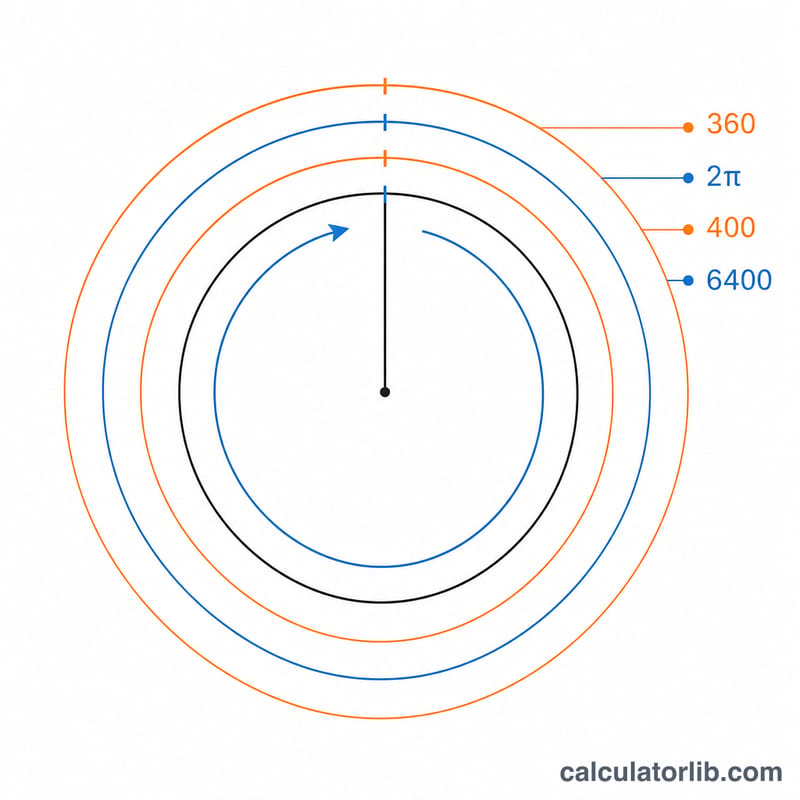
This Angle Unit Conversion Calculator converts a single angle expressed in one angular unit into every other supported unit at once: degrees, arcminutes, arcseconds, degrees-minutes-seconds (DMS), gradians (gon), radians, mils, and slope expressed as percent (%) and per mille (permil). It is a universal mathematical tool and is not tied to any country, although the mil output uses the 6400-mil full-circle convention (3200 mils per 180 degrees) common in NATO/Soviet artillery.
How to use it
Pick the unit of your entered value from the "Angle unit" dropdown, type the number into "Value", and submit. The result table shows the same physical angle in all units. For example, choosing "radian" and entering 1.5708 yields roughly 90 degrees.
The formula explained
The calculator first normalizes your input to a canonical value in degrees. Linear units use a fixed factor: arcminute = \(\deg/60\), gradian = \(\deg \times 0.9\), radian = \(\deg \times 180/\pi\), mil = \(\deg \times 180/3200\). Slope inputs are non-linear: \(\deg = \arctan(\text{value}/100) \times 180/\pi\) for percent. From canonical degrees it then derives every output, with radians = \(\deg \times \pi/180\). Slope outputs use \(\text{slope\%} = 100 \times \tan(\text{rad})\) and \(\text{slope permil} = 10 \times \text{slope\%}\).
Worked example
Input 1 degree. Then arcminute = 60, arcsecond = 3600, DMS = 1 deg 0 min 0 sec, gradian = $$1/0.9 = 1.1111,$$ radian = 0.0174533, mil = $$1 \times 3200/180 = 17.7778,$$ slope% = $$100 \times \tan(0.0174533) = 1.74551,$$ slope permil = 17.4551.
Angle Unit Conversion Table
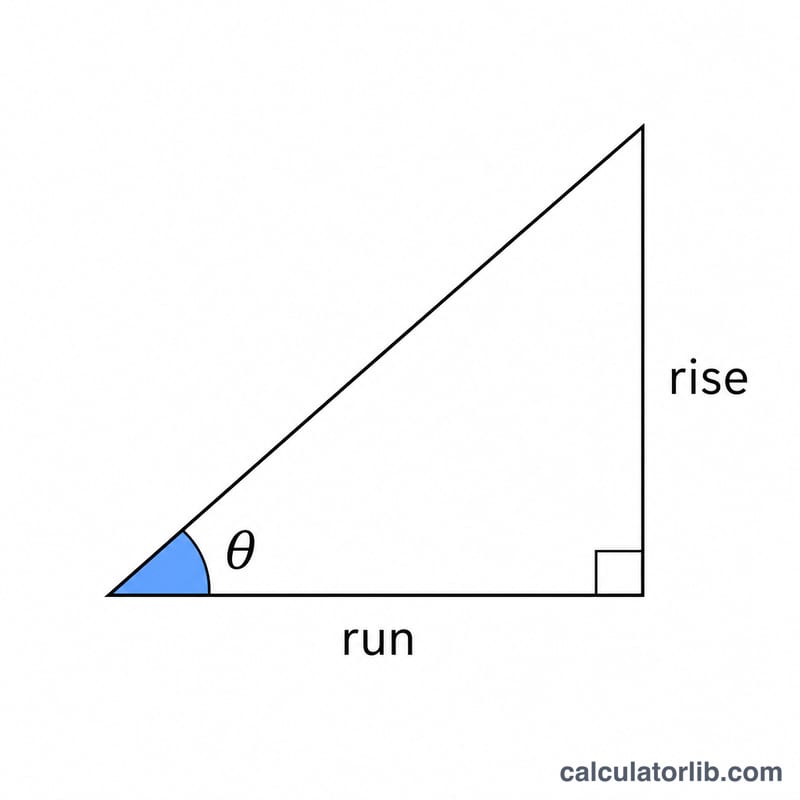
The table below converts several common angles between the major angular units. Mils use the NATO/artillery convention of 6400 mils per full circle. Slope percent is the tangent of the angle expressed as a percentage, \(100\tan\theta\); note that slope percent is non-linear and undefined at 90°.
| Degrees (°) | Gradians (grad) | Radians (rad) | Mils (6400) | Arcminutes (′) | Slope % |
|---|---|---|---|---|---|
| 0° | 0 | 0 | 0 | 0 | 0% |
| 1° | 1.11111 | 0.0174533 | 17.7778 | 60 | 1.7455% |
| 30° | 33.3333 | 0.5235988 | 533.333 | 1800 | 57.735% |
| 45° | 50 | 0.7853982 | 800 | 2700 | 100% |
| 90° | 100 | 1.5707963 | 1600 | 5400 | undefined |
| 180° | 200 | 3.1415927 | 3200 | 10800 | 0% (down-slope) |
| 270° | 300 | 4.7123890 | 4800 | 16200 | undefined |
| 360° (1 turn) | 400 | 6.2831853 | 6400 | 21600 | 0% |
Definitions & Glossary
- Degree (°)
- The most common angular unit; a full circle is divided into 360 degrees. One degree is \(1/360\) of a turn.
- Arcminute (′)
- One sixtieth of a degree, so a full circle contains \(360\times60 = 21600\) arcminutes. Written with a prime symbol.
- Arcsecond (″)
- One sixtieth of an arcminute, or \(1/3600\) of a degree, giving \(360\times3600 = 1\,296\,000\) arcseconds per circle. Written with a double prime.
- DMS (Degrees–Minutes–Seconds)
- A sexagesimal notation combining whole degrees, arcminutes and arcseconds, e.g. 30°15′30″. Common in navigation, surveying and astronomy.
- Gradian / gon (grad)
- A unit dividing the full circle into 400 parts, so a right angle is exactly 100 gradians. Used in some surveying and engineering work because of its decimal-friendly right angle.
- Radian (rad)
- The SI unit of angle, defined as the angle subtending an arc equal in length to the radius. A full circle is \(2\pi\) radians, so \(\pi\) radians = 180°.
- Mil (6400-circle)
- An angular unit used by militaries for artillery and ballistics, dividing the circle into 6400 mils (NATO convention) so that one mil subtends roughly 1 metre at 1000 metres.
- Slope percent (%)
- The grade of an incline expressed as rise over run times 100, equal to \(100\tan\theta\). A 45° angle equals 100%, and the value grows without bound toward 90°.
- Slope per mille (‰)
- The same ratio expressed per thousand, \(1000\tan\theta\); a 1% grade equals 10‰. Common in rail and drainage gradients.
Constants & Conversion Factors
All conversions in this tool reduce to a handful of fixed factors. Each row shows the constant and the relationship it represents.
| Constant | Value | Meaning |
|---|---|---|
| Full circle (degrees) | 360° | Degrees in one complete turn |
| \(\pi\) | ≈ 3.14159265 | Half-turn in radians (\(\pi\) rad = 180°) |
| Degrees per radian | \(180/\pi\) ≈ 57.29578 | Multiply radians by this to get degrees |
| Radians per degree | \(\pi/180\) ≈ 0.0174533 | Multiply degrees by this to get radians |
| Gradians per degree | 0.9 | \(400/360\); 1° = 0.9 grad |
| Mils per degree (6400) | \(6400/360\) ≈ 17.7778 | 1° = 17.7778 mils (NATO convention) |
| Arcminutes per degree | 60 | 1° = 60′ |
| Arcseconds per degree | 3600 | 1° = 3600″ |
| Full circle (mils) | 6400 | Mils in one complete turn (6400 convention) |
| Full circle (gradians) | 400 | Gradians in one complete turn |
| Slope percent | \(100\tan\theta\) | Grade as a percentage of run |
Worked example: to convert 30° to radians, multiply by \(\pi/180\): \(30\times0.0174533 = 0.5235988\) rad. To convert it to mils, multiply by 17.7778: \(30\times17.7778 = 533.333\) mils.
FAQ
Why does slope show "infinite" at 90 degrees? Slope equals the tangent of the angle, and \(\tan(90\deg)\) diverges to infinity, so the calculator flags it as undefined rather than printing a meaningless huge number.
Which mil convention is used? The 6400-mil full circle, i.e. 3200 mils per 180 degrees. Other systems use about 6283 mils; convert accordingly if you use those.
Is gradian the same as gon? Yes, gradian and gon are identical; a full circle is 400 grad.