
What Is the Unit Circle Calculator?
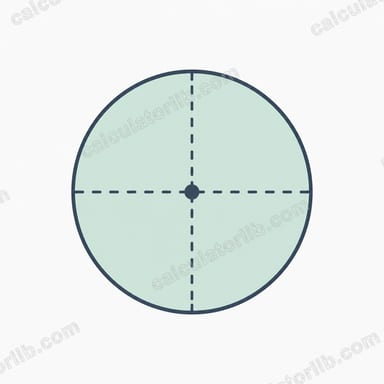
The unit circle is a circle of radius 1 centered at the origin (0, 0). For any angle θ measured counterclockwise from the positive x-axis, the point where the angle's terminal ray meets the circle has coordinates \((\cos\theta,\, \sin\theta)\). This calculator instantly returns that point along with \(\cos\theta\), \(\sin\theta\), and \(\tan\theta\) — for any angle you enter in degrees or radians.
How to Use It
Enter your angle, then choose whether it is in degrees or radians. The calculator converts as needed and reports the x-coordinate (\(\cos\theta\)), y-coordinate (\(\sin\theta\)), the tangent (\(y/x\)), and the angle expressed in both units. Angles can be negative or larger than 360° — the trig functions wrap around the circle automatically.
The Formula Explained
Because the radius is 1, basic right-triangle trigonometry collapses to the clean identities \(x = \cos\theta\) and \(y = \sin\theta\). The tangent equals the ratio \(y/x = \sin\theta / \cos\theta\), which represents the slope of the terminal ray. When \(\cos\theta = 0\) (at 90° and 270°), the tangent is undefined because the ray is vertical.
$$(x,\,y) = \left( \cos\theta,\; \sin\theta \right), \quad \theta = \text{Angle} \times \frac{\pi}{180}$$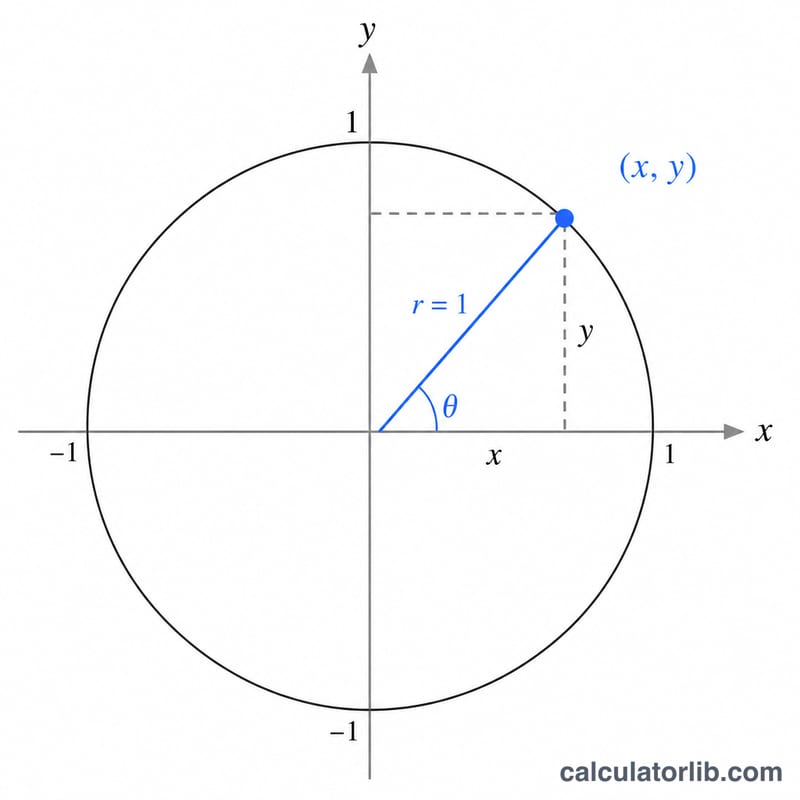
Worked Example
For θ = 45°: \(\cos 45° = \sqrt{2}/2 \approx 0.7071\) and \(\sin 45° = \sqrt{2}/2 \approx 0.7071\), so the point is \((0.7071,\, 0.7071)\). The tangent is $$\frac{0.7071}{0.7071} = 1.$$ This matches the well-known unit-circle value where the 45° ray bisects the first quadrant.
FAQ
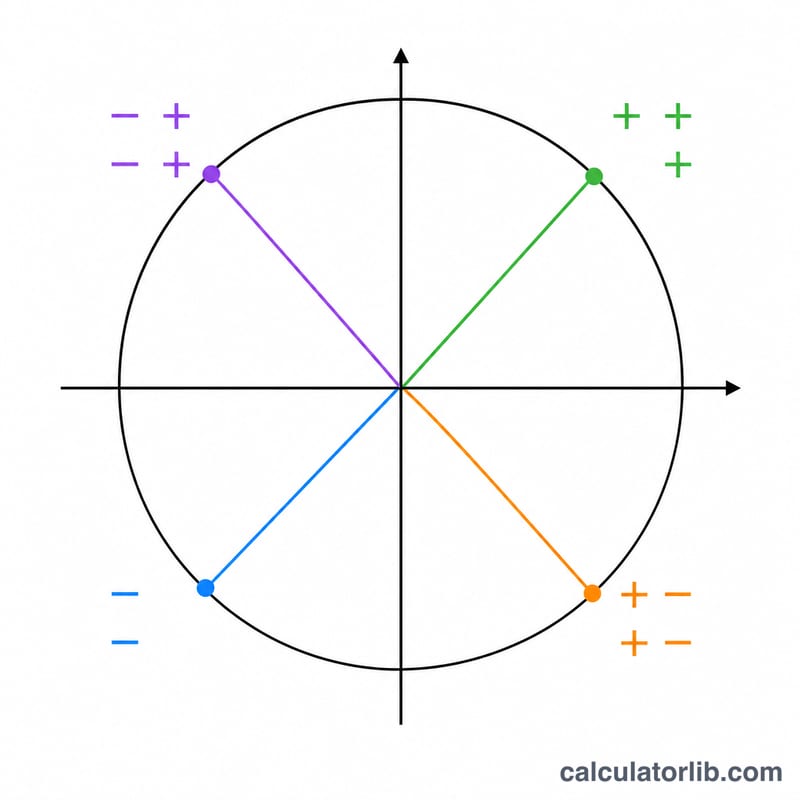
What does a point on the unit circle represent? Each point \((\cos\theta,\, \sin\theta)\) shows the horizontal and vertical components of a unit-length direction at angle θ.
Why is tan θ sometimes blank or NaN? At 90° and 270° the cosine is zero, so dividing by it makes the tangent undefined.
Can I enter angles beyond 360°? Yes. The sine and cosine functions are periodic, so 405° gives the same result as 45°.