
What is a rectangular frustum (obelisk)?
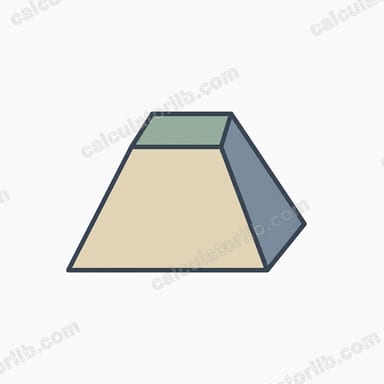
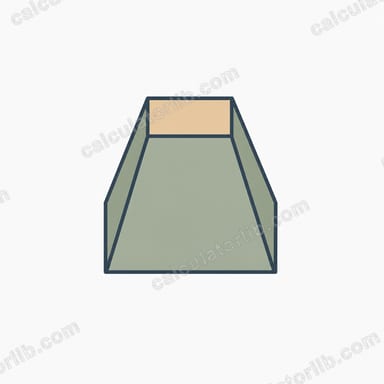
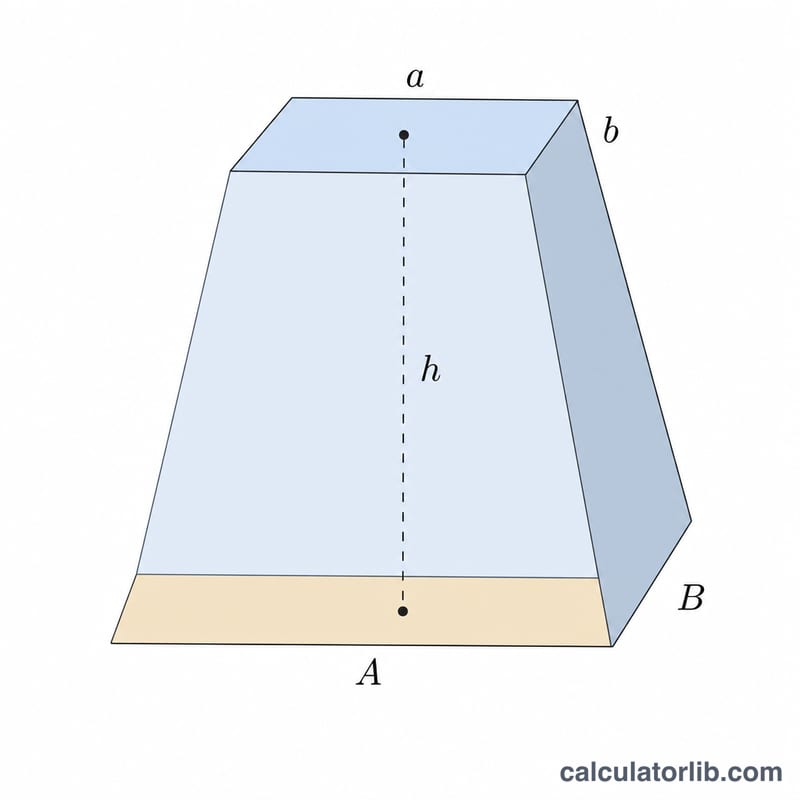
A rectangular frustum is the solid you get when you slice the top off a rectangular pyramid with a cut parallel to the base, leaving two parallel rectangular faces of different sizes joined by four sloping trapezoidal sides. In classical geometry this shape is called an obelisk and it belongs to the family of prismatoids. The top rectangle has sides a and b; the bottom rectangle has sides A and B, with a parallel to A and b parallel to B. The two faces sit in parallel planes separated by the perpendicular height h.
The formula explained
Because the top and bottom faces need not share the same aspect ratio, the simple "truncated pyramid" formula is not general enough. Instead we use the prismatoid rule:
$$V = \frac{h}{6}\left(S_{top} + 4\cdot S_{mid} + S_{bottom}\right)$$
Here \(S_{top} = a\cdot b\), \(S_{bottom} = A\cdot B\), and \(S_{mid}\) is the area of the cross-section halfway up. The mid section is itself a rectangle whose sides are the averages of the corresponding top and bottom sides, so \(S_{mid} = \frac{a+A}{2}\cdot\frac{b+B}{2}\). Substituting and simplifying gives the compact obelisk form: $$V = \frac{h}{6}\left[\left(2\,a + A\right)b + \left(2\,A + a\right)B\right]$$
How to use this calculator
Enter the two top sides (a and b), the two bottom sides (A and B), and the height h. All five lengths must be in the same unit; the volume comes out in that unit cubed. There is no unit conversion, so if you work in centimetres the result is in cubic centimetres. To rescale, multiply every length by the same factor s and the volume scales by \(s^3\).
Worked example
With \(a=3\), \(b=2\), \(A=4\), \(B=3\), \(h=2\): \((2\cdot 3+4)\cdot 2 = 20\), and \((2\cdot 4+3)\cdot 3 = 33\), summing to 53. Then $$V = \frac{2}{6}\cdot 53 = 17.6667 \text{ cubic units}$$ Cross-checking with the prismatoid form: \(S_{top}=6\), \(S_{bottom}=12\), \(S_{mid}=3.5\cdot 2.5=8.75\), so \(V=\frac{2}{6}(6+35+12)=17.6667\). The two methods agree.
FAQ
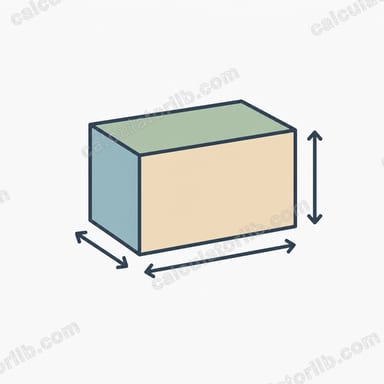
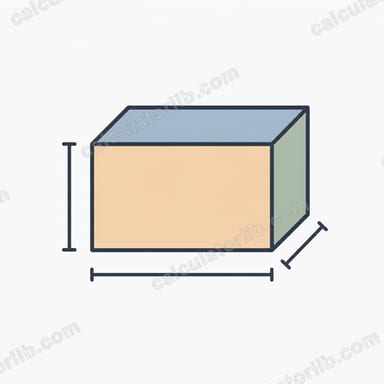
What if the top and bottom are equal? If \(a=A\) and \(b=B\) the solid is just a rectangular box and the formula reduces to \(V = a\cdot b\cdot h\).
What if the top shrinks to a point? Setting \(a=0\) and \(b=0\) gives a full rectangular pyramid, and the formula returns \(V = \frac{A\cdot B\cdot h}{3}\).
Can the height be zero? A height of 0 collapses the solid into a flat shape, so the volume is 0. Use a positive height for a real solid.