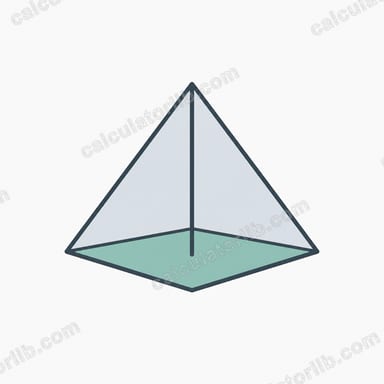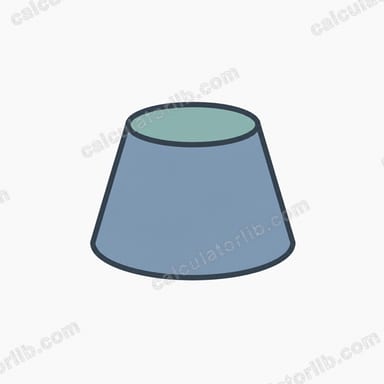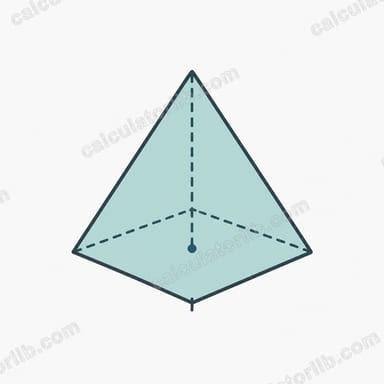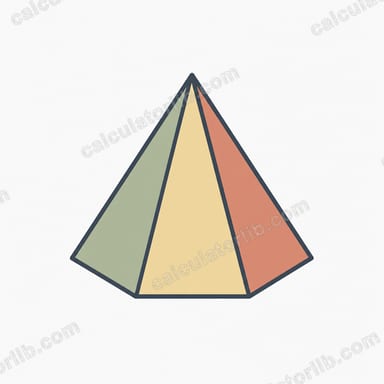

What is a pyramidal frustum?
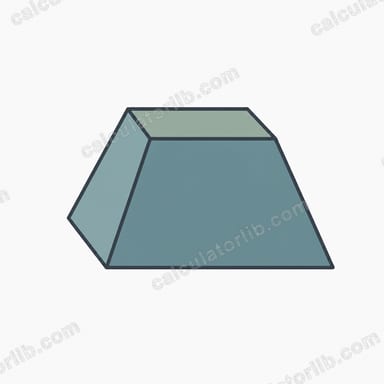
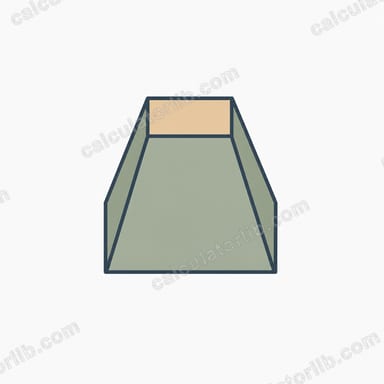
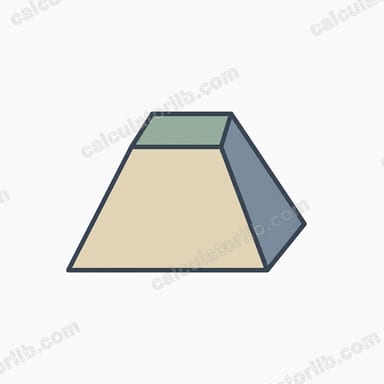
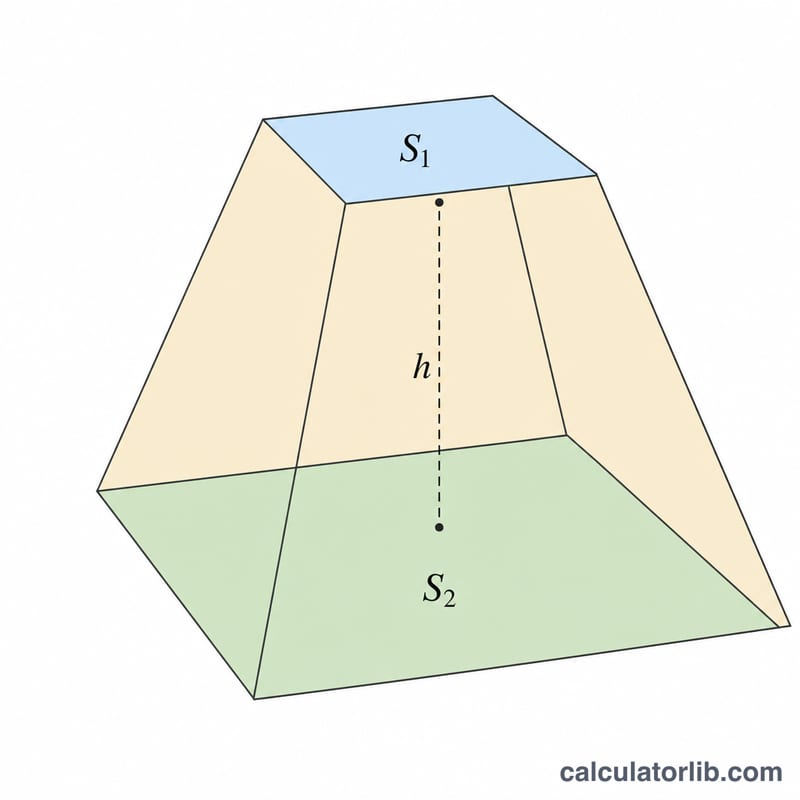
A frustum of a pyramid is the solid that remains when the top of a pyramid is sliced off by a plane parallel to the base. It has two parallel faces — a smaller top face and a larger bottom face — that are similar polygons (squares, rectangles, triangles, hexagons, and so on). This calculator finds the enclosed volume directly from the areas of those two faces and the perpendicular distance between them.
How to use this calculator
Enter three values: the top face area (S₁), the bottom face area (S₂), and the height (h). Use consistent units. If your areas are in square centimetres and your height is in centimetres, the volume comes out in cubic centimetres. No unit conversion is performed, so make sure the length unit used for the height, when squared, equals the unit used for the areas. All inputs must be non-negative.
The formula explained
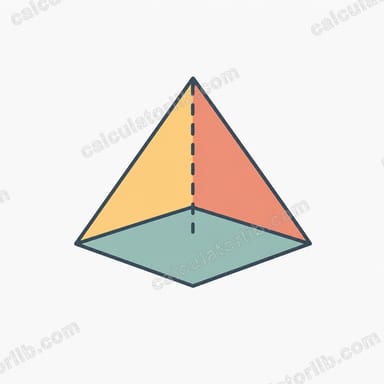
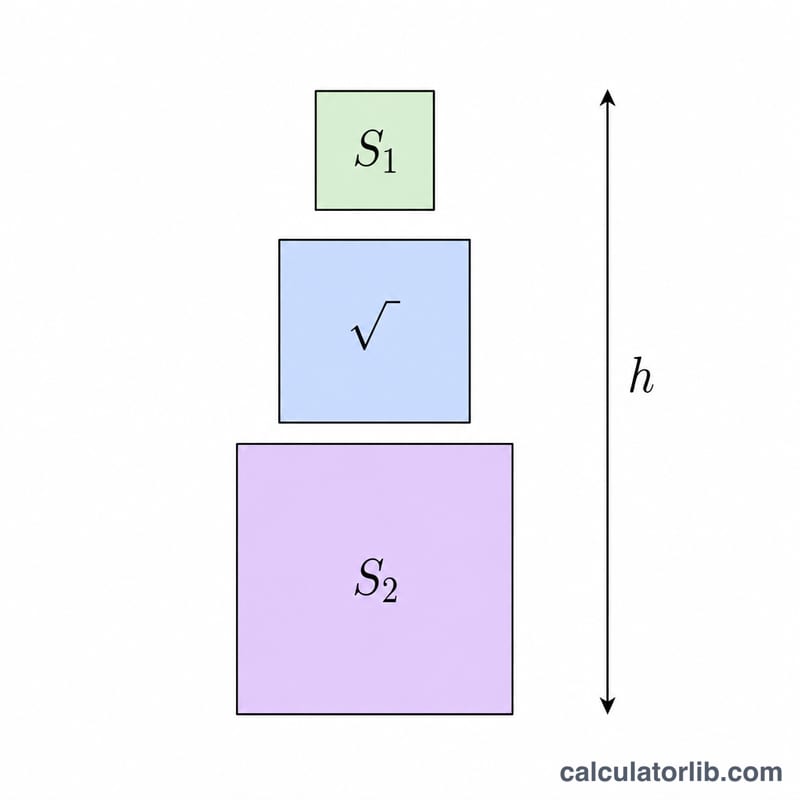
The volume is given by $$V = \frac{h}{3}\left(S_1 + S_2 + \sqrt{S_1\cdot S_2}\right).$$ This is a special case of the prismatoid formula. The first two terms are the top and bottom face areas; the third term, the geometric mean \(\sqrt{S_1\cdot S_2}\), accounts for the cross-section that smoothly tapers between them. When the two faces are equal (\(S_1 = S_2 = S\)) the formula reduces to \(V = h\cdot S\), the volume of a prism. When the top shrinks to a point (\(S_1 = 0\)) it reduces to \(V = \frac{h}{3}S_2\), the volume of a complete pyramid.
Worked example
Suppose the top area is 1, the bottom area is 3, and the height is 2. The geometric-mean term is \(\sqrt{1\cdot 3} = \sqrt{3} \approx 1.7320508\). Then $$V = \frac{2}{3}(1 + 3 + 1.7320508) = \frac{2}{3}(5.7320508) \approx 3.8213672 \text{ cubic units}.$$
FAQ
Does it work for any shape of pyramid? Yes — square, rectangular, triangular, or any polygonal frustum, as long as the top and bottom faces are parallel and similar.
What if I only know the side lengths, not the areas? Compute each face area first (for example, side × side for a square), then enter those areas here.
Why does the formula include a square root? The \(\sqrt{S_1\cdot S_2}\) term is the geometric mean of the two faces, representing the gradually changing cross-section between them; it is what makes the prismatoid formula exact for a frustum.